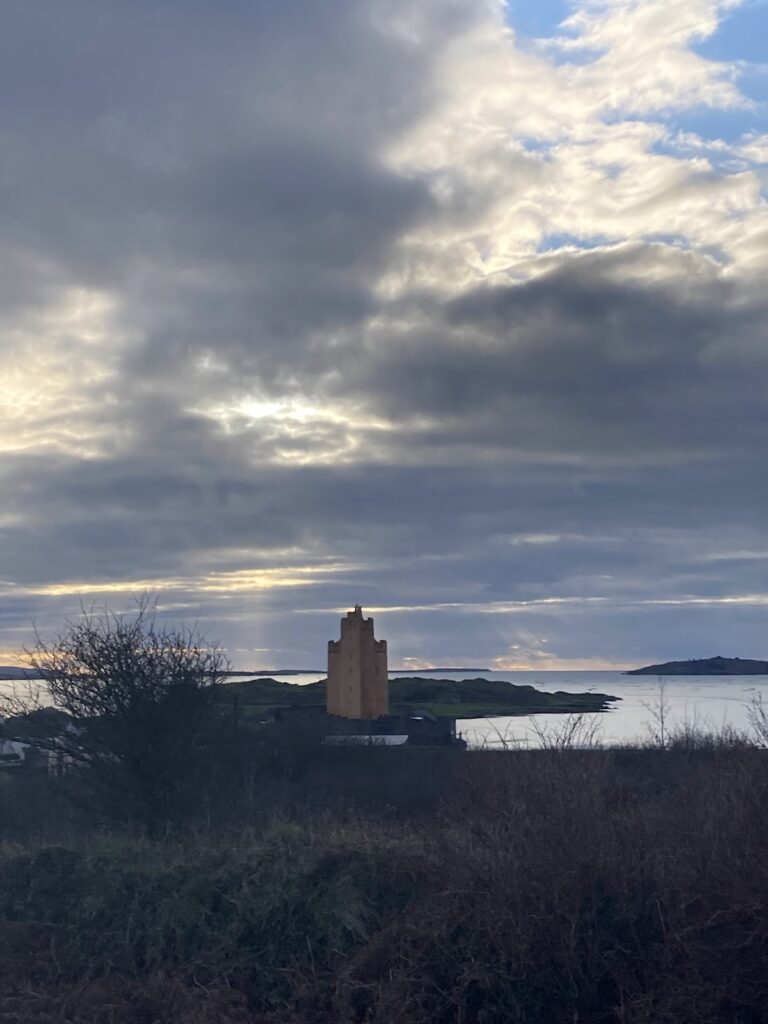
Cathedral Church of St. Fachtna: An Anglican Cathedral in Rosscarbery, Ireland


Site at a Glance
- Rating
- 4.5
- Popularity
- Very Low
- Country
- Ireland
- Primary era
- Early Modern
- External website
- Open
- Eras represented
- Early Modern, Modern
- Civilizations
- British, English
- Site type
- Religious
- Remains
- Cathedral
On this page8 sections
History
The Cathedral Church of St. Fachtna is an Anglican cathedral of the Church of Ireland in Rosscarbery, Ireland, rebuilt in the late sixteenth or early seventeenth century in the Perpendicular English style. It is the smallest cathedral in Ireland, approximately the size of a typical parish church, and remains one of three Anglican cathedrals in the United Dioceses of Cork, Cloyne and Ross.
Monastic foundation and medieval diocese
In the late sixth century, Fachtna, a Christian saint, founded a monastery in the area known as Ros Ailithir, meaning “wood of the pilgrims.” The monastery became the principal centre of West Cork and developed an international school. Brendan the Navigator, an early medieval Irish monastic saint traditionally associated with missionary voyages, was connected with the community as a teacher.
A church or cathedral has occupied the site since at least the tenth century. The Diocese of Ross was created in 1160. After Bishop John Edmund de Courcy resigned in 1517, Pope Leo X, head of the Roman Catholic Church from 1513 to 1521, ordered an inquiry into the diocese. The inquiry recorded that a cathedral already stood at Rosscarbery, calling it “Fachtna’s big temple.”
Rebuilding and diocesan union
William Lyon became Bishop of Ross in 1582 and was the last bishop to serve before the diocese was merged with Cork. Dissatisfied with the cathedral, he initiated a more suitable building. The work is dated either to substantial renovation or complete rebuilding between 1582 and 1589, or to a rebuilding phase between 1589 and 1612.
The Diocese of Ross was united with the Diocese of Cork in 1583, after which the see was based in Cork. The former cathedral church at Rosscarbery became one of three cathedrals in the United Dioceses of Cork, Cloyne and Ross when Cloyne joined the union in 1835. The Church of Ireland is the Anglican church in Ireland, and its cathedrals belong to the Anglican tradition.
Destruction, restoration, and later changes
During the Catholic Rebellion of 1641, an uprising and conflict in seventeenth-century Ireland, the cathedral was extensively damaged and left wrecked. The nave and tower were destroyed, while the chancel and two chapels were converted into a slaughterhouse. Bishop Lyon’s former house was burned. Lyon had died in 1617, and his deaf and mute daughter died in the fire.
The nave was rebuilt in the 1660s, and an order to construct a tower was issued in 1696. The cathedral has therefore been described as having been almost entirely rebuilt during the seventeenth century. Its original spire was removed in the late eighteenth century, and the present spire was added in 1806. Restoration between 2002 and 2005 included rebuilding the organ and restoring the bells, while another bell was installed in the tower in 2012.
Remains
The cathedral is a small cruciform building, meaning that its plan is shaped like a cross. Its walls are built of freestone, a stone suitable for regular cutting and masonry, and its present appearance brings together architectural elements from several periods. Gothic and Georgian windows stand alongside wooden casements with stone-linteled heads, while the west doorway beneath the tower is Romanesque, a medieval style associated with rounded arches and massive masonry.
Church structure and fabric
The late-sixteenth- or early-seventeenth-century building was substantially renovated or entirely rebuilt in the Perpendicular English style, a late medieval form of English Gothic known for strong vertical emphasis and large window tracery. In 1880, the surviving older walls were plastered and dashed. The combination of freestone walls, varied windows, wooden casements, and the Romanesque west doorway gives the building a mixed architectural character.
Fachtna’s associated remains
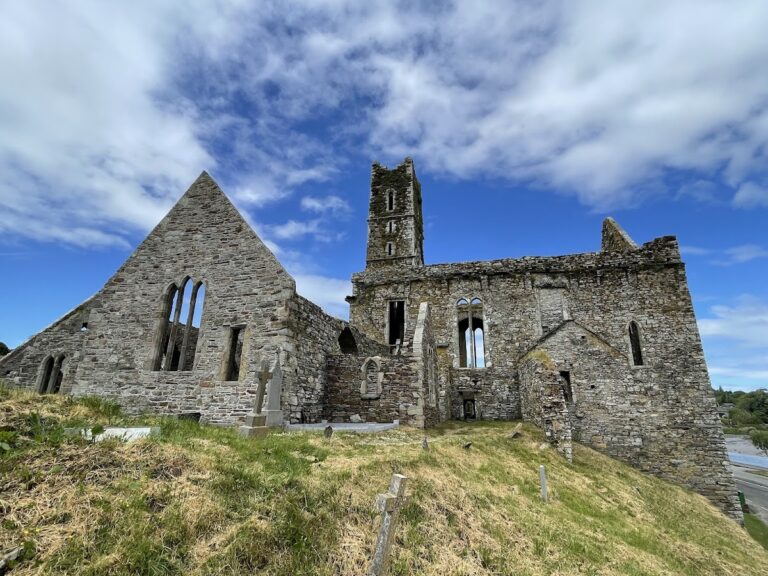
Ruins of a church attributed to Saint Fachtna survive on the southern slope of the land on which Rosscarbery is built. They are associated with the sixth-century religious foundation that established Ros Ailithir as a monastic centre.
Tower, spire, and bells
The tower contains a ring of six bells tuned to G. A ring of bells is a group hung for change-ringing, in which bells are swung through repeated arcs by ropes. The tower is the only one in Ireland fitted with a ringers’ gallery, allowing the congregation to watch the bells being rung, and its tenor bell weighs 636 kilograms. Storms blew the top from the spire in the winter of 1886 and again in February 1923.
Nearby sites