Annunciation Cathedral of Kazan: The Historic Seat of the Kazan Diocese
Site at a Glance
- Popularity
- High
- Country
- Russia
- Primary era
- Early Modern
- Eras represented
- Early Modern, Modern
- Civilizations
- Russian
- Site type
- Religious
- Remains
- Cathedral
On this page18 sections
History
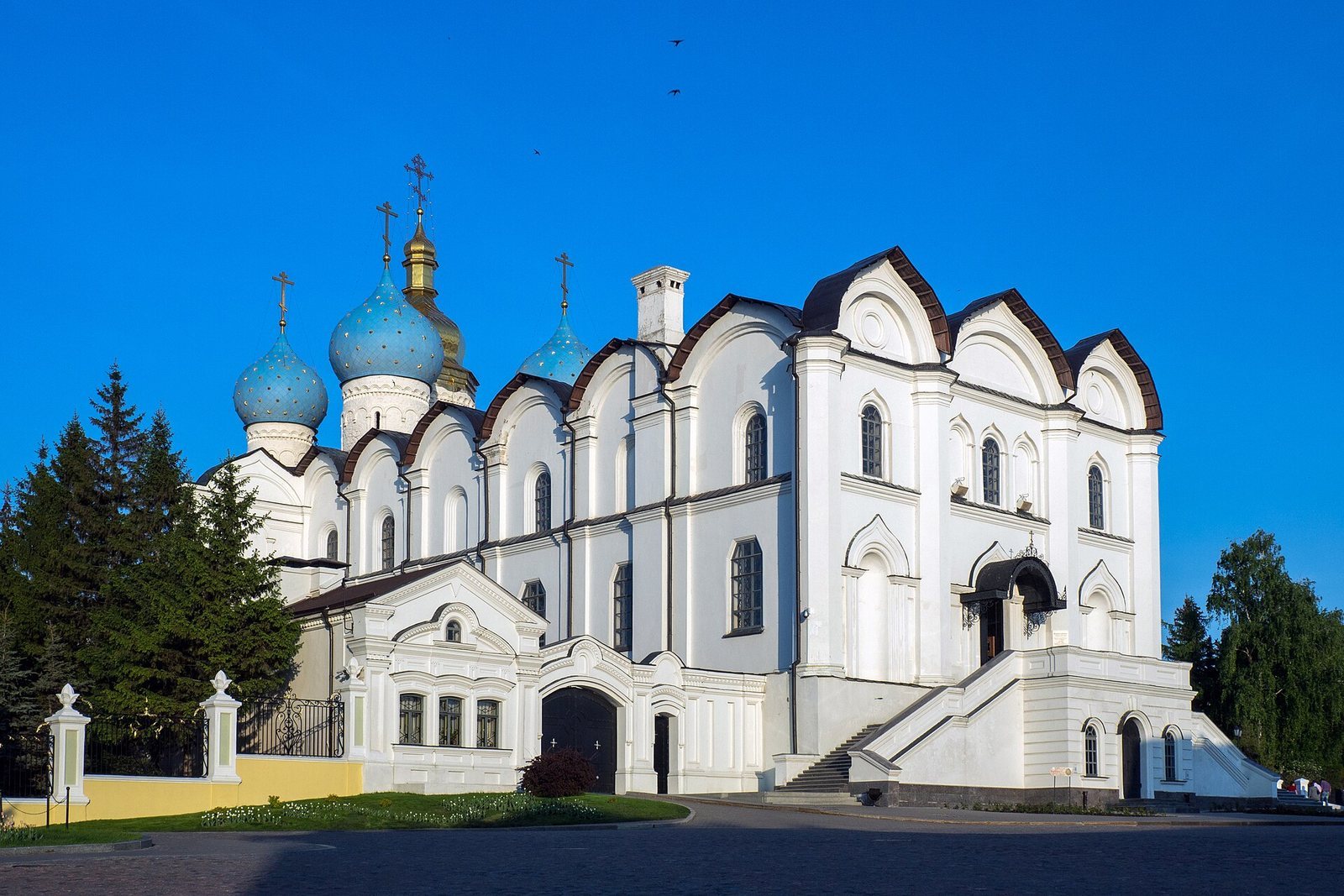
The Annunciation Cathedral of Kazan is an Orthodox cathedral in Russia’s Kazan Kremlin. Its stone building, begun in 1555 in the Pskov architectural tradition, was consecrated in 1562 and became the principal church of the Kazan Diocese, a region administered by a bishop. It is the oldest surviving historical and architectural monument in the Kazan Kremlin and the city.
Foundation and diocesan role
A wooden church dedicated to the Annunciation of the Mother of God was consecrated on 6 October 1552, after Ivan IV captured Kazan. The Kazan Diocese was established in 1555, and Gury Rugotin became its first archbishop, a senior bishop. The original church was too small to serve a diocese whose territory extended as far as Siberia. An imperial order therefore initiated construction of a stone cathedral in 1555. By 1561, 80 masons had arrived from Pskov. Archbishop Gury consecrated the new building on 15 August 1562.
The cathedral remained the seat of the diocese until 1918. Priests were ordained there for centuries, and bishops began to be consecrated there in the late nineteenth century. In the late 1500s, chapels dedicated to Saints Peter and Fevronia, and to Saints Boris and Gleb, were added. The church also served as a burial place for Kazan’s bishops and archbishops for more than 400 years. Vassian, buried in 1575, was the first; Archbishop Nicanor (Kamensky), buried in 1910, was the last.
Fires, alterations, and restoration
Fires damaged the cathedral in 1596, 1672, 1694, 1742, 1749, and 1757. During the 1742 fire, Gury’s relics were carried beyond the Bulak Canal. In 1694, the cathedral’s narrow windows were enlarged. An adjoining Church of the Nativity, also built that year, was later demolished after becoming badly dilapidated. Changes in 1736 altered the domes and added a western refectory and porch.
A major city fire on 3–4 September 1815 severely damaged the cathedral. The provincial archive housed inside burned, and the building stood neglected for two years. Archbishop Ambrose (Protasov) then led its restoration; the renewed church was consecrated on 19 June 1821. Emperor Nicholas I visited Kazan in 1836, and architect Foma Petondi’s plans were approved in 1841. A further city fire in 1842 made repairs necessary. The resulting work enlarged the cathedral to the west, north, and south, replacing the earlier refectory and porch. The side chapels were incorporated into the main church, while two separate heated chapels were established.
During the nineteenth century, the cathedral’s decoration and religious life continued to develop. Its icon screen was renewed in 1855, and later in the century an artel of icon painters led by N. L. Sofonov created extensive frescoes under Archbishop Anthony’s supervision. A reconstruction in 1906–1909 renewed the wall paintings, installed steam heating and electric lighting, and dedicated the left chapel to Saint Gury. Services in his honor were held three times a year, including on 4 October, the anniversary of the discovery of his relics. A procession from the Kazan Bogoroditsky Monastery brought the revered Kazan Icon of the Mother of God to the cathedral on that date. An imperial decree made it a non-working day in Kazan in 1854.
Revolution, Soviet use, and revival
During the fighting for Kazan in September 1918, Bolshevik forces shelled the Kremlin from guns on Powder Factory hill. All five cathedral domes were destroyed. The new authorities made the Kremlin a military zone, closed its churches, and moved the diocesan administration elsewhere. The cathedral ceased to serve as the diocesan seat. Worshippers were allowed to remove Gury’s reliquary and some icons; his relics passed between churches and are now kept at the Church of the Yaroslavl Wonderworkers in Arsk Cemetery. A portion was placed in a recreated reliquary in the cathedral.
Much of the cathedral’s collection of icons, liturgical vessels, embroidery, books, and other church objects was looted or disappeared. In 1919, art historian Pyotr Dulsky and professor Irinarkh Stratonov helped preserve part of the sacristy collection, and 85 surviving objects were transferred to the provincial museum. Services by the Renovationist movement, a reformist movement within the Russian Orthodox Church under Soviet rule, were permitted in 1920. The cathedral was closed again in 1925 and transferred to the museum department. Its bell tower was demolished during the 1920s, and the porch was dismantled. In 1932, the remaining tower structure was taken down for its bricks. Demolition of the cathedral itself was proposed and partly authorized in 1929, but the building survived.
The cathedral was used for the State Archive of the Tatar Autonomous Soviet Socialist Republic. Four levels of wooden floors were installed, the crypt became a vegetable storehouse, and Gury’s cell served as a watchman’s room. The archive moved elsewhere in 1997. Exterior restoration in 1977–1984 returned the building to its 1841 forms and reconstructed its domes and drums; the central dome was gilded in 1987. In 1995, the building was placed under the Kazan Kremlin State Historical and Architectural Museum-Reserve. Interior restoration began in 2000 and was completed in 2005, the 450th anniversary of the diocese. Archbishop Anastasy reconsecrated the cathedral on 19 July 2005, and Patriarch Alexy II celebrated its first liturgy after its revival on 21 July. It again functions as an Orthodox church and is a federally significant cultural heritage site of the Russian Federation.
Remains
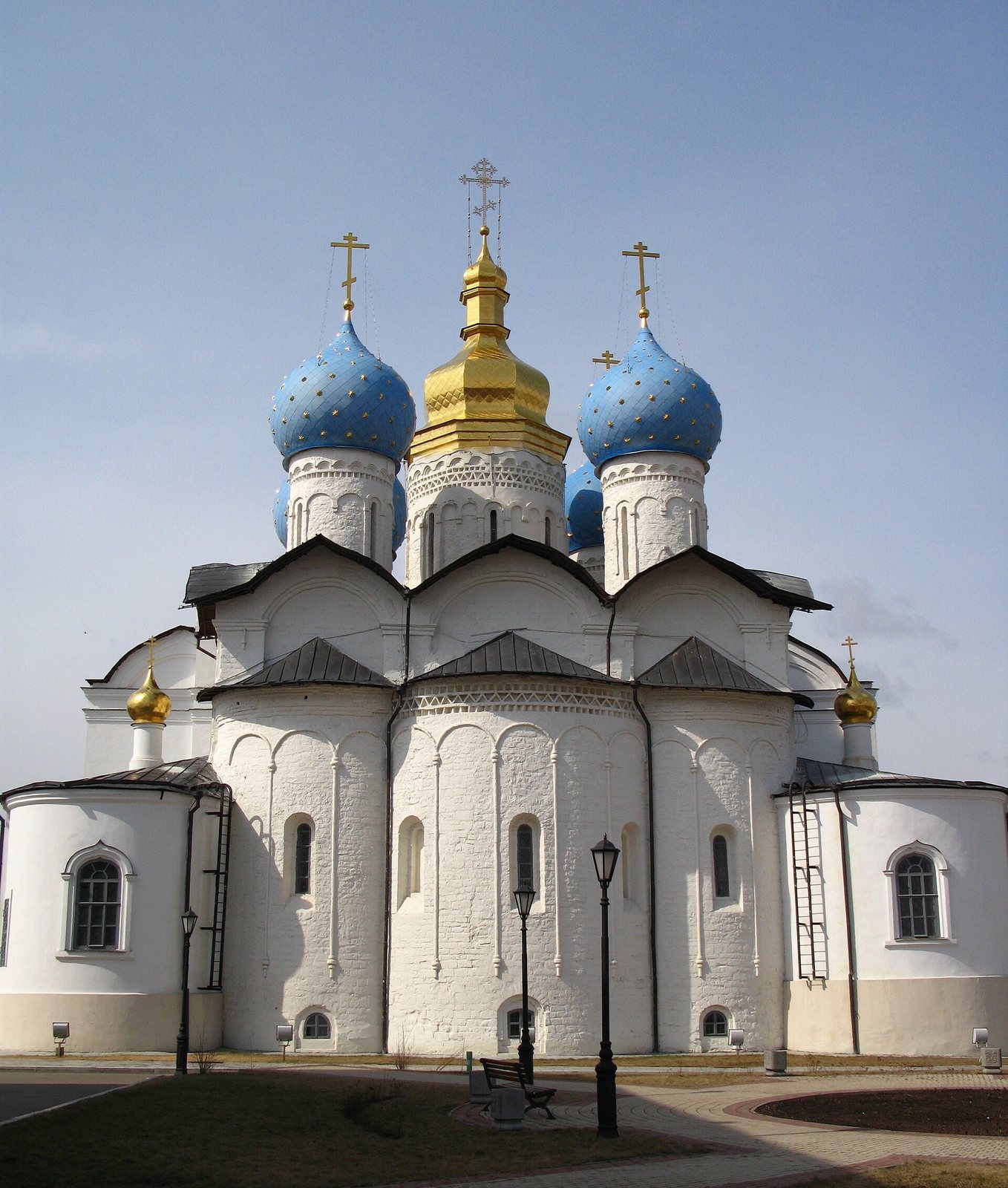
The cathedral combines a cross-domed plan, with its principal space organized beneath a central dome, and a central, cube-shaped body, three altar ends, and six round supports. Its original white-stone core and surviving Pskov-style details belong to the sixteenth-century building, while the restored exterior reflects the enlargement of the nineteenth century. A garden occupies the site of the former bell tower south of the cathedral.
Stone core and exterior
Original church and chapels
The original church was built of Volga limestone quarried on the high bank opposite Kazan. It measured 18 sazhen, about 38 metres, in length and 7 sazhen plus 2 arshin, about 16 metres, in width, making it nearly half the size of the later building. Its walls had keel-shaped gables ending in zakomary, curved gable-like roof forms. Six round columns supported the vaults, with two in the altar and four in the main worship space. Arches between the columns formed 12 vaults, while squinches, structures bridging the corners of a square space, supported the central dome. The original domes were helmet-shaped.
Late-sixteenth-century side chapels were dedicated to Saints Peter and Fevronia on the north and Saints Boris and Gleb on the south. A porch linked the chapels around the cathedral’s central volume. The central body, three apses, six massive round supports, foundations of two stone side chapels, and fragments of frescoes survive. The Pskov-style decoration includes an ornamental band around the central dome’s base and a row of small arches around the altar ends.
Enlarged and restored exterior
The alterations of 1736 replaced the helmet-shaped domes with onion-shaped ones and gave the central dome a Ukrainian Baroque-style top. A single-storey refectory and a stairway porch were added on the west. Petondi’s later expansion created a two-level western refectory and a stair to the choir gallery. Its heated side chapels had separate entrances and were divided from the main church by walls. The left chapel was dedicated to the Nativity of Christ in memory of the demolished church; the right was dedicated to Saints Boris and Gleb.
The exterior restored in 1977–1984 follows the 1841 appearance, with a central dome bearing a Ukrainian Baroque-style top and four onion-shaped cupolas. The central dome was gilded in 1987. The porch built to Petondi’s design was later demolished.
Interior decoration and fittings
Frescoes and painted decoration
A surviving fragment of the cathedral’s sixteenth- or seventeenth-century frescoes depicts the Kazan Icon of the Mother of God in an altar apse. It was uncovered during restoration in the 1990s. Other wall paintings, covering several thousand square metres, came to light during restoration around the turn of the twenty-first century. Frescoes in the western refectory showed the discovery and veneration of the Kazan Icon, Metropolitan Macarius ordaining Gury as archbishop, and Metropolitan Hermogenes finding the relics of Saints Gury and Barsanuphius. The refectory walls also carried images of saints associated with Kazan churches, including Cyprian and Justina, the Nine Martyrs of Cyzicus, and Princes Theodore, David, and Constantine.
Icon screen and floor
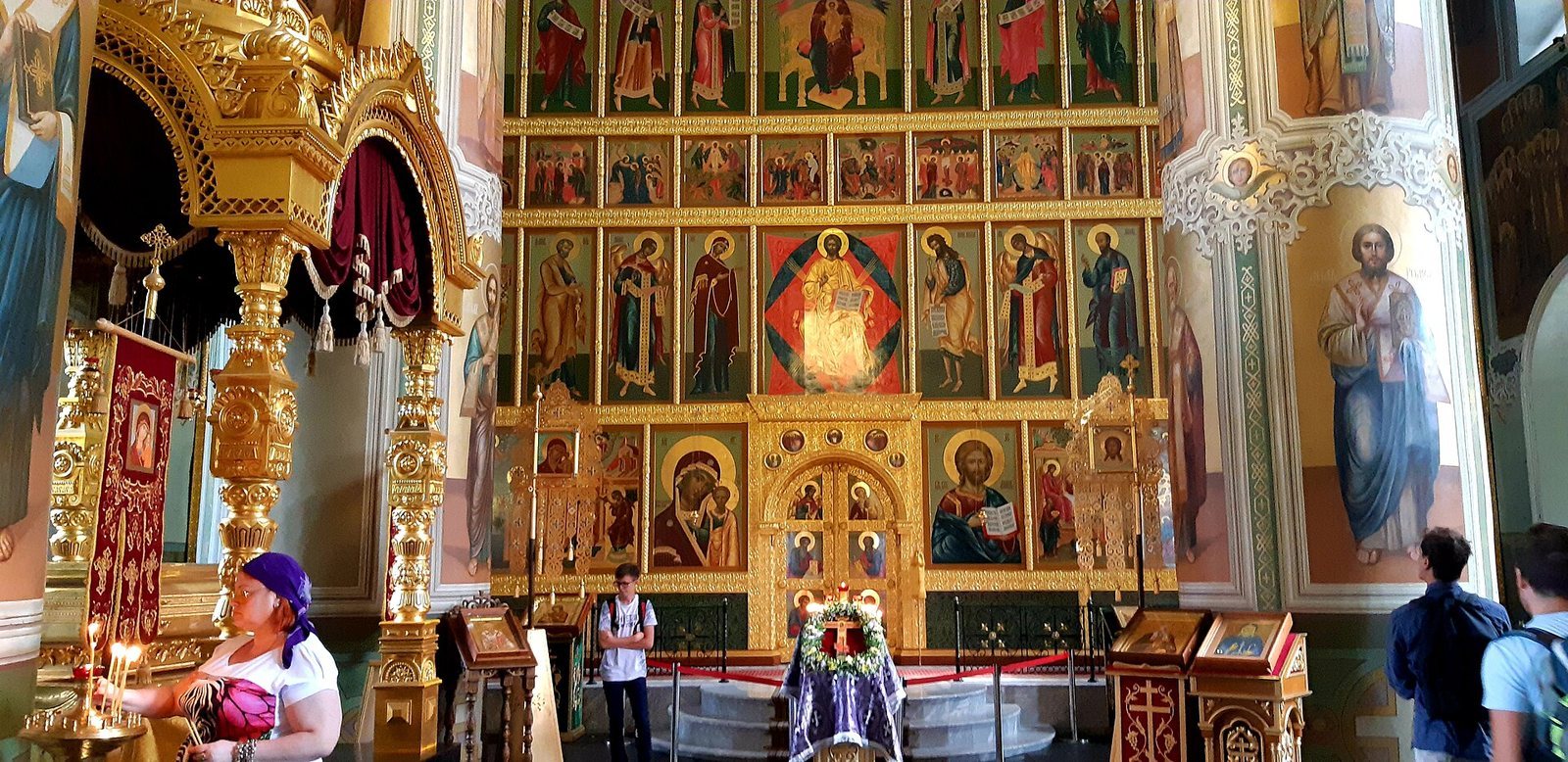
The five-tier iconostasis, a screen of icons separating the sanctuary from the main church, had icons in silver coverings. Its lowest tier included Christ enthroned, the Trinity, scenes of Christ’s descent into hell and Resurrection, the Annunciation, the Nativity, and Saint Gury. Images of the archangels Gabriel and Michael appeared on the southern and northern doors. Twelve feast scenes occupied the next tier, with the Last Supper at the center above bronze royal doors. The Deesis tier showed Christ with the Virgin Mary, John the Baptist, and the apostles; above it were Our Lady of the Sign and 16 prophets, then the Lord of Hosts and the forefathers. A cross topped the screen.
Three icons from the Deesis tier are now in the Republic of Tatarstan Museum of Fine Arts: a sixteenth-century image of the Apostle Paul and eighteenth-century images of Saint George and Metropolitan Alexis of Moscow. Patterned marble tiles laid on the raised area before the sanctuary and in the altar during the 1906–1909 reconstruction remain in place.
Sacristy, books, and church objects
A concealed sacristy room was made in the western refectory in the 1840s. Its contents included nine old metropolitan hoods, two made by Saint Barsanuphius; a sixteenth-century embroidered burial shroud; and a handwritten Gospel from the fifteenth century. A bishop’s robe embroidered in gold thread and with figures in the Stroganov workshops was given by the Stroganov brothers to Metropolitan Lawrence in the seventeenth century and is now in the Tatarstan Museum. A raspberry-velvet-covered saddle was used by Kazan’s church leaders in the Palm Sunday procession on a donkey. The collection also held a Stroganov-style calendar icon belonging to Gury, kept in the cathedral until 1918, and a corner of his coffin.
Other sacristy objects included a late-seventeenth-century gold-and-enamel altar cross belonging to Metropolitan Adrian and containing apostles’ relics, and a bishop’s medallion set with 209 diamonds that Catherine II gave to Metropolitan Benjamin. Another diamond-set cross came from Catherine’s own jewelry. The sacristy held richly embroidered vestments, including garments associated with Metropolitans Lawrence and Tikhon; a complete seventeenth-century episcopal set weighed as much as 40 kilograms.
Two Gospels from the cathedral collection are now in the National Museum of the Republic of Tatarstan. One, dated 1478, was commissioned by Bishop Vassian of Tver and given to the cathedral by Archbishop Gury. The other was printed in Moscow in 1606 and donated by Metropolitan Ephraim. Its inscription records Ephraim’s gift and his part in crowning Mikhail Feodorovich, the first Romanov tsar, in 1613. The book has miniatures of the four Evangelists, with ornament and changes to some miniature designs by the master Parfeny. The cathedral library also held valuable sixteenth- and seventeenth-century printed and handwritten books. Many passed to Kazan University, and surviving volumes bear a handwritten mark identifying the cathedral.
Gury’s cell and the bishops’ burial spaces
Cell and relics of Saint Gury
A small cell beneath the Boris-and-Gleb chapel was discovered during the 1841 reconstruction. Built of the same Volga stone as the cathedral, it has a mineral-pigment image of the Savior Not Made by Hands on one wall, probably painted by Gury. A doorway was cut into its west side, and a chapel was later added beside it; that chapel survives. Gury’s silver reliquary stood by the cathedral’s north wall. Savva Aristov provided the original container. In 1633, Prince B. I. Cherkassky donated an embroidered cover depicting Gury, and Timofei Shalanin paid for a carved, gilded canopy. Merchant Petr Sveshnikov provided a new reliquary in the mid-nineteenth century.
Crypt and episcopal graves
The cathedral crypt includes a chapel dedicated to All Saints, established in 1896 beneath the main altar. A doorway in the main apse led into it. Bishops’ graves were arranged along the north and south walls and beneath the altar. Graves from the old Boris-and-Gleb chapel were moved beneath the altar in 1840. In 1907, after the floor was opened, Professor A. I. Aleksandrov identified burial locations, and markers bearing bishops’ names were installed. The crypt and burials in the Boris-and-Gleb chapel were ransacked during the Soviet period; burials in the main church may have survived.
Bell tower and associated chapels
Bell tower
A white-stone bell tower more than 50 metres high was built beside the cathedral in 1630–1640, replacing a wooden belfry mentioned in sixteenth-century records. Its five tiers included three levels of flame-shaped kokoshniks, decorative arched forms, and a dome originally shaped like a helmet. A striking cross crowned with a crown and a dove from Noah’s Ark topped the tower. Its largest bell, on the first tier, weighed 1,500 poods, about 24,570 kilograms. The tower had a striking clock in the eighteenth century and stood beside the refectory porch, slightly lower than the Söyembikä Tower.
Chapel beneath the tower
A chapel beneath the bell tower was first dedicated to Saint Irene. It was closed in the late eighteenth century because of its poor condition, restored in 1832, and rededicated to Saint Herman of Kazan.