Catacombs of Saint Agnes: An Early Christian Burial Complex in Rome
Site at a Glance
- Popularity
- Medium
- Country
- Italy
- Primary era
- Classical
- Eras represented
- Classical
- Civilizations
- Roman
- Site type
- Burial
- Remains
- Catacomb
On this page10 sections
History
Origins, Agnes, and early expansion
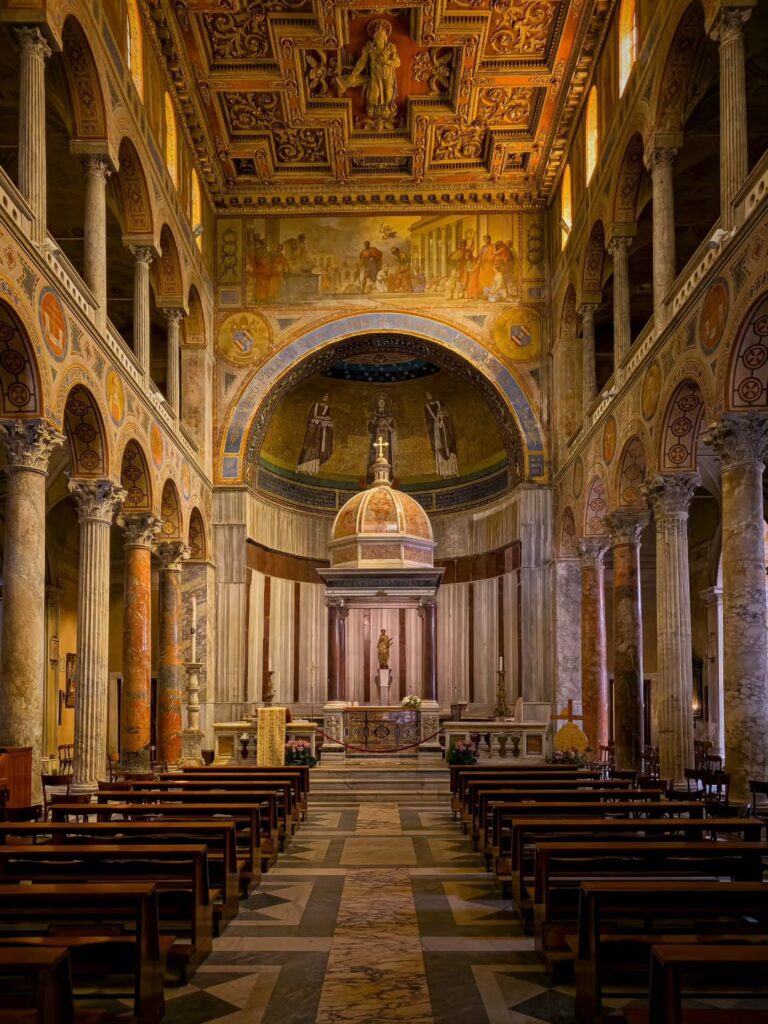
The Catacombs of Saint Agnes are an underground Christian burial complex beneath the monumental complex of the Basilica of Saint Agnes Outside the Walls in Rome, Italy. The cemetery began in the second half of the third century and became associated with the burial of Agnes, an early Christian martyr. Ancient tradition linked the burial ground to her family and placed it near imperial property.
Agnes’s date of martyrdom is uncertain and has been connected with persecutions under the Roman emperors Decius, Valerian, or Diocletian, all associated with persecution of Christians. A Latin tradition describes her as a noblewoman of the Claudian family who died at age twelve on January 21, 304. In that account, she was accused of witchcraft and condemned to be burned. The flames did not harm her, and after her hair grew to cover her, she was killed by a sword thrust to the throat.
The earliest literary notice, the Depositio martyrum from the first half of the fourth century, gives January 21 as Agnes’s dies natalis, the anniversary of her death understood as her birth into heaven, and places her burial on the Via Nomentana. A poem by Pope Damasus I confirms the burial tradition. Later accounts include Ambrose of Milan’s De virginibus and hymn Agnes beatae virginis, the Christian poet Prudentius’s Peristephanon, and the fifth-century Passio sanctae Agnetis, a devotional narrative of a saint’s suffering that brings earlier testimony together.
Expansion and church building
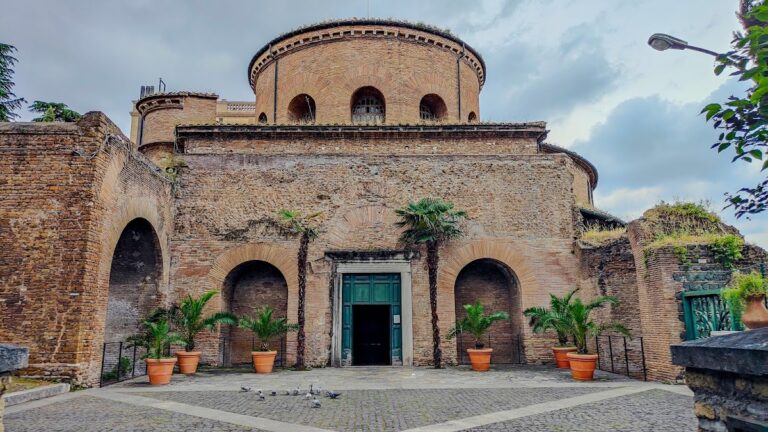
During the fourth century, the original burial area grew to include three additional regions. Emperor Constantine I took control of the ground above Region IV and built a basilica dedicated to Agnes, now in ruins, along with a mausoleum. His daughters Constantina and Helena were later buried in the mausoleum. Excavations in the 1970s established that a pagan burial ground dating to the mid-second century had occupied the ground above Region IV before it was destroyed to make way for Constantine’s basilica.
Under Pope Liberius, who held office from 352 to 366, a small shrine was built above the cemetery in Agnes’s memory. Pope Symmachus, whose papacy lasted from 498 to 514, converted the shrine into a small basilica. In the first half of the seventh century, Pope Honorius I rebuilt it as the basilica. This construction cut through and destroyed parts of the catacomb below.
Rediscovery and archaeological study
The cemetery was eventually abandoned and forgotten. In the early sixteenth century, the Dominican friar Onofrio Panvinio rediscovered and explored it. Antonio Bosio studied the catacombs in 1632 but confused them with the nearby Greater Cemetery, or Coemeterium maius. In the eighteenth century, people seeking relics and treasure caused serious damage to the complex.
At Giovanni Battista de Rossi’s request, Mariano Armellini excavated the cemetery in the second half of the nineteenth century. His work brought some well-preserved areas to light and established the division into four regions; he excavated Region I in 1869. In the early twentieth century, the priest Augusto Bacci investigated the history and layout of Agnes’s commemoration and Region I. The priest Umberto Maria Fasola studied Region IV in 1971 and 1972.
Remains
Underground layout and inscriptions
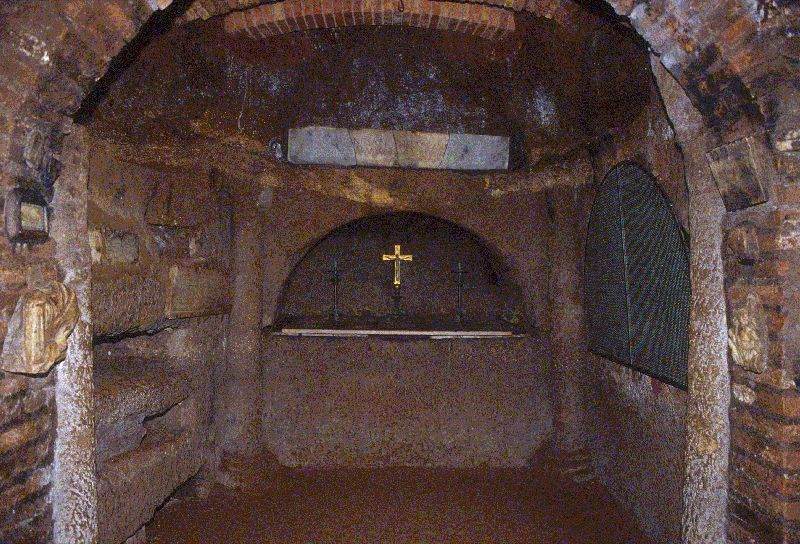
The catacombs extend across three underground levels and are divided into four regions. They lie at the second mile of the Via Nomentana, within the complex of Saint Agnes Outside the Walls. The regions occupy ground beneath the present streets, basilica, and attached monastery. Numerous inscriptions form an important part of the surviving evidence.
Region I
Region I lies beneath the present Via di Sant’Agnese, to the left of the basilica. It is the oldest part of the complex. Construction of the basilica above cut substantially into this section of the cemetery.
Region II
Region II is one of the four underground sections and suffered particularly heavy damage from relic seekers.
Region III
The largest region extends mainly beneath the monastery attached to the basilica and beneath the Via Nomentana. An ancient quarry connected it to the nearby Greater Cemetery. When Armellini excavated Region III, a layer of silt had protected much of it from tomb robbers. Many objects recovered there are now held in the Vatican Museums.
Region IV and commemorative inscriptions
Region IV lies between the present basilica and the ruins of Constantine’s basilica. Its entrance staircase was built using an earlier pagan mausoleum. Inscribed stone slabs from the burial ground above were reused in the staircase and in tombs below, preserving their inscriptions. The region contains the cemetery’s oldest dated inscription, a 314 epitaph for a man named Sisinnius.
A marble slab bearing Pope Damasus I’s poem about Agnes was inscribed by his calligrapher, Furius Dionysius Filocalus. Reused as paving and later found by chance, the slab is now in the entrance hall, or narthex, of the basilica of Saint Agnes Outside the Walls.