Castle Virnsberg: A Teutonic Order Castle in Germany


Site at a Glance
- Rating
- 4.1
- Popularity
- Low
- Country
- Germany
- Primary era
- Medieval
- External website
- Open
- Eras represented
- Medieval, Early Modern
- Civilizations
- Crusader, Holy Roman Empire, Teutonic Order
- Site type
- Military
- Remains
- Castle
On this page12 sections
History
Castle Virnsberg is a medieval castle in Germany, located above Virnsberg in the municipality of Flachslanden. First mentioned in 1235, it became a Teutonic Order castle and remained associated with the order for more than 500 years.
From Noble Property to Burgravial Possession
The castle was originally held by the Reich ministerials of Uffenheim. Reich ministerials were members of the medieval ministerial nobility, a class of legally dependent retainers who served rulers in administrative and military roles while holding property and authority. After Ludwig of Virnsberg joined an uprising against Emperor Frederick II, he was required in 1235 to surrender his half of the property to the counts of Hohenlohe. The counts sold that share to the Nuremberg burgraves later in the same year.
Burgrave Conrad I acquired the second half in 1259. The Nuremberg burgraviate retained the complete property until 1294, when it transferred Virnsberg and its associated possessions to the Teutonic Order.
The Teutonic Order Commandery
Virnsberg Commandery belonged to the Teutonic Order’s Bailiwick of Franconia. The Teutonic Order was a medieval Catholic religious and military order that governed commanderies and larger territorial units. Virnsberg consequently formed a Catholic enclave within Protestant Ansbach and remained a castle of the order for more than five centuries.
Secularization and Modern Ownership
In 1803, secularization transferred church-owned property into secular ownership or administration. After this change, Castle Virnsberg passed frequently between owners, mainly private individuals, although institutions such as the Protestant Welfare organization also held it.
The Nuremberg lawyer Friedrich von Herford acquired the castle in 1977 and transferred it in 2001 to the nonprofit Schlossverein Virnsberg association. The complex was sold to a Munich investment company in 2017 and has since been administered through Schloss Virnsberg GmbH & Co. KG. The entire castle ensemble is in serious need of renovation. It is protected as an architectural heritage monument in Bavaria.
Remains
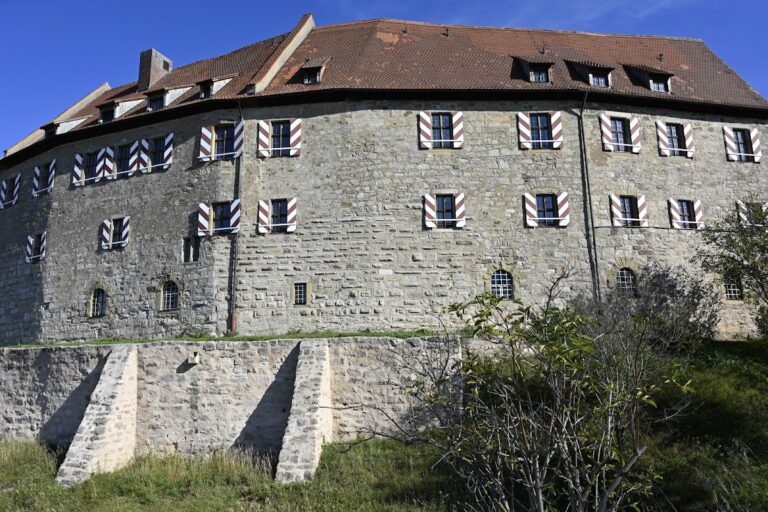
Castle Virnsberg unusually combines a hilltop castle with a moated castle. The complex stands on a rise immediately northwest above Virnsberg, above the Kemnath. Its spaces extend from a southern lower courtyard through an access route and middle courtyard to an inner castle enclosed by its own moat. Fortifications, a zwinger, service buildings, a bailiff’s house, a dovecote, a stone bridge, walls, and an enclosure form part of the ensemble.
Lower and Middle Courtyards
Lower Courtyard
The lower courtyard occupies the southern part of the complex. Its service buildings are arranged in a horseshoe shape, with a dovecote dating to around 1700 included among them. A moat follows the southern and western sides of these buildings.
Access Ramp and Outer Defences
A rising access ramp proceeds clockwise around the inner castle toward the middle courtyard. On its western side, a late fifteenth-century outer curtain wall flanks the ramp. The route reaches a gate enclosure built at the end of the fifteenth century.
Middle Courtyard
The middle courtyard is bounded on its northwestern side by two building wings joined at an obtuse angle. Two rectangular gun towers project from the northern side, and fifteenth- or sixteenth-century casemates stand at their feet. A casemate is a vaulted or enclosed defensive chamber used for guns.
Inner Castle
The inner castle has a polygonal plan and is surrounded by a moat. Buildings completely enclose its courtyard, preserving a compact defensive and residential core within the wider complex.
Gateway and Chapel
Entry into the inner courtyard is through a vaulted gateway at the eastern corner of the north wing. A two-storey Baroque castle chapel occupies the northeastern corner of the inner castle.
Octagonal Keep
A freestanding octagonal keep stands behind the northwestern corner. A keep is the principal fortified tower of a castle, and this tower forms a separate vertical element within the enclosed inner complex.