Castle Pfaffroda: A Renaissance Castle and Historic Estate in Germany


Site at a Glance
- Rating
- 4.5
- Popularity
- Very Low
- Country
- Germany
- Primary era
- Early Modern
- External website
- Open
- Eras represented
- Early Modern
- Civilizations
- Electorate of Saxony, Holy Roman Empire
- Site type
- Domestic
- Remains
- Castle
On this page12 sections
History
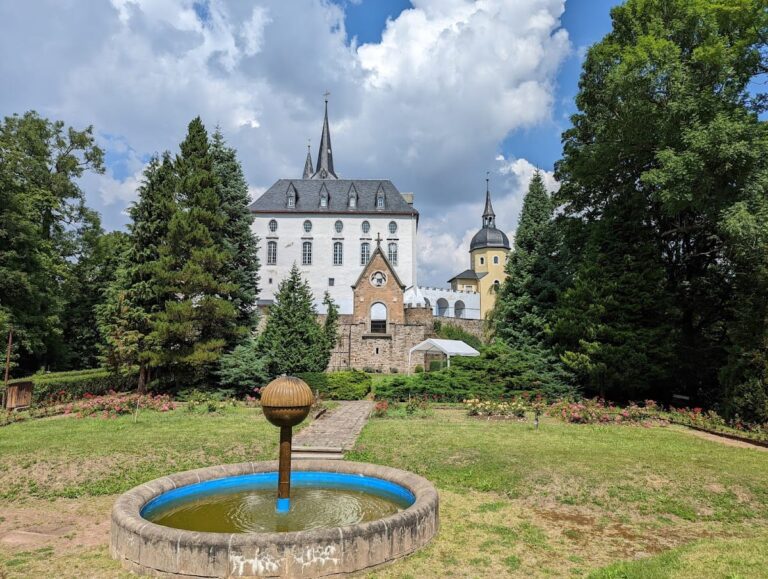
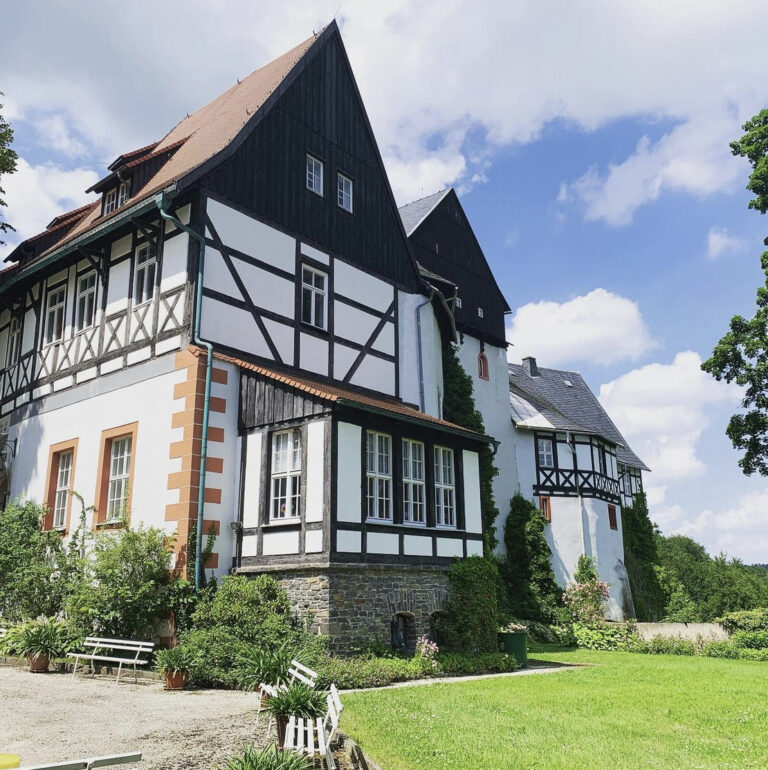
Castle Pfaffroda is a Renaissance castle in Pfaffroda, Germany, built in 1575–1578 as the residence of the Schönberg family. It developed from an earlier medieval estate and later passed through feudal, aristocratic, state, and institutional ownership, reflecting the political and social changes of the region.
Medieval origins and feudal lordship
The predecessor of Castle Pfaffroda was a farm established in the early thirteenth century by secular clergy of Ossegg Monastery. The site was first recorded as a knightly estate in 1512. Between 1352 and 1389, Peter von Schönberg acquired the lordship of Sayda, including Purschenstein and Pfaffroda, as a fief of the Burgraves of Meissen.
After Burgrave Heinrich II of the Meinhering line died at the Battle of Aussig in 1426, the Margraves of Meissen became the site’s feudal lords. The Schönbergs retained the lordship of Purschenstein, which became a fief of the Wettins, the ruling dynasty whose territories included the Margraviate of Meissen and later Saxony.
The Schönberg Renaissance residence
In 1480, Caspar von Schönberg of Frauenstein and Pfaffroda travelled to Rome and undertook to rebuild a church destroyed by fire. Pope Sixtus IV later granted him an indulgence. Caspar and his second wife, Barbara von Bünau, built the Renaissance castle between 1575 and 1578.
Caspar von Schönberg held several important offices. He served as a chamberlain to the Elector, a chief mining official, and a district official. The castle therefore belonged to a family whose local lordship was connected with the administration of mining and the government of the electorate.
War, rebuilding, and free ownership
The Thirty Years’ War, the major European conflict of 1618–1648 that brought military, demographic, and economic disruption to the German lands, severely affected the castle, church, and village. Castle Pfaffroda was partly destroyed. During the war, Caspar-Heinrich von Schönberg gave Bohemian religious exiles a new home in his lordship of Purschenstein.
The conflict left the Schönberg family in serious financial difficulty, and it could no longer retain all its properties. Shortly before his death in 1650, Georg Friedrich von Schönberg of the Saxenburg branch, the Saxon electoral chief mining official, purchased Pfaffroda from August, the son of Caspar-Heinrich. The estate probably thereby became an allod, meaning land held as free property rather than as a feudal fief.
Georg Friedrich’s son Caspar also became chief mining official and later acquired Dörnthal. Castle Pfaffroda was rebuilt and enlarged after 1650, establishing the later form of the complex after the destruction of the war.
From the Napoleonic era to the twentieth century
In August 1813, during the passage of Napoleon’s troops, Joachim Murat, King of Naples, spent one night at Castle Pfaffroda. In the following century, Carl Alexander von Schönberg (1857–1928) left Pfaffroda to his adopted son Alfons Diener von Schönberg, the son of his sister Sara and an authority on the history of the Schönberg family.
After the Second World War, the Saxon administration expropriated large landowners and factory owners, including Hubertus Diener von Schönberg, the castle’s owner. The estate lands and extensive forests were divided, and the castle became public property of the German Democratic Republic.
Institutional use and modern ownership
Following its expropriation by the Red Army, the castle housed refugees and expellees from Germany’s former eastern territories. From 1947 it operated as a residential care home, sometimes accommodating 140 people. Between 1946 and 1990, the complex also served other purposes, including use as a museum.
A chimney fire on 4 December 1953 destroyed the south wing and the top of the tower. The south wing was rebuilt by 1956, while the tower received a temporary roof. Its top was restored in its original form in 2001. The care home continued after German reunification under the Marienberg district.
An exhibition on the castle and its history began in the former stable wing in 1999. During work in the exhibition rooms in 2002, eight matchlock guns from 1660 and a gilded armour collar belonging to Elector Johann Georg II from 1664 were discovered. The guns were associated with the castle armoury. The armour collar belonged to the Dresden Armoury, a museum collection of historical weapons and armour in Dresden, whose holdings had been stored at Pfaffroda from 1943 to protect them from destruction.
Since 2004, the crypt on the grounds has again belonged to the von Schönberg family. A crypt is a burial chamber, often beneath a church or another religious building. Hubertus Diener von Schönberg was buried there on 14 August 2004.
Because extensive repairs were needed to the roofs and exterior envelope, the operator closed the care facility in 2015, when it had 65 residents. In spring 2017, Joachim Heinrich Diener von Schönberg and his brother Carl-Alexander Diener von Schönberg bought the vacant castle and founded the Alfons Diener von Schönberg Foundation. Helene Margarete von Schönberg has lived in the castle since May 2018, while the Kultur- und Sozialzentrum Schloss Pfaffroda operates an exhibition on its history. The former castle site was registered as an archaeological monument on 14 January 1981.
Remains
Setting and earlier castle site
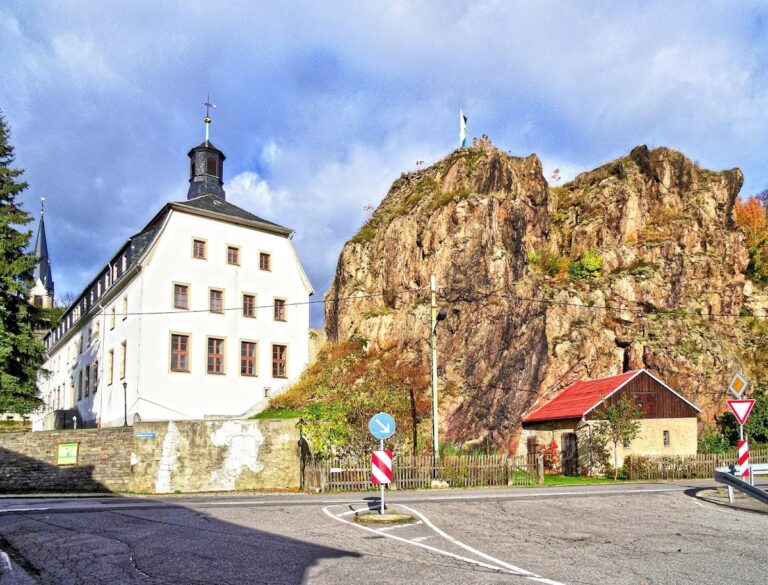
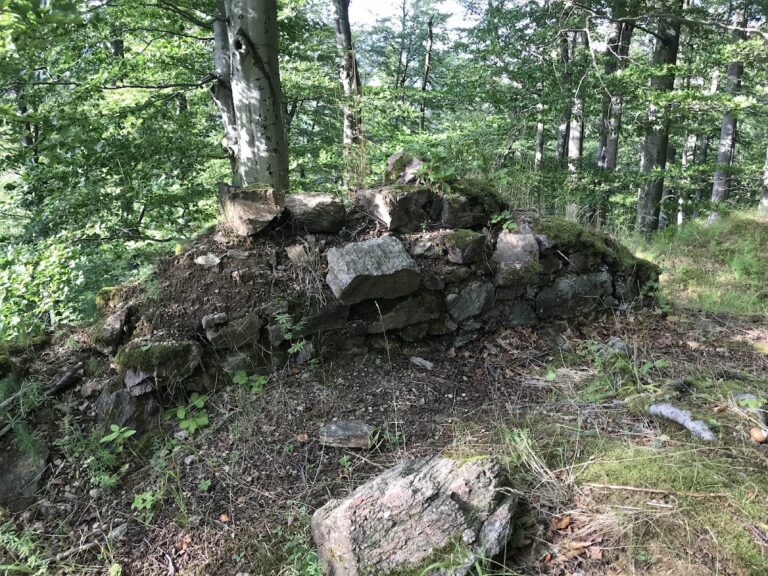
Castle Pfaffroda stands on a rocky promontory in the southern part of Pfaffroda, on a southwest-facing spur above the Bielabach. The Renaissance castle occupies a larger area than the earlier castle, which covered a rocky spur approximately 75 metres in diameter. A slight depression in the courtyard may mark the line of the former castle moat. It lies about 40 metres from the tip of the spur.
Castle buildings and grounds
South wing and tower
The complex includes a south wing and a tower. The south wing was reconstructed after the chimney fire of 1953, while the tower top was restored in its original form in 2001. A Renaissance portal on the southwest gable survives from 1578 and bears an alliance coat of arms.
East wing and crypt
The east wing formerly served as a stable and now contains the exhibition associated with the castle’s history. A crypt on the grounds remains connected with the von Schönberg family. The grounds also include a castle park and ponds in the vicinity.
Armoury objects
Eight matchlock guns dating from 1660 were associated with the former castle armoury. A matchlock gun is a firearm fired by a smouldering cord that ignited the gunpowder charge. The same work in the exhibition rooms revealed a gilded armour collar made for Elector Johann Georg II in 1664. The collar belongs to the Dresden Armoury, rather than to Castle Pfaffroda, and had been stored at the castle during the Second World War.
Nearby sites