Castle of Saint-Maurice-de-Rémens: A Historic Estate and Saint-Exupéry Memorial Site


Site at a Glance
- Rating
- 4.7
- Popularity
- Low
- Country
- France
- Primary era
- Early Modern
- Eras represented
- Early Modern, Modern
- Civilizations
- French
- Site type
- Domestic
- Remains
- Castle
On this page10 sections
History
The Castle of Saint-Maurice-de-Rémens is an eighteenth-century estate in France, in the village of Saint-Maurice-de-Rémens. Built in the Empire style and completed in 1756, it was constructed by Claude Colabau de Rignieux, a former captain in the Bourbonnais Regiment, an ancien-regime French military formation. The castle later became closely associated with the childhood of the aviator and writer Antoine de Saint-Exupéry, whose family memories helped give it a lasting cultural identity.
Construction and the Revolution
Claude Colabau de Rignieux, born in 1715 and deceased after 1797, built the castle in the middle of the eighteenth century. During the French Revolution, a period that dismantled much of France’s ancien-regime political and social order, the property was not confiscated. Its two towers were nevertheless lowered in the name of equality, altering the building’s original appearance.
Because Colabau de Rignieux had no descendants, he transferred the estate to his nephew Jean Marie Alexandre Colabau de Julienas (1742–1812). Colabau de Julienas had been a lieutenant colonel in the French Guards Regiment, a senior officer in another ancien-regime military formation, and held the rank of Knight of Saint Louis, a royal military order awarded for service. He died at Saint-Maurice, and his epitaph survives beneath the bell tower of the parish church.
The Tricaud alterations
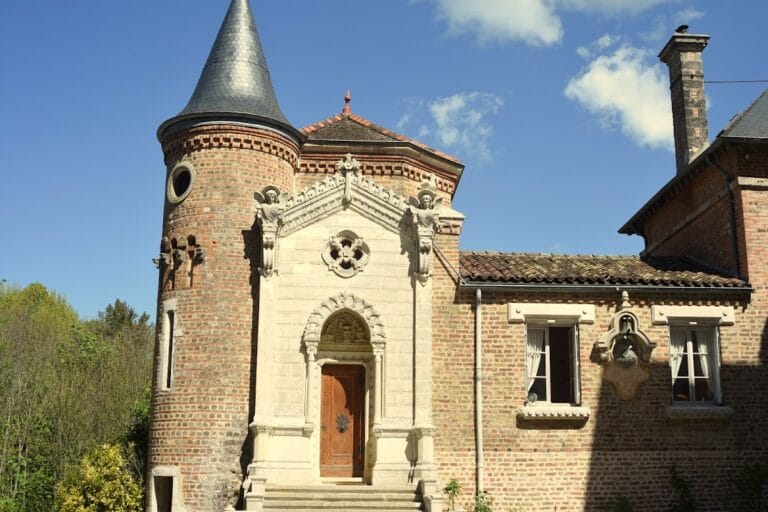
Adolphe de Tricaud was identified as the owner in 1829. His son Léopold de Tricaud was living at the castle by 1862 and formally inherited it after his father’s death in 1872. Léopold subsequently undertook a substantial campaign of alteration. The façades appear to have been renovated, attic levels were added to the wings whose upper sections had been removed during the Revolution, and a chapel was built.
Around 1880, Léopold also had the western stables and a saddlery rebuilt. After his death, his widow Gabrielle de Lestrange retained the estate. When she died in April 1920, she left it to her great-niece Marie de Fonscolombe. Marie sold the farm and lands because she had limited personal wealth and found the property difficult to manage.
Saint-Exupéry’s childhood home
Antoine de Saint-Exupéry (1900–1944), the French aviator and writer best known as the author of The Little Prince, spent much of his childhood at the family property. He later referred to the castle in works including Wind, Sand and Stars and Flight to Arras. He was baptized in the castle chapel in 1900 and attended a final family Christmas there in 1932. These associations led to informal names such as the “Little Prince castle” and “Saint-Ex’s castle.”
After two of her children died and her three adult children left, Marie de Fonscolombe could no longer meet the estate’s maintenance and repair costs. She placed the castle on the market in 1931. On 20 December 1932, the City of Lyon’s school fund acquired it to establish a preventorium colony. A preventorium was a residential health institution intended to protect children at risk of illness, particularly tuberculosis. The Countess of Saint-Exupéry welcomed the planned use.
Institutional uses and wartime events
From September 1933 to 1953, the property operated as a preventorium colony. It also hosted colonies for children from Brest and Lyon from 1933 into the 1990s under the management of the Lyon school fund. Between October 1953 and December 1986, the castle became a boarding school for young people from Lyon, including Wards of the Nation and children placed in care. The PEP, the organization for pupils in public education, was entrusted with management, while the two organizations responsible for the site divided its expenses from 1953 to 1986.
In September 1939, the castle was requisitioned for a proposed auxiliary military hospital, and central heating was installed. The property returned to the City of Lyon’s school fund on 27 July 1940. In December 1944, pilots of the Tactical Air Force, an Allied formation supporting ground forces, took off from Saint-Maurice-de-Rémens during operations by the French First Army in Alsace and stayed at the castle. They included the French flying ace Edmond Marin la Meslée of the 5th Fighter Wing.
Ownership and the museum project
The City of Lyon retained ownership until 2009, despite earlier efforts by several officials to dispose of the property. That year, the municipality of Saint-Maurice-de-Rémens bought the castle for EUR 950,000. With support from Antoine de Saint-Exupéry’s heirs, it proposed a “Little Prince House,” a cultural venue dedicated to the writer’s work and memory. The project failed, and the castle later fell into obscurity.
In February 2020, the Auvergne-Rhône-Alpes region acquired the castle and its park in an effort to revive the memorial project. An opening was planned for 2024, the eightieth anniversary of Saint-Exupéry’s death, with 2025 also considered as a possible date. The property is currently intended for a museum project.
Remains
Main building
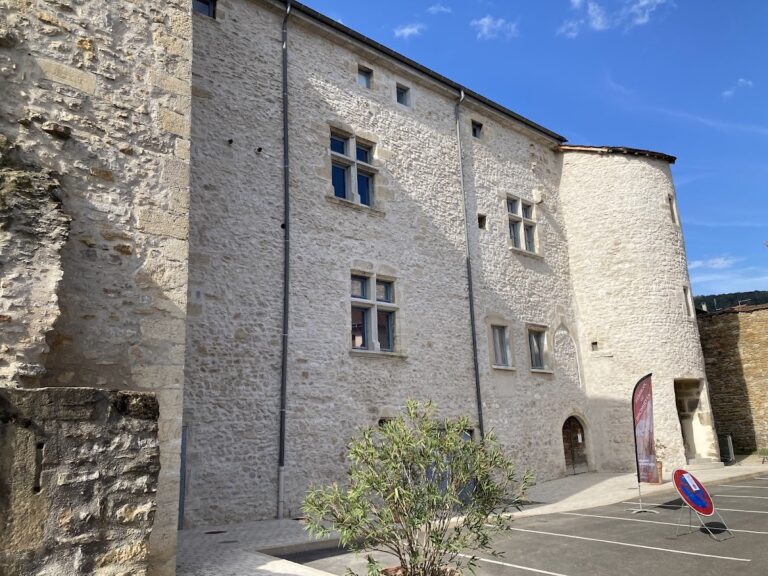
The castle is an eighteenth-century building completed in 1756 and described in the Empire style, an early nineteenth-century neoclassical style associated with the Napoleonic period and formal monumental design. Its original composition included two towers. During the French Revolution, their upper sections were lowered, and the wings later received attic levels during Léopold de Tricaud’s alterations. The façades were renovated after 1872, when the chapel was also added to the estate.
Western outbuildings
The stables and saddlery to the west of the castle were rebuilt around 1880. Very little furniture remained in the castle by 2022. The former stables preserve a replica of the aircraft in which Antoine de Saint-Exupéry disappeared, linking the surviving outbuildings with the estate’s later memorial role.
Park
The castle forms part of an associated park. The grounds have hosted large-scale performances and concerts, adding a later public and cultural use to the historic estate.