Schloss Westerhaus: Historic Estate and Winery in Ingelheim am Rhein


Site at a Glance
- Rating
- 4.5
- Popularity
- Low
- Country
- Germany
- Primary era
- Modern
- External website
- Open
- Eras represented
- Early Modern, Modern
- Civilizations
- Electoral Palatinate, German, Holy Roman Empire
- Site type
- Domestic
- Remains
- Castle
On this page11 sections
History
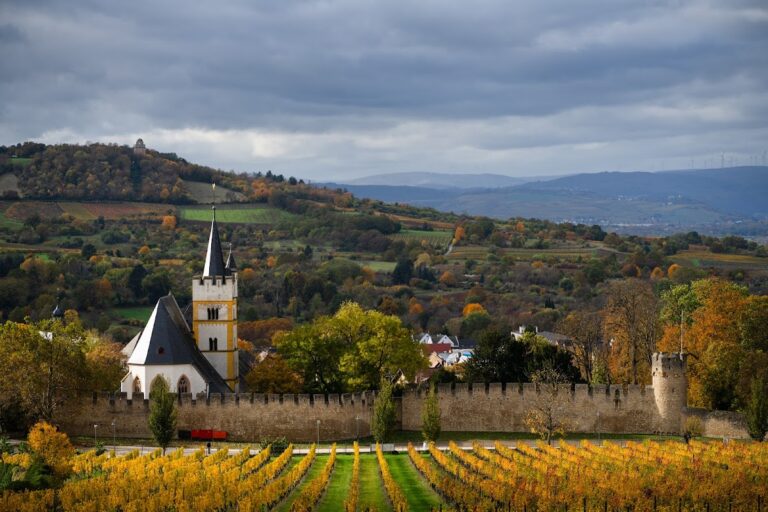
Schloss Westerhaus is a historic estate in Germany, situated on the Westerberg near Großwinternheim within Ingelheim am Rhein. It is the largest estate in Rheinhessen, and its present appearance was shaped chiefly by conversion and extension work carried out between 1922 and 1927.
Medieval origins and noble ownership
Westerhaus first appears in written evidence in 1408 as a house and fields on the Westerberg. Its foundation is believed to be considerably earlier and has been associated with the establishment of Charlemagne’s imperial palace at Ingelheim in the eighth century. Charlemagne, the Frankish ruler who became emperor in 800, created major royal and imperial centres across his realm. The General Directorate for Cultural Heritage of Rhineland-Palatinate places the first mention in its cultural-monuments list in 1190.
The Counts of Bolanden and Ingelheim lived at Westerhaus for more than 600 years. As a fief of the Electorate of the Palatinate, a major principality of the Holy Roman Empire, the estate remained in the possession of the Counts of Ingelheim for more than four centuries. French Revolutionary troops expropriated it at the beginning of the nineteenth century.
The Opel agricultural estate
On 4 October 1900, Heinrich Opel of Rüsselsheim, one of Adam Opel’s five sons, acquired Westerhaus and developed it as a model agricultural estate. His wife, Emilie, was the daughter of Friedrich Weber, a Hessian economic councillor who had leased the Mönchhof state domain near Kelsterbach and later owned the Petersau estate.
Before the improvements of the twentieth century, transport and cultivation on the Westerberg were difficult. Horse- and ox-drawn carts carried supplies up and down the hill, while strong westerly winds and thin loess soil restricted farming. The Opels secured water rights by acquiring the Eulenmühle mill and its mill stream in the Selz Valley. A pumping system then carried water up the mountain for irrigation. Deep ploughing and early mechanisation helped increase the estate’s economic success.
Road construction began in 1916 as part of a military plan to extend the defensive system of the Fortress of Mainz. A route connected Altegasse in Ingelheim with Westerhaus, and a rack railway, which uses a toothed rail and geared traction to climb steep gradients, was built along it. The railway was completed, but the planned eastern defensive belt, including trenches and fortifications directed against France, was abandoned after military plans changed. The railway was later removed. Heinrich von Opel converted the route into a private road in 1920, and his daughter Irmgard von Opel later covered it with asphalt. For many years it remained known as the rack-railway road.
Horse breeding and wartime use
A one-room school operated at Westerhaus for several years, serving eight children from four grade levels. During the Second World War, Irmgard von Opel directed the creation of a military hospital for horses and soldiers from all sides. Schloss Westerhaus was consequently spared bombing.
The estate’s stud farm also became closely associated with Irmgard von Opel’s riding career. Regarded as one of the leading riders of the 1930s in eventing and show jumping, she won the German show-jumping derby at Klein-Flottbek in 1934 while riding her grey horse Nanuk. She was the first woman to win the competition, which is now part of Hamburg.
The Westerberg stud-farm monument zone was established in 1912. Its building group was constructed mainly between 1920 and the beginning of the 1930s, and the stud farm is now regarded as one of Germany’s leading thoroughbred breeding establishments.
Wine estate and cultural use
Heinz von Opel and his wife Claudia took over the Westerberg in 1978 and progressively opened it to the public from 1979. Their work included planting trees and creating a wine trail. Since 2008, Ivonne Countess von Schönburg-Glauchau, born von Opel, and her husband Johannes Count von Schönburg-Glauchau have run the wine estate as its fourth generation of operators.
The estate is now best known for Weingut Schloss Westerhaus. It has belonged to the Rheinhessen regional association of the Verband Deutscher Prädikatsweingüter since 1983. The VDP is a German association of quality wine estates that classifies and promotes wines from designated vineyard sites. Schloss Westerhaus cultivates 18 hectares, producing wines characterised by freshness and minerality. Its traditional Whitsun courtyard festival and jazz events remain part of the estate’s cultural identity, and since 2019 the castle has also hosted the Rheingau Music Festival.
The winery first appeared on the list of Germany’s 100 best wineries in 1987 and has been included repeatedly among the world’s 1,000 best estates since 1990.
Remains
Castle courtyard and agricultural yard
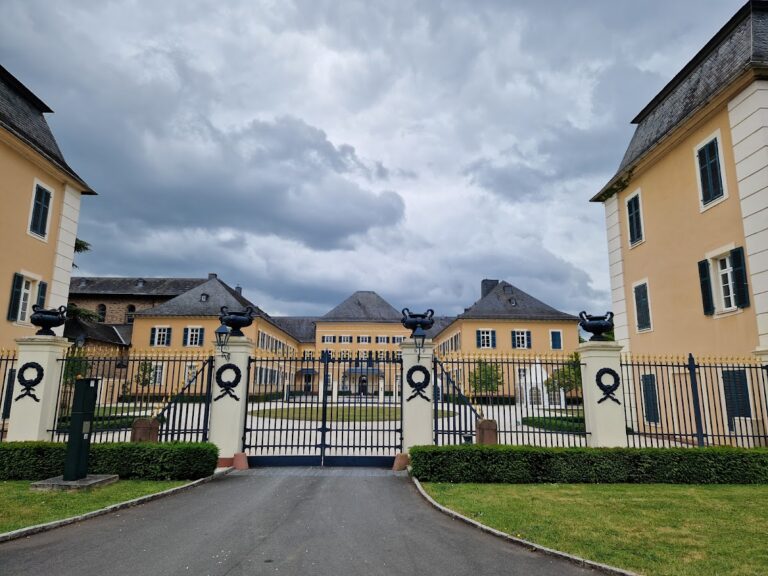
Schloss Westerhaus occupies the Westerberg as a two-part complex formed by a castle courtyard and a service or agricultural yard. The main building is a castle-like structure with a mansard hipped roof. Built in the 1920s, it is visible from the surrounding valley. The complex also contains a terraced park with a water basin and enclosing boundary, together with open park-like spaces, paddocks, riding grounds, and mature trees associated with the stud farm.
Stepped-gable building
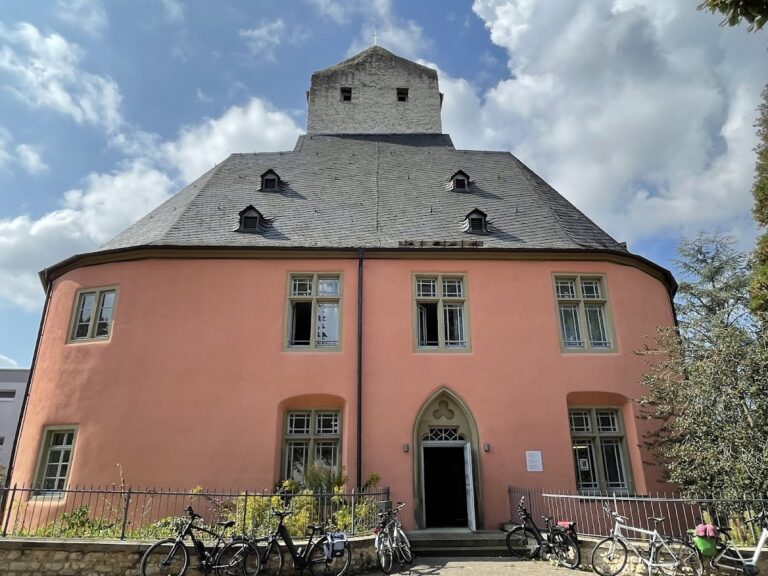
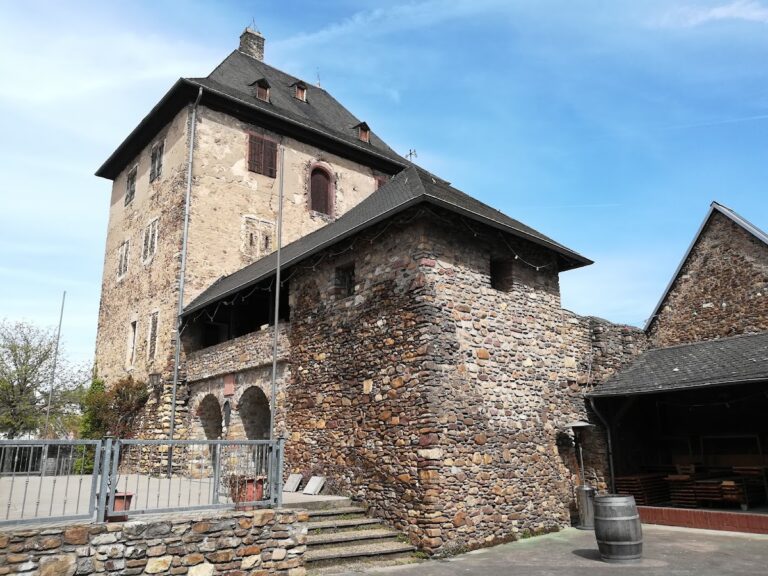
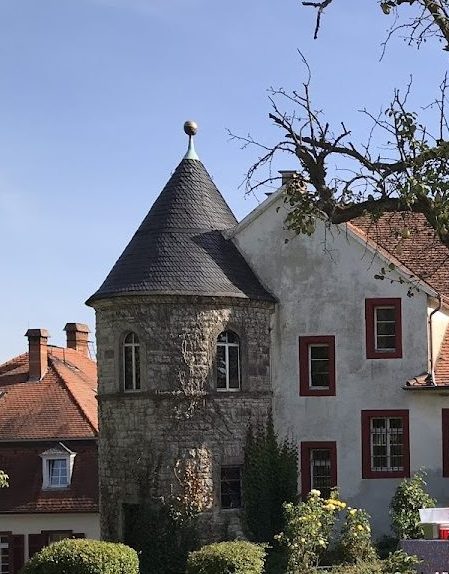
An auxiliary stepped-gable building preserves a core that probably dates from the sixteenth or seventeenth century. Its stair tower and wine-press house were added in 1922, linking an older building fabric with the estate’s twentieth-century redevelopment.
Barn
A large barn with a mansard roof was built during the 1920s as part of the agricultural yard. Its construction belongs to the period in which the estate was reorganised and expanded under the Opel family.
Stud farm facilities
The stud farm includes a prominent indoor riding arena, as well as paddocks and riding grounds set within the open spaces of the Westerberg. These facilities belong to the estate’s development as a horse-breeding establishment and provide the physical setting for its long association with eventing, show jumping, and thoroughbred breeding.
Cellar and vineyards
The winery’s cellar is cut into the mountain. Its form has been compared to a stalactite cave, and its subterranean construction is suited to wine storage. The vineyards occupy ancient shell-limestone formations. The geological base of the Westerberg is described as a limestone reef about 90 metres thick, covered by approximately 50 centimetres of soil. Fossil shells and snails from millions of years ago can still be found in the vineyards.
The principal vineyard is the monopole Ingelheimer Schloss Westerhaus, a site cultivated exclusively by one estate. Further plantings lie in the Sonnenhang, Schlossberg, Sonnenberg, and Klostergarten sites. About 70 percent of the vineyard area is planted with Burgundy varieties, including grape types of Burgundy origin such as Pinot varieties, while the remaining 30 percent is planted with Riesling.