Castle of Gemona: A Strategic Medieval Fortress in Italy


Site at a Glance
- Rating
- 4.4
- Popularity
- Low
- Country
- Italy
- Primary era
- Medieval
- External website
- Open
- Eras represented
- Medieval
- Civilizations
- Holy Roman Empire
- Site type
- Military
- Remains
- Castle
On this page10 sections
History
Castle of Gemona is a fortified hilltop complex in Gemona, Italy, whose origins probably reach back to around 500 BC. The site developed from an ancient hillfort, was modified by the Carni, and was later converted by the Romans into a castrum, a fortified military settlement, with a watchtower. Its position above the historic center guarded the route from the Friulian plain, where two Roman roads toward Noricum converged.
Ancient and Early Medieval Fortifications
The first hillfort probably protected the path from Sella S. Agnese toward Artegna. The Carni, an ancient people of the Alpine and north-eastern Italian region, altered the site in the third century BC. Roman military use followed, with the establishment of a castrum and watchtower.
Later rebuilding and repair phases were linked to repeated threats and invasions. Work followed attacks associated with the Quadi and Marcomanni in 166 and 167, the Visigoths under King Alaric in 409, and the Huns under Attila in 452. Further construction is attributed to the Goths between 489 and 493, the Byzantines in 553, and the Alemanni led by the Lombard duke Gisulf after the first Avar invasion in 611. The Alemanni were a Germanic confederation active in central Europe, while the Lombards established a kingdom in Italy during the early Middle Ages. Paul the Deacon later referred to a Lombard castrum occupying the site of an earlier fortification.
The Lords of Gemona and the Patriarchate
Around the year 1000, the Lords of Gemona completely rebuilt the castle. Their origins remain unknown, but the family enlarged the complex for the last time during the fourteenth century, creating the arrangement from which the present plan is thought to derive. Between 1019 and 1042, Patriarch Poppone granted the castle as a fief to the family. The Patriarch of Aquileia was both the senior ecclesiastical ruler of the Patriarchate and a territorial authority in north-eastern Italy.
The family’s control ended through a series of transfers. After acquiring the Castle of Prampero in 1271, the family divided the two castles among the four sons of Enrico of Gemona on 10 November 1279. Federico of Gemona sold his share of Castle of Gemona to the Municipality of Gemona in 1311 for 300 marks. In 1321, the sons of Federico’s brother Mattia transferred the remaining portion to the patriarch for 160 marks, ending the family’s residence there.
Renovation followed the 1321 sale, partly in response to a siege by the Counts of Gorizia at the beginning of the fourteenth century. The attackers did not breach the walls. After 1349, the recorded work focused mainly on a new tower and smaller repairs, including repairs after lightning damage.
The castle first served as the residence of the Lords of Gemona and later as the residence of the patriarchal captain, probably in the western tower. Its facilities included quarters for guards and troops, an armoury, stores for sieges, a tribunal, and prisons. Until 1238, it was also one of the temporary residences of the Patriarch of Aquileia. Among its notable guests were Emperor Conrad III, who stopped there on his return from the Second Crusade in 1149; Azzo IV d’Este, who was in Gemona for his 1204 marriage to Alice, daughter of Rinaldo, Prince of Antioch; and Charles IV, who passed through while travelling to Rome for his imperial coronation in 1354.
Decline, Destruction, and Reconstruction
An earthquake in 1348 damaged the castle. By 1381, some sections had become unsafe and were demolished. Their stone was reused in the restoration of Gemona’s town walls in 1396. Venetian rule began in 1420, after which the castle was definitively abandoned and repeatedly quarried for building material. Stone was used for the raised upper floor of the Hospital of Saint Michael in the fifteenth century, for the present Town Hall in 1503 and 1522, and for rebuilding the cathedral’s masonry and principal facade in 1825.
The earthquake of 1511 caused further collapses, and the Venetians did not rebuild the damaged structures. Although dismantling was already advanced, the castle may have been inspected in 1571 because of fears of a Turkish incursion, and it was still regarded as impregnable at that time.
The castle and its gardens were almost completely levelled by the 1976 earthquake. Comprehensive reconstruction began in the 2000s and is still ongoing. The gardens reopened in 2008, and the castle received Italian national-heritage designation. By November 2024, reconstruction of the clock tower and former prisons had been completed. Since 2019, the clock tower has housed a museum and exhibition venue.
Remains
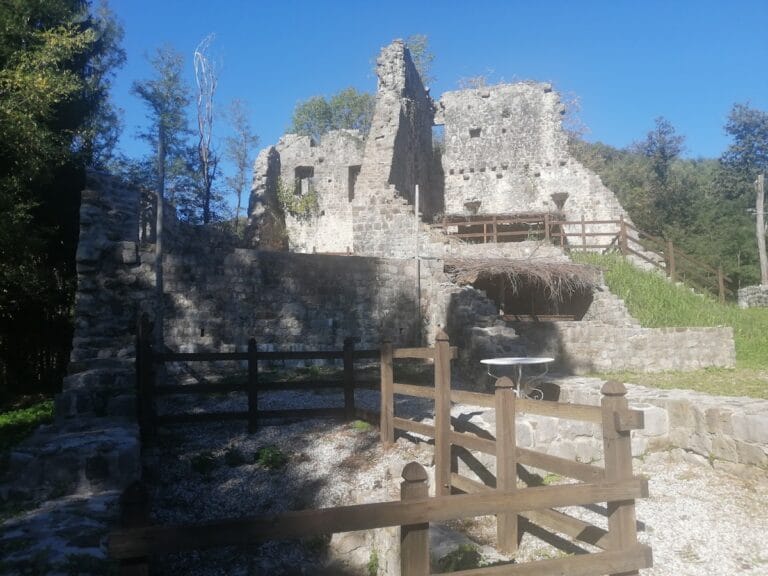
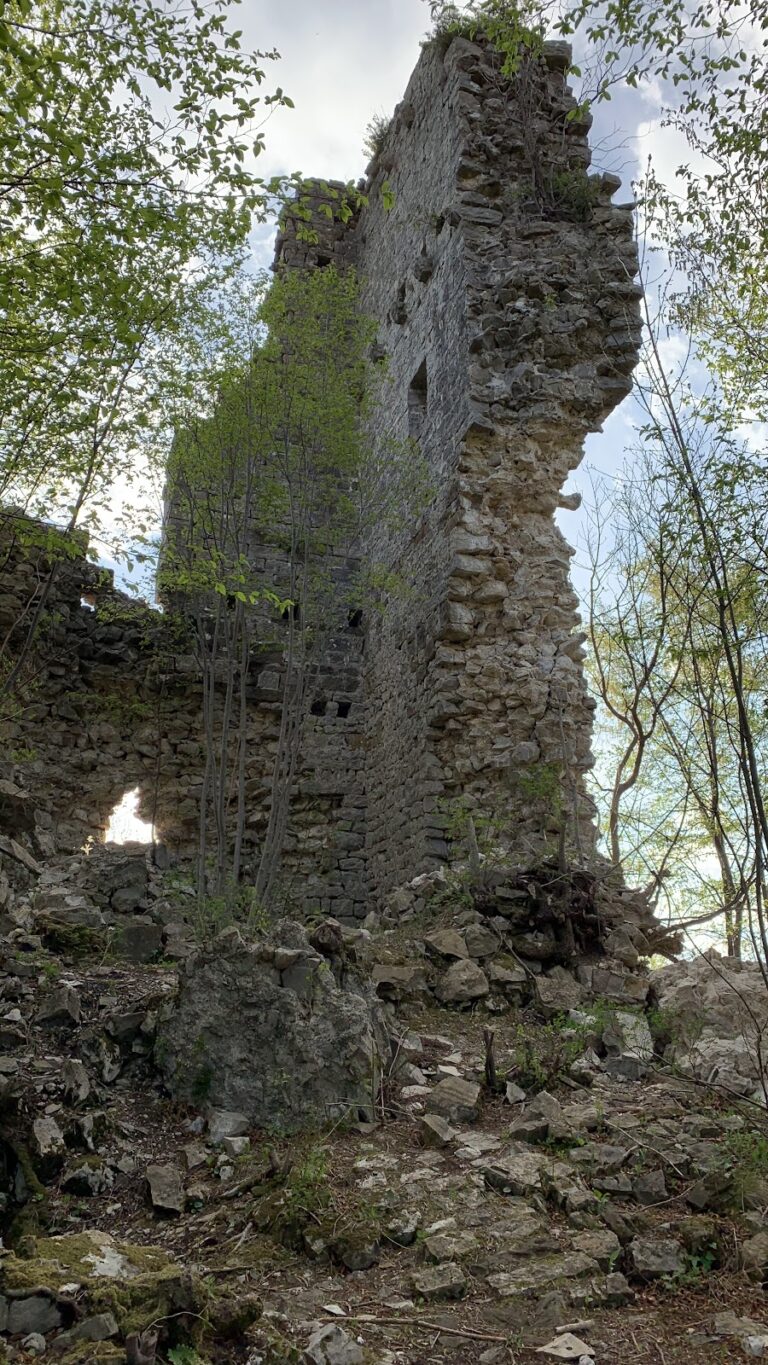
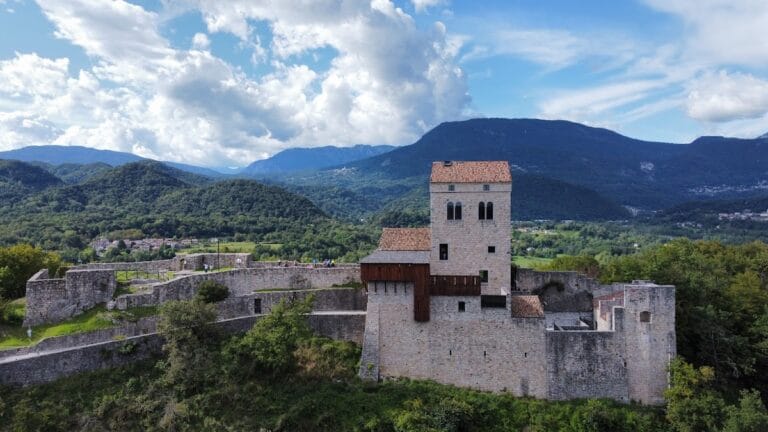
The complex occupies the rocky summit of Castle Hill at an elevation of 305 metres, above Gemona’s historic center and overhanging the valley. Its walls follow exposed bedrock, including along the route overlooking the cathedral. The medieval layout comprised a large palace, three towers, and a surrounding defensive wall. Surviving elements are arranged around an inner courtyard enclosed by masonry, with a multi-level garden inside the castle enclosure.
Approach and Enclosure
The historic approach begins at Via Bini and follows the former castle route of the Salita dei Longobardi, a rising path made up of gradual ramps and 150 steps. Within the summit enclosure, the courtyard organizes the surviving masonry, towers, and palace remains, while the gardens occupy several levels inside the defensive boundary.
Towers and Residential Structures
Clock Tower
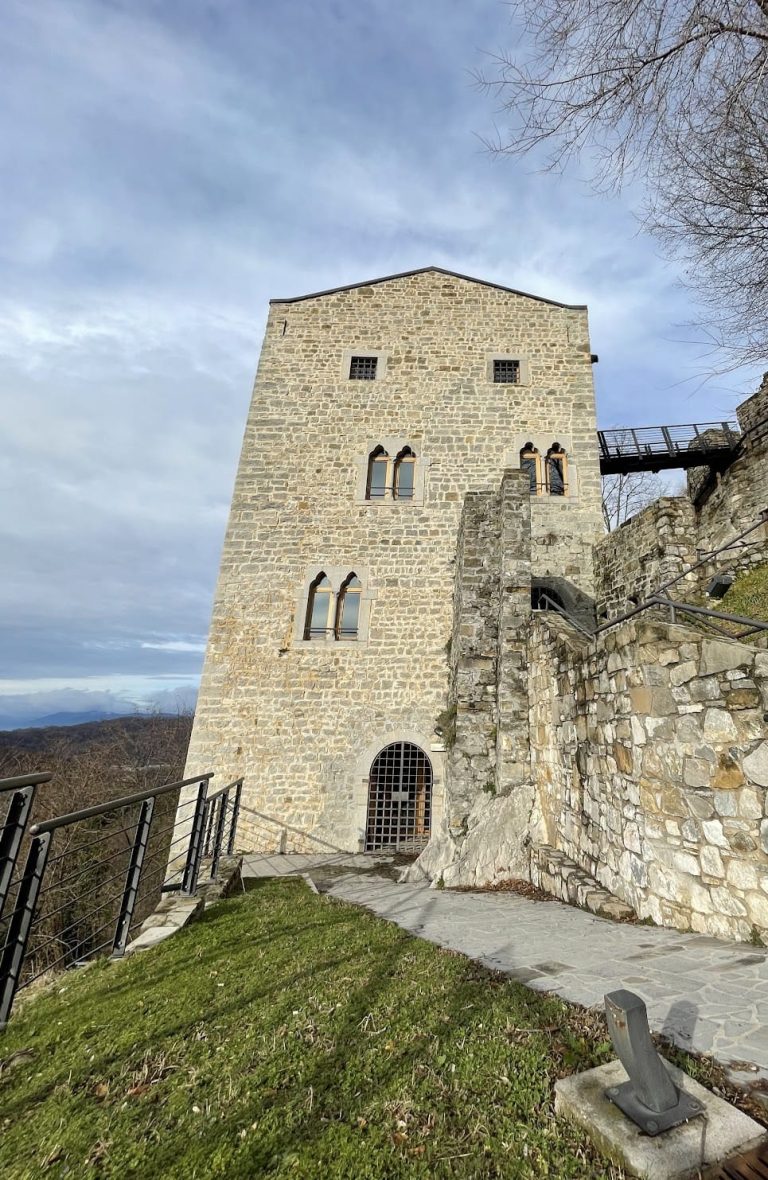
The clock tower rises 30 metres and has a square plan, eight storeys, and walls about 1.5 metres thick. Its first storey preserves a section of very ancient masonry. A stone staircase from the inner courtyard leads upward, and the summit ends in a string course and a crenellated parapet, a battlemented wall top with alternating raised sections and openings. Until the 1976 earthquake, the tower contained Gemona’s community bell, cast in 1784. The bell bears images of the town’s protectors, Saint Thomas the Apostle, Saint Michael the Archangel, and Saint Anthony of Padua, above the inscription “HIS DEFENSORIBUS GLEMONA TUTA.”
Northern Tower
A second tower stands north of the clock tower. It has five storeys, a tiled roof, and walls approximately 2 metres thick. From 1826 to 1967, it housed the castle prisons. Reconstruction of the former prisons was complete by November 2024.
Torate
The remains of the torate occupy the south-west corner of the complex. This structure probably served as the principal residence of the Lords of Gemona, the Patriarchs, and important guests.
Nearby sites