Castle of Lochstädt: Teutonic Order Fortress in Russia


Site at a Glance
- Rating
- 3.9
- Popularity
- Low
- Country
- Russia
- Primary era
- Medieval
- Eras represented
- Medieval, Early Modern
- Civilizations
- Teutonic Order
- Site type
- Military
- Remains
- Castle
On this page14 sections
History
Castle of Lochstädt is a Teutonic Order castle in Russia, in Pawlowo near Baltiysk, Kaliningrad Oblast. The medieval German Catholic religious-military order first recorded the site in 1270 and rebuilt its timber-and-earth fortification in stone between 1275 and 1285 as a Gothic Ordensburg, or castle of a military religious order. It was intended to control access to the Vistula Lagoon, a shallow coastal lagoon separated from the Baltic Sea by the Vistula Spit, but changing waterways soon reduced its strategic value.
Foundation and Teutonic administration
Before the Teutonic castle, a Prussian stronghold called Luxete stood at the beginning of the Vistula Spit. The name Lochstädt, also written Lochstedt and later associated with Burg Pawlowo, may have come from the Samland nobleman Laucstiete or from the German word Loch, meaning a deep channel. Its origin remains uncertain. The castle formed part of the Teutonic Order’s advance from Balga into Samland, an expansion assisted by Ottokar II Přemysl.
Lochstädt housed a commander from 1291 to 1305. An amber administration, responsible for the organized control and exploitation of the region’s amber, operated there from 1265 to 1581. In 1311, while the convent house was under construction, the Lochstädt channel began to silt up and a channel at Pillau formed. This geographical change removed much of the castle’s military importance, leaving the amber administration as its principal continuing function.
Late medieval and early modern use
After the commandery, an administrative district or establishment of the Teutonic Order, was abandoned, Lochstädt became the residence of a caretaker of the Königsberg commandery. The caretaker continued to oversee the amber monopoly until the end of Teutonic rule. Heinrich von Plauen, a former Grand Master of the Teutonic Order who had been deposed from that office, lived at Lochstädt from 1422 until his death in 1429. He became the castle’s caretaker approximately six months before his death.
During the Reiterkrieg, shortly before the end of the Teutonic Order’s state, 700 Swedish mercenaries sent to support Grand Master Albrecht were quartered at the castle. Lochstädt then deteriorated. Serious structural decay was reported in 1512, although an inspection in 1603 still considered its thick walls and tower militarily strong, despite the tower’s missing roof. Polish forces besieged the castle during the war of 1520 to 1521.
In 1626, during the Polish-Swedish War, Gustavus Adolphus of Sweden used Lochstädt as a base after landing at Pillau on 6 July. His soldiers caused extensive damage, and defensive earthworks were added after the Swedish withdrawal. When Gustavus Adolphus returned the following year, he attacked the castle, but Prussian troops withdrew before a battle took place. Swedish forces continued to use Lochstädt as a base during the Thirty Years’ War and into the second half of the seventeenth century.
Decline, religious use, and demolition
An assessment in 1664 described the castle as very dilapidated. After the church of St. Adalbert at Tenkitten collapsed on 24 November 1669, its congregation transferred worship to the nearby castle chapel. Services continued there until 1945, and this long religious use probably helped preserve the castle from complete demolition.
Frederick I of Prussia ordered the enclosing walls and unusable buildings demolished in March 1705 so that their materials could be used in the fortifications at Pillau. Administrative records generally place the dismantling of the north and east wings and the tower in 1701 or 1702. The defensive walls and the projecting latrine tower, or dansker, were also dismantled. A description from 1713 nevertheless portrayed the complex as a four-wing main building with a tower and outer bailey, probably reflecting an earlier survey rather than its later condition.
Russian troops occupied Lochstädt during the Seven Years’ War. Nikolaus Friedrich von Korff, Russian governor-general of Königsberg, reacquired the property for the state and had the chapel interior redesigned in 1760. French occupation troops under General Louis-Vincent-Joseph Le Blond, Comte de Saint-Hilaire, were quartered there from 1807 to 1809 during the Fourth Coalition War, causing further damage. After the Treaty of Tilsit, the Prussian state sold the remaining property to a private owner to help meet its financial contributions, but Prussia reacquired it about half a century later.
Rediscovery and destruction in the modern period
The outer bailey burned several times during the nineteenth century and was destroyed. The surviving rooms served as a residence for royal forestry officials in 1888, a school from 1891, and the East Prussian local-history museum. Surveys by Conrad Steinbrecht, a German architect and architectural historian who studied Teutonic Order buildings, and by Adolf Boetticher recognized the complex’s considerable art-historical importance. In 1895, removing layers of limewash revealed frescoes in the commanders’ chambers. They were secured and restored in 1937, when a wooden gallery incorporating part of the cloister was reconstructed on the courtyard side.
Fighting at the end of the Second World War damaged the buildings, and Soviet forces captured the Lochstädt strongpoint on 22 April 1945. Photographs from 1948 show the half-height south wing, including its gate passage and sacristy, together with the west wing still standing. During the 1960s, however, the remains were demolished to their foundations, reportedly because of a belief that the Amber Room, an ornate chamber decorated with amber panels and other precious materials, might be hidden there.
A Lithuanian expedition removed sixteenth- to eighteenth-century manuscripts and books, the archive of Ludwig Rhesa, and works by Kristijonas Donelaitis from the ruins in 1945. Additional old manuscripts, including writings by Donelaitis and other documents, were found in the cellars in 1967. In December 1989, a search for the missing Amber Room followed a former Königsberg firefighter’s claim that about 25 large crates containing dismantled panels had been taken to Lochstädt in January 1945. Excavators and heavy equipment cleared the cellar rubble to the foundations. The search was abandoned after no lower cellar, crates, or panels were found. A rusted German submachine gun and a tube of Wehrmacht liver sausage were among the recorded finds.
Further digging in 2000 destroyed the basement levels and cellars. Castle of Lochstädt is now a ruin protected as a cultural-heritage monument of federal significance in the Russian Federation. Some bricks are exhibited at the Germanisches Nationalmuseum in Nuremberg, while several capital fragments are preserved in the lapidarium at Malbork Castle.
Remains
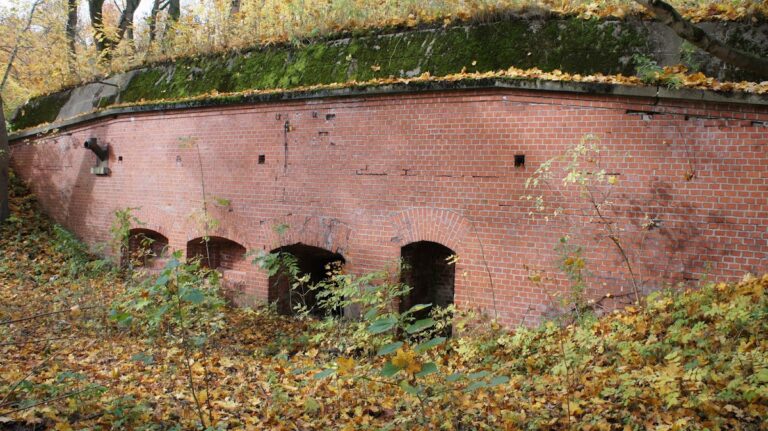
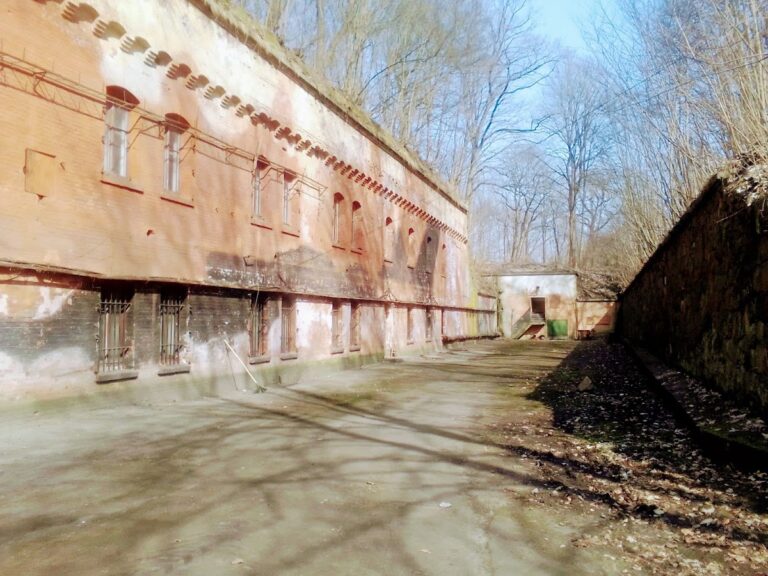
Lochstädt was a lowland Gothic castle organized around a courtyard. A shaped moat protected its eastern and northern sides, while slopes about 20 metres high descended toward the lagoon on the west and south. The stone complex developed from an earlier timber-and-earth enclosure and consisted principally of a four-wing main building with an outer bailey. Demolition, fires, wartime damage, and later digging greatly altered the surviving layout.
Main castle buildings
South wing and chapel
The south wing was the oldest part of the stone complex. It contained the castle chapel, a narrow antechamber extending westward, and the refectory, or remter, which occupied the remainder of the wing. On the courtyard side, the chapel wing had elaborate portals with rounded mouldings and brightly glazed, multicoloured bricks. A wooden gallery incorporating part of the cloister was reconstructed along this side during the 1937 restoration. The chapel was remodelled internally in 1760 and continued to serve the Tenkitten congregation until 1945.
West wing
The west wing contained smaller rooms covered by late Gothic vaults. After the Second World War, this wing and the half-height south wing remained standing, with the south wing retaining its gate passage and sacristy. Both were later demolished down to foundation level.
North and east wings
The north and east wings were dismantled for building material, principally for the fortifications of Pillau. The tower was also taken down, along with the defensive walls and the dansker, a projecting latrine tower connected to a castle by a passage. The outer bailey was later destroyed by repeated nineteenth-century fires.
Entrances and decoration
Gate passage
The gate passage had a rounded, profiled pointed-arch decoration set within a niche framed by bricks of different colours. Half-quatrefoils rested on shaped consoles within the arch, adding carved detail to the principal entrance.
Commanders’ chambers
The fresco cycle in the commanders’ chambers presented scenes and figures from Christian scripture and tradition. It included the Archangel Michael killing the dragon, the Annunciation, Christ and the adulterous woman, the Resurrection, the Sacrifice of Isaac, Moses receiving the tablets of the Law, Saint Christopher, the Crucifixion, Saint George, and the Adoration of the Magi. The artist is unknown. A thick coating of limewash had covered the paintings before their discovery in 1895, and conservation and restoration followed in 1937.
Associated remains
The ruined Lochstädt parish cemetery lies approximately 100 metres west of the castle ruins. The site’s surviving material also includes manuscripts and books recovered from the ruins and cellars, while architectural fragments from the demolished complex are preserved in Nuremberg and Malbork.
Nearby sites