Castle of Arbeteta: A Frontier Fortress in Guadalajara

Site at a Glance
- Rating
- 4.2
- Popularity
- Very Low
- Country
- Spain
- Primary era
- Medieval
- Eras represented
- Medieval
- Civilizations
- Crown of Castile, Umayyad
- Site type
- Military
- Remains
- Castle
On this page12 sections
History
Castle of Arbeteta is a Spanish fortification in Arbeteta, Guadalajara, Spain, built at least by the tenth century and associated with the Arab military architecture of the Caliphate of Cordoba. It occupied a frontier position above the Rambla ravine, defending routes across the Upper Tagus and the Cuenca mountains.
Caliphate frontier
The castle probably formed a secondary post in the defensive belt protecting the northern frontier of the Caliphate of Cordoba, the Muslim state that ruled much of the Iberian Peninsula from Cordoba. It depended on the Middle March, the central frontier zone where fortified settlements guarded routes and borders, whose capital was at nearby Medinaceli. Its low masonry, construction methods, and southern arrangement, including a keep guarding the entrance, point to an Arab origin. The fortress may have occupied the site of an older hillfort.
Arbeteta guarded one of the few routes across the Upper Tagus and the Cuenca mountain region. This route connected Cuenca and its extensive Merino sheep flocks with northern Castile, including the pastures and lands of Soria and La Rioja. The area was contested between the Caliphate of Cordoba and the Kingdom of Castile, particularly from the conquest of Toledo in 1085 to the Battle of Las Navas de Tolosa in 1212.
Incorporation into the Land of Cuenca
Legends later associated the fortress with the Hospitallers, the military religious Order of Saint John, but the earliest documentary references to Arbeteta date from the twelfth century. On 17 January 1190, Alfonso VIII, the Castilian king who ruled from 1158 to 1214, granted Arbeteta and several other villages to the territory of the Council of Cuenca.
During the Christian repopulation of the region, Arbeteta and its castle belonged to the powerful Council of Cuenca, a medieval municipal authority that controlled extensive lands and settlements. Arbeteta was a small village in the northern part of the Land of Cuenca, governed locally by two mayors and two councillors appointed by Cuenca.
Noble rivalry and the Medinaceli takeover
From the mid-thirteenth century, the Carrillo, Albornoz, Mendoza, and Acuña families competed with Cuenca for land and municipal rights, especially in the northern mountain pastures. These disputes intensified during the civil struggles of the fifteenth century, when royal authority in Castile weakened.
The Count of Medinaceli sought to extend his territory southward, check the growing influence of the Mendozas of Guadalajara, and control the pasturelands and wool routes between Soria and Cuenca. In autumn 1469, the fortress fell into his hands, possibly after its castellan, Alfonso Bordello, surrendered it to Álvaro Carrillo de Albornoz, lord of Paredes. A castellan, or alcaide, was the official responsible for commanding and administering a castle.
Cuenca responded by attempting to attack the castle with its militias and forces led by Álvaro de Mendoza and the Marquis of Villena. The Count of Medinaceli and his ally Pero Carrillo de Albornoz, lord of Albornoz, Torralba, and Beteta, then attacked Cuenca in October 1469.
Medinaceli possession was legally confirmed on 18 March 1477, when the Catholic Monarchs, Isabella I of Castile and Ferdinand II of Aragon, granted Luis de la Cerda, fifth Count and first Duke of Medinaceli, lordship over Arbeteta, its castle, and its territory. The grant also included another 400 vassals in the Land of Cuenca. Arbeteta strengthened the duke’s control of the Upper Tagus and his advance into La Alcarria, an area traditionally dominated by the Duke of the Infantado.
Return to royal control
After Luis de la Cerda died in 1501, Arbeteta paid homage to his successor, Juan de la Cerda, second Duke of Medinaceli, on 13 November of that year. The town and castle remained in the Medinaceli domains only briefly. Following Cuenca’s intervention, the Crown and the second duke agreed that Arbeteta would return to royal and municipal control in exchange for other compensation. In this context, royal control, or realengo, meant land held directly under the Crown rather than under a private noble lord.
During the sixteenth and seventeenth centuries, the Crown regularly appointed the castle’s castellans. Each received an annual payment of 250,000 maravedis in cash, together with 250 fanegas of provisions, divided equally between wheat and barley. A maravedí was a historical Iberian monetary unit, while a fanega was a traditional measure of dry goods whose capacity varied by region. The castellans included Alonso Osorio, a commander of the Order of Santiago and captain of the Catholic Monarchs; Diego de Zúñiga, chief hunter and falconer of King Philip the Handsome; and Antonio Domingo de Mendoza Caamaño y Sotomayor, second Marquis of Villagarcía and second Viscount of Barrantes.
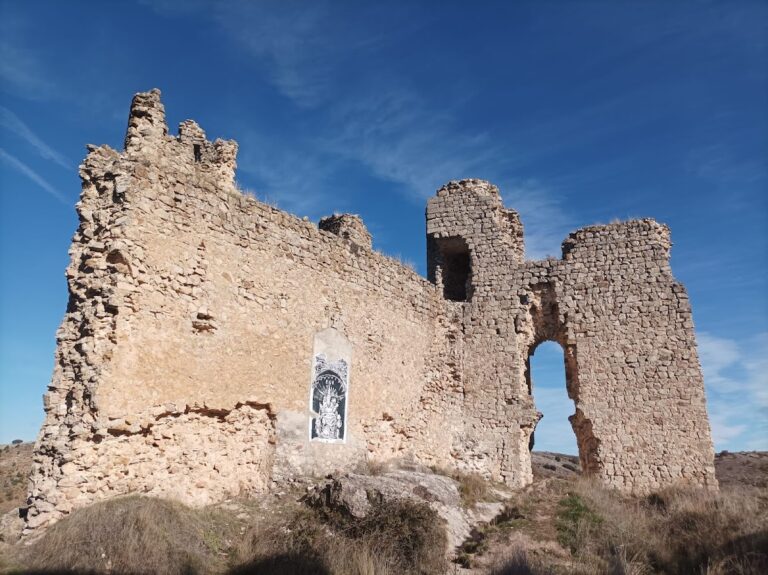
The castle was in use from the tenth through the sixteenth centuries. It is privately owned, classified as a consolidated ruin, and has a stated current use as a dwelling. The site is legally recognized as an Asset of Cultural Interest.
Remains
Layout and construction
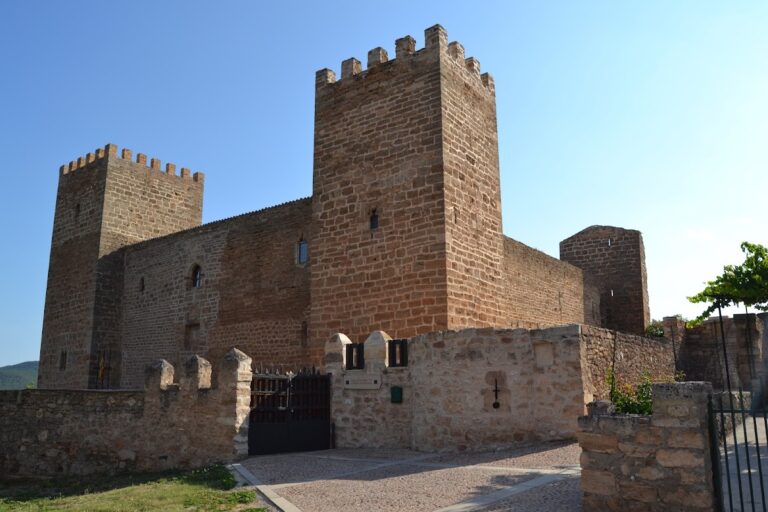
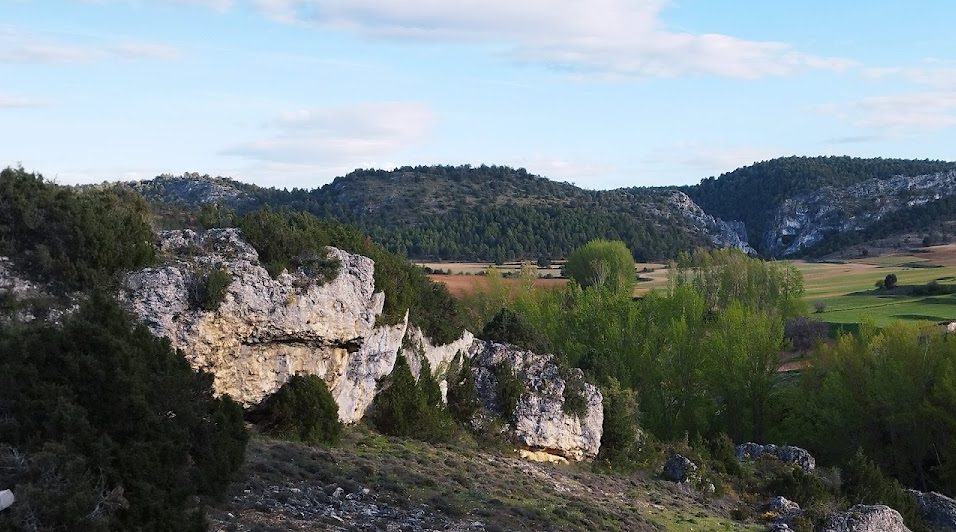
Castle of Arbeteta occupies a rocky position above the ravine formed by the Rambla stream. The fortress has a quadrangular plan, a large tower, and an enclosing perimeter of approximately 120 metres. Stone, lime, and rubble masonry form its principal construction materials. Buildings were arranged along the perimeter walls around a central courtyard, creating an inward-facing layout within the fortified enclosure.
Defenses and later alterations
Moat and entrance
A moat surrounded the fortress, and a drawbridge provided the entrance. The narrow approach used today was formerly cut through so that water encircled the castle and access was possible only across the drawbridge. A postern, or small secondary gate, opens toward the ravine.
Southern keep
The keep, the principal defensive tower, stands in the southern part of the fortress and protected the entrance. Its low masonry and construction work are among the features associated with the castle’s Arab origin. The tower forms part of the defensive arrangement that controlled access to the enclosure.
Northern walls
The first Duke of Medinaceli carried out the castle’s major known reform, probably the only substantial alteration to the older building. Above the La Rambla ravine, the northern walls were fitted with large windows, lateral stone benches, and parapets pierced for firearms. A rough sentry box from the same reform survives with a similarly fortified gun port.
Courtyard cistern
A cistern carved directly into the rock survives in the floor of the central courtyard. Its position within the courtyard belongs to the internal arrangement of the buildings that once ran along the enclosing walls.