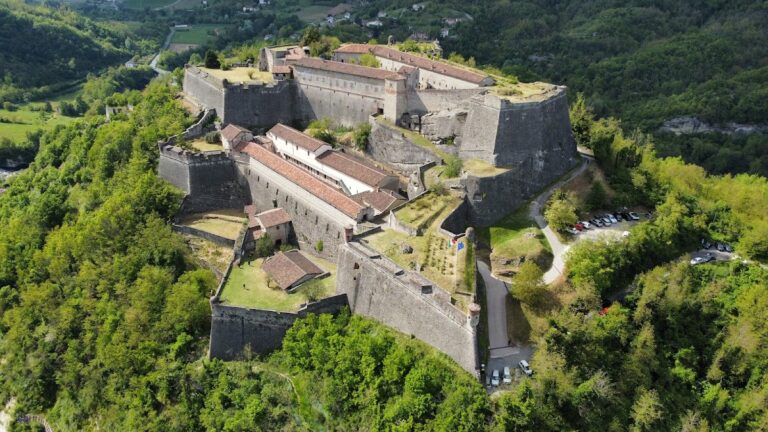
Castellar Ponzano Castle: A Fortification on the Scrivia Crossing


Site at a Glance
- Rating
- 4.5
- Popularity
- Very Low
- Country
- Italy
- Primary era
- Medieval
- External website
- Open
- Eras represented
- Medieval, Early Modern
- Civilizations
- Duchy of Milan, Holy Roman Empire, Spanish
- Site type
- Military
- Remains
- Castle
On this page15 sections
History
Castellar Ponzano Castle is a historic fortification in Castellar Ponzano, Italy, beside the Scrivia River and the Roman Via Postumia. The castle’s origins probably lie in the early medieval period, when a strongpoint was established to protect the aqueduct that carried water from the Scrivia to Tortona. The site occupied a strategically useful position on a road linking Aquileia with Genoa, and later became part of the network of fortified places around Tortona.
Roman and medieval origins
The area was already defended or garrisoned during the Roman period. The Via Postumia, begun in 148 BC, supported movement across northern Italy, while the nearby aqueduct supplied Tortona. The first fortification probably developed to guard this infrastructure, although the earliest certain references to the castle date from the thirteenth century.
The original structure was probably destroyed before 1200 after the Holy Roman Emperor Frederick I, known as Barbarossa, ordered the destruction of Tortona in 1155 during his campaigns in Italy. The castle was rebuilt and restored from the thirteenth century onward. Thirteenth-century documents refer to a fortified place below the settlement, while other records associate the property with the noble Ponzano family, a branch of the older Frankish Manfredingi family.
The Ponzano jurisdiction extended across the Scrivia to its left bank, where the Manuello mill stood. The mill had initially belonged to the bishops of Tortona before being assigned to the Ponzano family’s fief. Control of this installation encouraged the family to strengthen the castle and its related structures.
The Ponzano family and Visconti rule
In 1365, Emanuele Ponzano, serving as vicar general of Galeazzo II Visconti, received a noble diploma from Emperor Charles IV and the title of count. He also gained the right to draw water from any watercourse within the municipality of Tortona for irrigation and mill use. These privileges reinforced the family’s authority over the castle’s surrounding territory and its water resources.
The family’s position was challenged in March 1429, when Giacomo Visconti, lord of Tortona, ordered the Manuello mill and the Ponzano tower to be bombarded because he regarded the Ponzanos as rebellious. The family surrendered the tower to Tomaso de’ Gentili and ended the dispute by swearing loyalty to the duke. The settlement continued to be known as Castellar Ponzano in 1462.
A stone slab in the inner courtyard bears a profile resembling Dante and several esoteric symbols. Dante Alighieri may have passed the castle between 1309 and 1310 while travelling along the Via Romera toward Paris, but the possibility remains unconfirmed.
The Balbi period and sixteenth-century warfare
By the census of 1541, the castle was the residence of Galeazzo Balbi, who became commissioner of Tortona in 1543. He probably lived there to control water flowing south toward the city. Balbi supported the Sforza dynasty, which ruled the Duchy of Milan, and consequently aligned himself with the Habsburgs in their contest with French influence. He later became the castle’s owner, replacing the Ponzano family, whose political allegiance lay with the opposing French and Guelph sides.
After the death of Francesco II, the last Sforza ruler, the territory around Tortona became involved in the Franco-Habsburg struggle for control of Milan. In early June 1544, French-aligned troops advanced south toward Serravalle. Spanish cavalry were stationed at Tortona, while an Italian contingent occupied the castle and was later joined there by Spanish troops. The Spanish forces drove the French back across the Scrivia near Castellar Ponzano.
Under the Balbi family, the castle was extensively renovated and enlarged. A new residential section was built against the northern perimeter wall, and other additions altered the medieval complex. The family’s fortunes declined during the middle of the seventeenth century. A French attack in 1642 was followed by serious deterioration of the castle.
Later ownership and changing strategic importance
In 1654, the noble brothers Nicolò Maria and Biagio Busseti of Tortona purchased the castle. They carried out a partial restoration before transferring it to the Guasone family in 1715. The Guasones remained its formal owners from 1824 until the second half of the twentieth century.
The castle and the Guasone family were involved in a crucial episode during the Battle of Marengo in 1800, when Napoleon’s French forces fought the Austrian army near Alessandria. The local parish priest, Don Guasone, coordinated the passage of French troops across the Scrivia at the castle. This crossing allowed Lieutenant General Louis Desaix to reach the battlefield and surprise the Austrian forces, helping reverse the course of the battle.
After the Napoleonic Wars, the area around Tortona became more peaceful. Castellar Ponzano retained strategic value as a crossing point over the Scrivia until the middle of the nineteenth century. Industrial development and modern communications and transport then reduced its military importance, and the castle was used as a country residence. The Taroppio family acquired and restored it during the 1970s. Luca Sforzini became its owner in 2022.
Remains
The castle stands near the Scrivia River, the line of the Roman Via Postumia, and the aqueduct that supplied Tortona. Its surviving fabric combines traces of the earlier fortified enclosure with later residential additions. The perimeter was trapezoidal, with walkways along its walls and a corner tower that helped connect the defensive circuit with the principal building.
Medieval enclosure and courtyard
Cellar and perimeter walls
The only identified surviving traces of the original castle are in the central cellar, which once formed part of the northern side of the perimeter. The original southwest corner tower has disappeared, although walkways formerly extended from it along the enclosure walls. These remains preserve the outline of the earlier defensive arrangement.
Inner courtyard
Between the thirteenth and fifteenth centuries, the castle probably acquired an inner courtyard with a brick colonnade and semicircular arches. A walkway above the colonnade connected the principal building with the southwest corner tower. The courtyard’s cross vaults collapsed after the deterioration of the castle in the seventeenth century. Simple wooden roofs replaced them, removing the walkways that had linked the main structure with the tower.
Courtyard slab
The inner courtyard contains a stone slab with a profile resembling Dante, together with several esoteric symbols. Its imagery relates to the tradition that Dante may have passed through the area, although the proposed journey through the castle’s surroundings remains a possibility rather than a certainty.
Balbi-period additions
Northern residential wing
During the Balbi period, a new volume was constructed along the northern side against the existing perimeter wall. It served as a residence, and frescoes bearing the Balbi family’s heraldic emblem remain visible on the ground floor. The addition reflects the castle’s transformation from a primarily defensive complex into a residence with an expanded domestic function.
Southern loggia
A loggia with semicircular arches was also built along the southern side during the Balbi period. Two arches survive, extending from the main body of the castle to the external perimeter wall. Their position records the later enlargement of the complex and its connection between the central building and the outer enclosure.
Eastern entrance
An inscription bearing Galeazzo Balbi’s coat of arms is set at the former eastern entrance. It preserves a direct association between the surviving entrance area and the family that renovated and enlarged the castle in the sixteenth century.
Earlier portico and cellar
A wooden portico from an earlier period was transformed into a large cellar with brick vaults. The portico may have been built by Templar or Hospitaller knights and may have sheltered pilgrims, but both the attribution and the proposed use remain uncertain. The vaulted cellar nevertheless preserves evidence of a substantial alteration to an earlier part of the complex.