Château de Birac: A Medieval Fortified Château in France


Site at a Glance
- Rating
- 3.5
- Popularity
- Very Low
- Country
- France
- Primary era
- Medieval
- External website
- Open
- Eras represented
- Medieval
- Civilizations
- County of Toulouse, French
- Site type
- Military
- Remains
- Castle
On this page8 sections
History
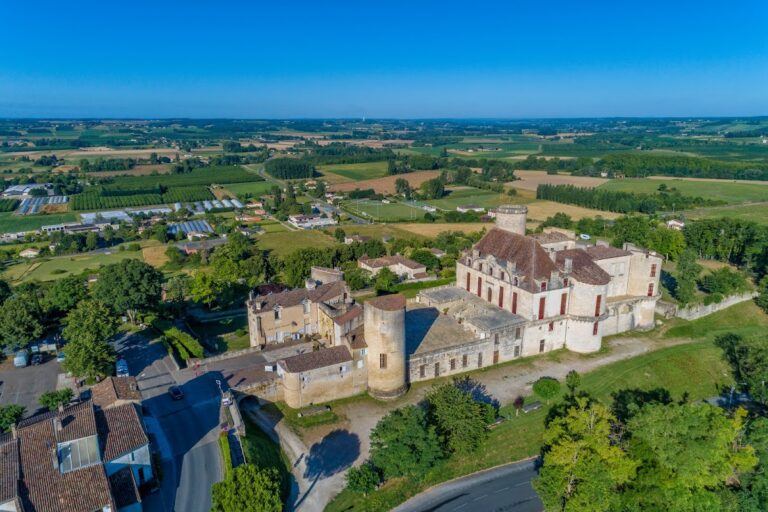
Château de Birac is a medieval fortified château in Birac-sur-Trec, France, rebuilt during the first half of the sixteenth century and originally intended for defense. Its earliest recorded form was the castrum of Birac, a fortified settlement associated with a medieval lordship, mentioned in 1259 when Amanieu de Birac paid homage to the Count of Toulouse.
The medieval lordship
In 1259, control of the lordship was divided between the Birac and Pins, also written Piis, families. Guillaume-Raimond IV de Pins designated his son Anissant as heir to the castles of Birac and Verteuil. Anissant died without children before 1297, and the inheritance then passed to his elder brother Barthélemi de Pins. Barthélemi also died without children in August 1297, after which their brother Sansanier de Pins inherited both estates.
Sansanier’s son, Anissant de Pins, was born around 1294 from his first marriage to Brunissende de Comminges d’Espagne. He became lord of Birac and several other estates, married Régine de Goth, daughter of Arnaud-Garcie de Goth, and died before 20 November 1388. After the death of his granddaughter Claire de Pins, the family’s possessions passed to the Albret-Verteuil family.
Rebuilding under the Lard family
The château was rebuilt during the first half of the sixteenth century by the Lard family, whose name also appears as Lart or Lars. Members associated with Birac included Bernard de Lard, lord of Birac, who died in 1437; Louis, or Loys, de Lard, lord of Birac and seneschal of Castres; Gabriel de Lard; Antoine de Lard de Galard, lord of Birac and Aubiac; and Joseph de Lard de Galard.
Marriage connected the Lard family with other noble houses. Louis de Lard married Marie de Noaillan in 1482 and later Catherine de Lustrac. Gabriel de Lard married Anne de Galard, heiress of Aubiac, in 1513, while Antoine de Lard de Galard married Renée de Coustin de Bourzolle in 1534. Joseph de Lard de Galard, lord of Birac and Aubiac, married Marie de Noailles on 21 February 1572.
Joseph’s daughter, Henrie-Renée de Lard and Galard, became lady of Birac and Aubiac. On 5 June 1596 she married Agésilas de Narbonne de Talairan. Their descendants included François de Narbonne, François II de Narbonne, and Jean François de Narbonne-Lara, who later became count and duke of Narbonne-Lara. Cardinal de Sourdis, a senior Roman Catholic cleric, spent the night of 11 to 12 September 1600 at the château.
Later ownership and protection
The lordship was seized from the Narbonne family in 1715. André d’Allenet purchased it on 23 August 1719, and the title later passed through his sister and heir, Adelaïde d’Allenet, to Léonard Guillaume de Brivazac, a king’s councillor in the Grand Chamber of the Parliament of Bordeaux. He held the title of Baron of Birac in Agenais, the historic province centred on Agen.
During the French Revolution, the lordship was seized in 1792 as the property of an émigré, a person who had left France for political or counter-revolutionary reasons. Its possessions were sold in 1794. Léon de Brivazac had taken part in the Quiberon expedition, a royalist military operation of 1795, and returned to France in 1802. He partially repurchased the property in 1805.
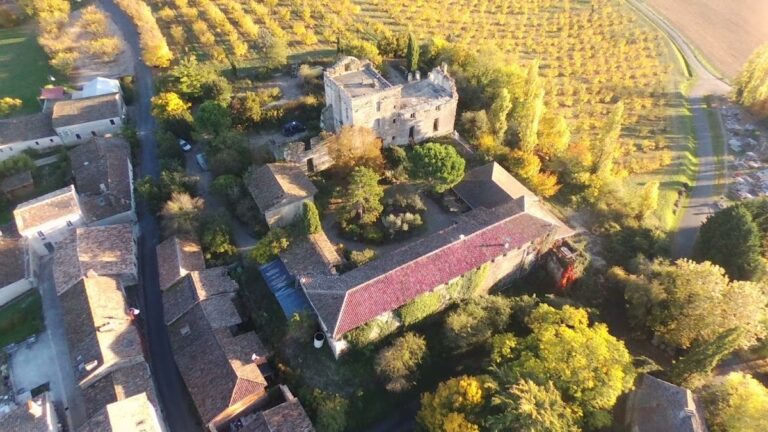
The château was already a ruin at the beginning of the twentieth century. The ruins as a whole, their subsoil, and the former dovecote belonging to the château’s former farm were listed as historic monuments on 9 December 1993. The property remains privately owned and is used as an enclosure for horses.
Remains
Château de Birac is situated in the hollow of a valley within the territory of Birac-sur-Trec. The surviving complex consists of the ruins of the fortified château as a whole and the archaeological ground beneath them, together with the former dovecote of the château’s farm.
Fortified château and farm remains
Château ruins
The château survives as a ruin of a medieval fortified building whose original purpose was defense. The remains are considered as a whole, along with their subsoil, preserving the physical and archaeological ground associated with the stronghold. The building’s major rebuilding took place during the first half of the sixteenth century, when the Lard family held Birac.
Former dovecote
The former dovecote belonged to the château’s former farm and forms part of the protected complex. It survives as an associated agricultural structure alongside the château ruins and subsoil.