Palace in Chałupki: A Baroque Residence on the Oder Frontier


Site at a Glance
- Rating
- 4.8
- Popularity
- Medium
- Country
- Poland
- Primary era
- Early Modern
- External website
- Open
- Eras represented
- Medieval, Early Modern
- Civilizations
- Habsburg, Holy Roman Empire
- Site type
- Domestic
- Remains
- Palace
On this page10 sections
History
Palace in Chałupki is a Baroque residence in Poland, transformed around 1682 from an older frontier castle that guarded a crossing of the Oder. Its history reflects the changing rule of Upper Silesia, from the dukes of Racibórz and Opava to the Habsburgs, Prussia, and the Polish state.
Medieval stronghold
The site originated in the thirteenth century, when wooden fortifications protected a ford across the Oder. They were probably built in 1247 by Henryk of Baruth, a knight from Upper Lusatia. The stronghold was known as Barutswerde, belonged to the dukes of Opole and Racibórz, and was granted to knights as a fief, meaning property held from a superior lord in return for service and allegiance.
By the end of the thirteenth century, the stronghold on the Oder’s right bank and the settlement of Bogumin on the left bank belonged to the Duchy of Racibórz. The first written reference dates from 1373, when Duke Jan I of Racibórz granted the castle, the town of Bogumin, and half of Zabełków to the knight Pasko. The castle was then a fortified crossing protected by a moat.
Ownership and defensive rebuilding
The castle changed hands several times among the dukes of Racibórz and Opava and their feudal holders. In 1422, Duke Jan II Żelazny of Racibórz sold Barutswerde to Bielik of Kornica. Margrave Jerzy Hohenzollern, a border ruler from the Hohenzollern dynasty, acquired it in 1523. He rebuilt the castle in response to the Ottoman threat, and the bastion defenses probably belong to this phase. Bastion fortifications used projecting angular structures to cover walls and approaches.
An urbarium from the beginning of the seventeenth century lists numerous farm and service buildings around the castle. An urbarium was a historical register of estates, obligations, and associated buildings, so the entry indicates that the stronghold had become the center of a wider landed complex.
Baroque transformation
The Thirty Years’ War, a European conflict fought from 1618 to 1648, caused the Hohenzollerns to lose their Upper Silesian possessions, including Bogumin and the castle. In 1623, the Habsburgs pledged Bogumin to the Henckel von Donnersmarck family, which then became the castle’s owner.
The Henckel von Donnersmarcks established the park around the residence. After inheriting Bogumin, Eliasz Andrzej Donnersmarck transformed the old frontier castle into a Baroque palace around 1682 while retaining elements of the earlier fortifications.
Division of Silesia and later owners
After the Silesian Wars, the eighteenth-century conflicts through which Prussia acquired most of Silesia, the division of Silesia in 1742 placed the palace under Prussian rule while Bogumin remained under Habsburg rule. The Lichnowsky family owned the palace from 1803. Salomon von Rothschild purchased it in 1846, and the Rothschild family retained ownership until 1936, when Nazi authorities transferred it to Baroness von Kirchen und Pancken, the widow of a general.
Polish state ownership and reuse
The Polish state took possession of the palace in 1945. The building then stood vacant for many years. Repair work began in the second half of the 1970s, when the property was owned by the Katowice Voivodeship Tourist Services Enterprise. A hotel opened in the palace in 1983. In 1993, ownership passed to the Krzyżanowice commune, a local-government unit, and from 1994 the property was leased to a private individual.
The palace is entered in the register of immovable monuments of the Silesian Voivodeship. An earlier registration dates from 1966, while the current register entry is dated 2020.
Remains
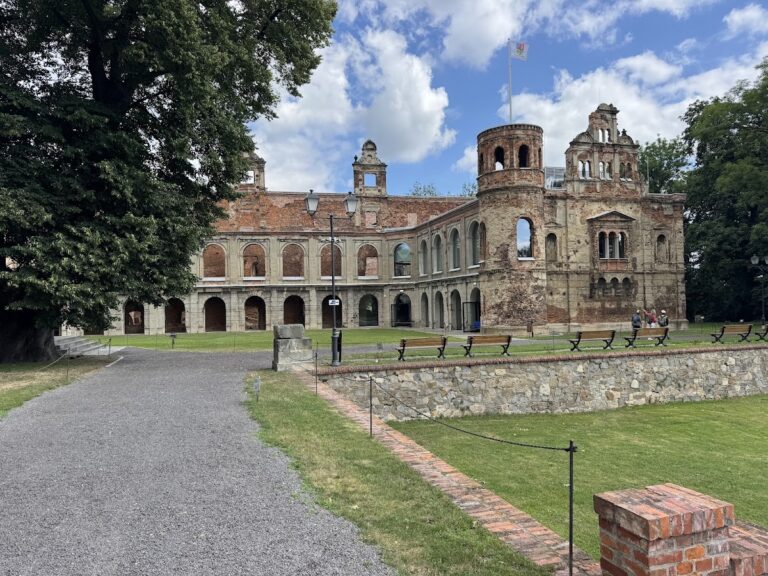
The surviving complex combines a rectangular Baroque palace, remnants of the medieval and early-modern frontier castle, and a surrounding park. It stands in Chałupki approximately 300 metres from the bridge over the Oder linking Poland and the Czech Republic. The building is currently used as a hotel, restaurant, and reception venue.
Palace building
The palace follows a rectangular plan and has a tower on its northwestern side. A mansard roof covers the building. This roof type has two slopes on each side, with the lower slope steeper than the upper one, creating additional roof space. The Baroque structure incorporates surviving parts of the earlier castle, and a coat of arms of the Rothschild family is positioned above the entrance.
Earlier fortifications
The medieval castle was enclosed by a moat and later strengthened with bastion fortifications. Relics of these earlier defensive works remain incorporated into the palace complex. Farm and service buildings stood around the castle by the beginning of the seventeenth century, forming part of the estate associated with the fortified residence.
Park
The park established by the Henckel von Donnersmarck family survives around the palace. It contains 26 species of trees and shrubs, preserving an important element of the residence’s Baroque-era setting.
Nearby sites