Castle Hill: Medieval Fortification at Mere



Site at a Glance
- Rating
- 4.6
- Popularity
- Low
- Country
- United Kingdom
- Primary era
- Medieval
- Eras represented
- Medieval
- Civilizations
- English
- Site type
- Military
- Remains
- Castle
On this page7 sections
History
Castle Hill, also called Mere Castle, is the ruin of a medieval fortification above Mere in Wiltshire, England. Richard, Earl of Cornwall, began building the stone castle in 1253, during the expansion of Mere as a planned settlement. The castle formed part of the development of a small early 13th-century community that later prospered through the wool trade and, subsequently, the linen trade.
Foundation and early development
Mere was a relatively unimportant settlement when Richard acquired its manor in 1243. Richard, the brother of King Henry III and one of the wealthiest English nobles of the 13th century, began constructing the castle ten years later. Its creation coincided with the establishment of an unofficial market and the planned growth of the settlement below.
The castle was renovated around 1300, possibly because of the threat of rebellion in England at that time. Richard’s son Edmund inherited the property, but after Edmund’s death it reverted to the Crown. Edward II then granted it to his royal favourite Piers Gaveston, whom the king had made Earl of Cornwall. After Edward II and Gaveston lost power in 1327, John, Edward II’s second son, took possession as the new Earl of Cornwall. Edward III later reacquired the castle, which thereafter became a permanent part of the Duchy of Cornwall, the hereditary estate associated with the holder of the title Duke of Cornwall.
Decline and later history
The castle declined and was abandoned during the 14th century. In 1398, Richard II ordered the lead from its roofs to be removed for reuse at Portchester Castle in Hampshire. By 1660, the castle’s stonework appears to have been dismantled, and the material was apparently reused in building work in the settlement below during the 18th century.
Excavations took place at Castle Hill in 1887 under T. H. Baker and C. N. Wyld, although most of their results were later lost. In the 21st century, the site is protected as a scheduled monument, a historic or archaeological place protected by law because of its national importance. It is owned by the Duchy of Cornwall and leased to the local parish council. A ceremony is held at the site each Easter.
Remains
Hilltop earthworks and defenses
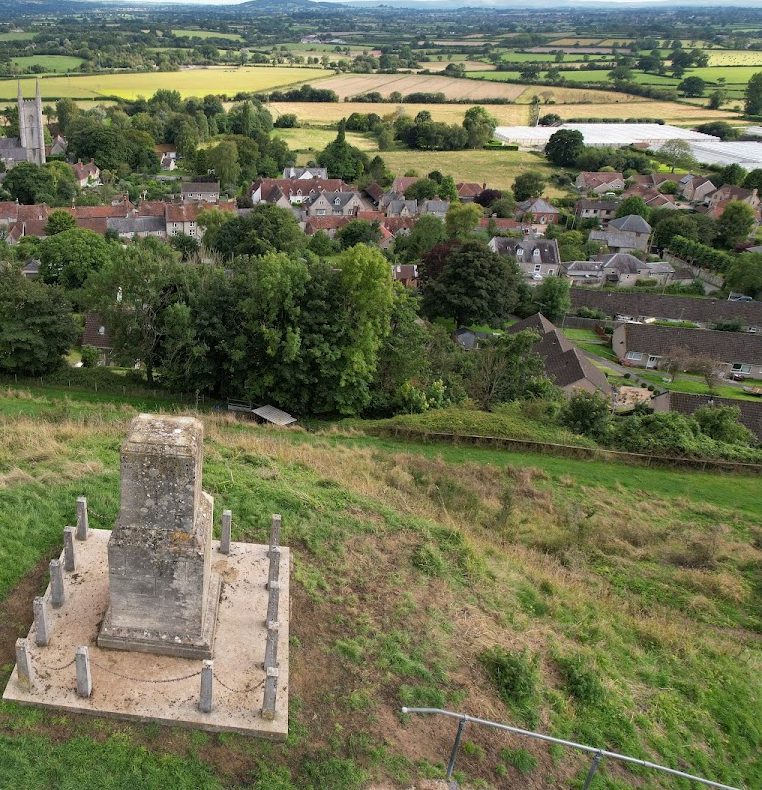
The castle occupied Long Hill, a chalk ridge overlooking Mere. The summit was flattened and its slopes were scarped, meaning that the ground was cut into steeper faces to strengthen the position. A ditch about 5 metres deep ran along the western side. These reshaped banks, slopes, and ditches form the surviving earthworks of the castle.
Enclosure and entrances
Documentary evidence describes a rectangular stone-built enclosure with six towers. The entrance was probably on the western side, while a possible road approached by ascending the southern slope of the hill. The complex included both an inner gate and an outer gate, creating a layered entrance arrangement. The castle may have resembled a smaller version of Framlingham Castle, the medieval stronghold in Suffolk.
Internal buildings and surviving features
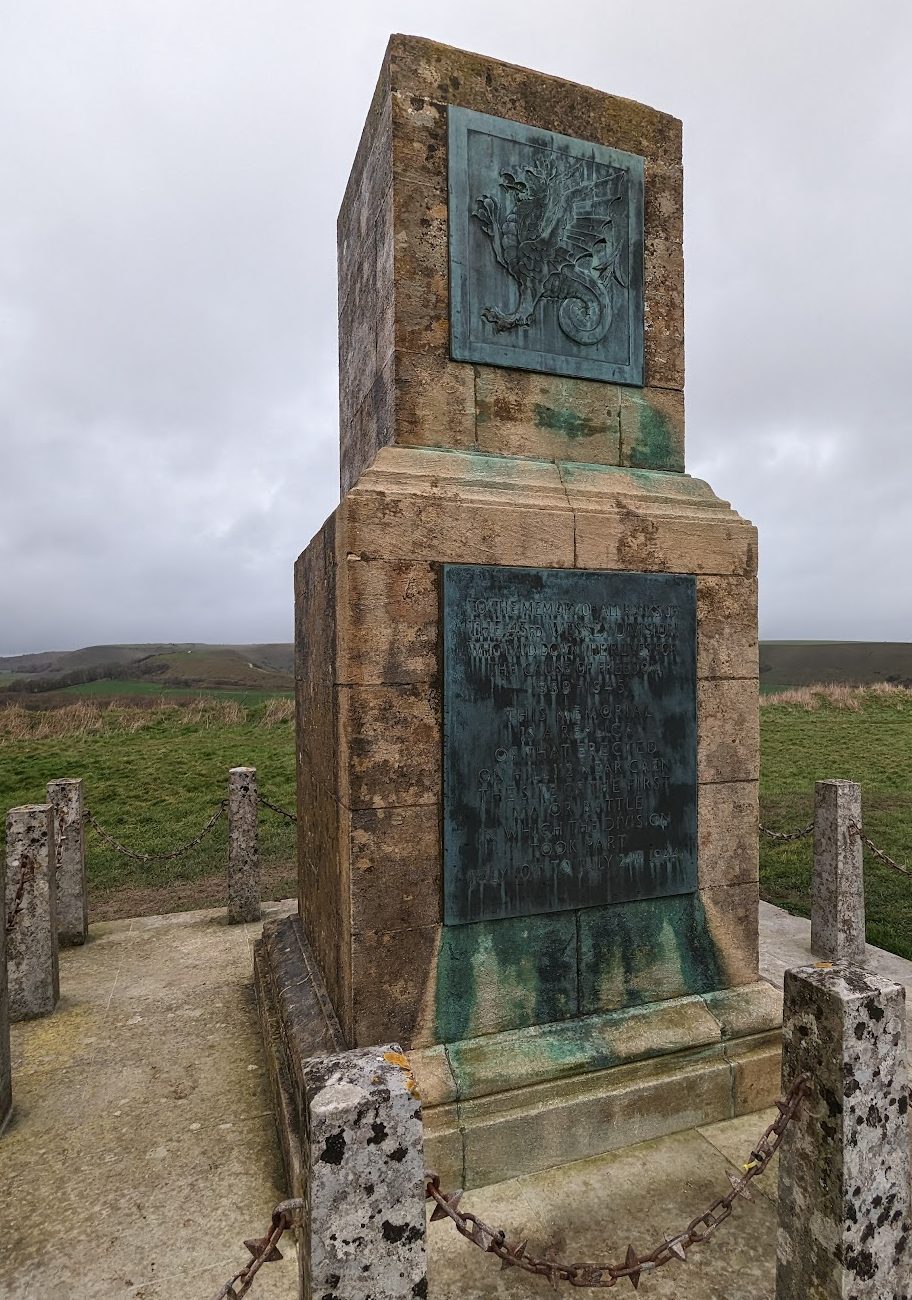
The enclosure contained internal buildings, a deep well, and a chapel. The castle’s former masonry and metalwork were removed after its abandonment, leaving the earthworks as the principal physical remains. A flagpole and a memorial to the 43rd (Wessex) Infantry Division, a British Army formation associated with the historic region of Wessex, now stand on the castle site.