Castillo-Palacio: A Muslim-Era Fortress and Palace in Estepa, Spain


Site at a Glance
- Rating
- 4.4
- Popularity
- Very Low
- Country
- Spain
- Primary era
- Medieval
- External website
- Open
- Eras represented
- Medieval, Early Modern
- Civilizations
- Almohad, Umayyad
- Site type
- Military
- Remains
- Castle
On this page6 sections
History
Castillo-Palacio is a ruined Muslim-era defensive complex in Estepa, Spain, built on the hill of ancient Ostippo. Its walls enclosed the central walled city, or madina, of the medieval Islamic settlement, while an alcázar, a fortified palace or citadel, defended the weaker side of the hilltop and its entrance. The first walls were constructed around the tenth century, and the complex was reformed in the twelfth century after the Almohad invasion. The Almohads were a North African Islamic dynasty and religious movement that ruled parts of the Iberian Peninsula during that period.
Islamic Origins and Christian Conquest
Most of the extensive enclosure around the hill is Islamic in origin, although some sections may connect with earlier defensive systems. After Ferdinand III conquered Estepa in 1240, the town and castle passed to the Crown of Castile and León. In 1267, Alfonso X donated them to the Military Order of Santiago, a Christian military-religious order involved in the campaigns that expanded Christian rule in Muslim-ruled Iberia.
The order rebuilt and strengthened the complex between the thirteenth and sixteenth centuries. Its work included repairs to the enclosing walls and additional reinforcement of the alcázar. Estepa served as an advanced position facing the Kingdom of Granada, the final major Muslim polity in the Iberian Peninsula, and the town was attacked several times. In 1462, Muley Abulhacen, a Nasrid ruler of Granada, captured the suburb, but Rodrigo Ponce de León, a Castilian nobleman and military commander, recovered it soon afterward.
Palace, Abandonment, and Protection
After the completion of the Reconquista, the long process by which Christian kingdoms expanded into Muslim-ruled Iberia, Estepa lost its strategic importance. In 1543, Philip II sold the castle and town to Adán Centurión. His son and successor, Marco Centurión, became the first Marquis of Estepa.
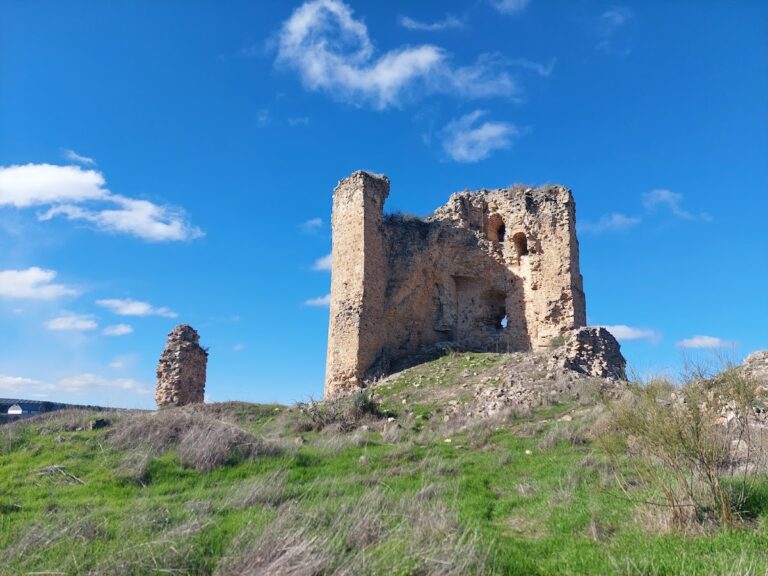
Under the lords of Estepa, the castle-alcázar was converted into a palace and underwent a radical change of function. The Palace-Alcázar was abandoned in the mid-eighteenth century. The gradual depopulation of the madina, together with the increasing importance of its suburb, led to the disappearance of the Santa María quarter. The abandonment of the palace contributed to the decline of the settlement, and the rest of the enclosure subsequently deteriorated as its military value disappeared.
Construction and alteration of the complex extended from approximately the tenth to the eighteenth century. Castillo-Palacio has been protected as a Spanish Historic Heritage monument and classified as a Property of Cultural Interest since 1985.
Remains
The complex occupies the highest point of Estepa, an elevated position selected for defensive observation. Its surviving remains consist of the extensive circuit around the former Islamic madina and the alcázar within it. The medieval hilltop has been altered by the later construction of the Convents of Santa Clara and San Francisco, followed by a cemetery, while the former castle-alcázar survives in ruins.
The Enclosing Walls
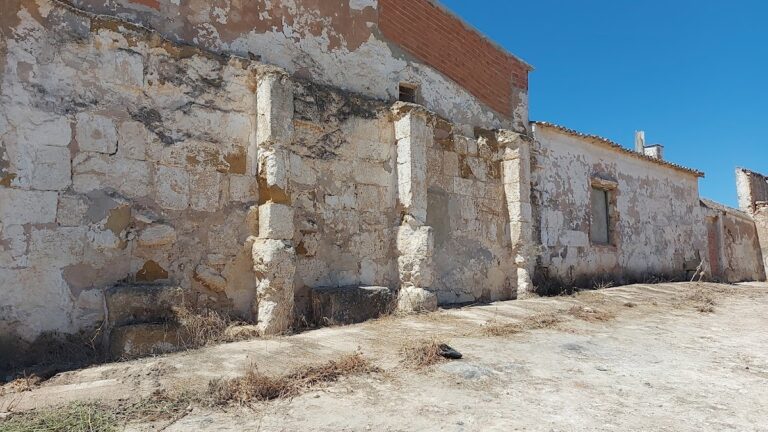
The enclosing walls form a broad circuit around the hill and are predominantly Islamic in origin. Their earliest construction belongs to around the tenth century, with reforms carried out in the twelfth century. Some sections may preserve connections with earlier defensive arrangements. Limited medieval wall sections and surviving towers remain within the complex, alongside the Major Parish Church of Santa María.
The Alcázar and Defensive Works
The alcázar occupied the part of the settlement that protected the weaker side of the hilltop and the entrance. The Military Order of Santiago particularly strengthened this inner fortress and the surrounding defenses during its rebuilding phase between the thirteenth and sixteenth centuries. The defensive works included a tower of homage, the principal fortified tower of a castle, and the system protecting the Gate of the Town. Later conversion into a palace changed the function of the castle-alcázar, which now survives as a ruin.