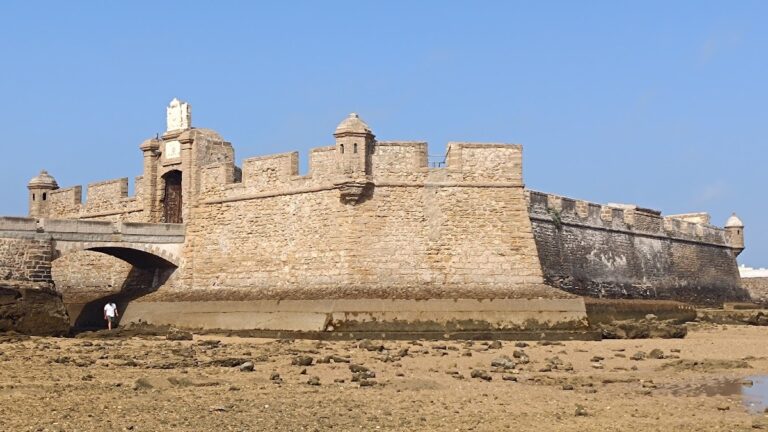
Castillo de San Lorenzo de Puntales: Fortress Guarding the Inner Bay of Cádiz

Site at a Glance
- Rating
- 4.2
- Popularity
- Very Low
- Country
- Spain
- Primary era
- Early Modern
- External website
- Open
- Eras represented
- Early Modern
- Civilizations
- Spanish
- Site type
- Military
- Remains
- Fort
On this page10 sections
History
Castillo de San Lorenzo de Puntales is a Spanish fortress in Cádiz, built and repeatedly strengthened as part of the defenses controlling the entrance to the inner Bay of Cádiz. Its present form developed from a small sixteenth-century artillery work into an Italianate fortification whose principal purpose was to protect access to the Arsenal of La Carraca.
Origins and destruction in 1596
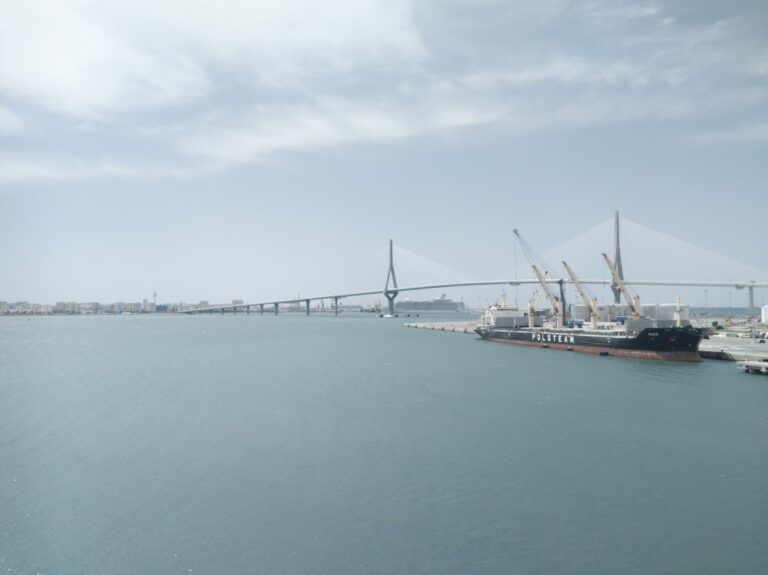
The fortress stands at El Puntal, a narrow point of land that restricts passage into the inner bay. In 1554, the military engineer Juan Bautista Calvi argued that the position required protection because it was especially exposed to attack from the mainland. By 1588, a small fort occupied the site. It consisted of an artillery tower armed with five cannons.
That early fortification was destroyed during the capture of Cádiz in 1596. An Anglo-Dutch fleet of more than 150 ships and about 15,000 men entered the bay under Robert Devereux, 2nd Earl of Essex, an English military commander and courtier. Cádiz was taken, and the occupation lasted 15 days. The city was extensively looted and burned, while the fort at El Puntal was completely destroyed.
Rebuilding under Philip II
In 1598, Philip II, king of Spain from 1556 to 1598, ordered the rebuilding of Cádiz and the strengthening of its defenses. Work on the new fortress at El Puntal began that year under Cristóbal de Rojas, the military engineer also responsible for Santa Catalina Castle. Alonso de Vandelvira later continued the project and altered its design.
Construction advanced slowly. The piles had been installed by 1609, and the foundations were complete by 1612. De Rojas died in 1616 before the fortress was finished. Vandelvira adopted a concrete-based building method rather than traditional masonry because it gave the defenses greater protection against cannon fire.
Expansion and military role
Further changes followed in 1634 under Luis Bravo de Acuña, a military engineer associated with Spanish fortification work. During the first half of the eighteenth century, the landward front was built under the direction of the Marquis of Verboom, Jorge Próspero de Verboom. A battery aimed toward the channel was later planned as part of the continuing effort to control the approach.
Castillo de San Lorenzo de Puntales operated within a wider defensive system that included San Luis Castle and Matagorda Castle. Its guns helped control the entrance to the bay and the passage toward the Arsenal of La Carraca. During conflicts in the nineteenth century, the fortress was reconstructed again, with the work completed in 1863. No comparably important alteration has taken place since that reconstruction.
Protection and present use
The castle is owned by the Spanish Ministry of Defence and serves as a facility of the Spanish Navy, with restricted access. It received the general protection established by the decree of 22 April 1949 and by Spain’s Historical Heritage Law 16/1985. In 1985 it was declared a Property of Cultural Interest as a monument. It received special recognition among the castles of Andalusia in 1993 and forms part of the historic site associated with the Cortes, Spain’s representative legislative assemblies, and the Constitution of 1812, adopted by the Cortes assembled in Cádiz during the Peninsular War.
Remains
Fortified layout
The fortress has an oval plan and follows an Italianate fortification design. Its defenses were arranged around two demi-bastions, projecting sections with one principal face and a flank. Flanks, ditches, and curtain walls, the defensive wall sections linking projecting defenses, completed the outer system. A drawbridge isolated the fortress and formed the controlled entrance.
Barleta battery
The waterside or left-hand part of the fortress was occupied by the Barleta battery, an open artillery position intended to direct fire toward a designated approach. It could accommodate up to 14 cannons and several mortars. Its fire worked with the guns of Matagorda Castle on the opposite side of the bay, producing crossfire over the passage leading toward the Arsenal of La Carraca and the inner bay.
Internal service buildings
Within the fortification stood a group of simple masonry buildings and service spaces supporting its military function. These included powder-storage facilities, warehouses, accommodation for personnel, a chapel, a guardhouse, workshops, and kitchens. Together, they provided the spaces needed for storing weapons and supplies, housing the garrison, worship, supervision, maintenance, and food preparation.
Paired electricity towers
A tower belonging to the Sevillana Electricity Company has stood in front of the castle since the mid-twentieth century. It forms a pair with a corresponding tower at Matagorda on the opposite side of the bay, near the defensive position whose guns once worked with those at El Puntal.