Castillo de la Estrella: A Medieval Fortress in Málaga, Spain


Site at a Glance
- Rating
- 4.4
- Popularity
- Low
- Country
- Spain
- Primary era
- Medieval
- External website
- Open
- Eras represented
- Medieval
- Civilizations
- Almohad, Crown of Castile
- Site type
- Military
- Remains
- Castle
On this page11 sections
History
Castillo de la Estrella, also called Castillo de Teba, is a medieval fortress in Teba, Spain, whose chronology reaches back to the Almohad period of al-Andalus in the twelfth and thirteenth centuries. Al-Andalus was the name used for Muslim-ruled territories in the Iberian Peninsula, and the castle is classified as having Nasrid architectural style. Built on a site with evidence of an earlier Neolithic settlement, it later became a frontier stronghold during the Christian conquest of the region.
Early settlement and Roman-era traditions
Archaeological remains indicate that people occupied the hill during the Neolithic period. A later tradition, recorded by the historian Henriquez de Jorquera, attributed the settlement’s origins to Phocaean Greeks, who were said to have established Ategua or Attega around 2240 BC. The Phocaeans came from the Greek city of Phocaea and founded colonies around the western Mediterranean. This early identification and date belong to historical tradition rather than a secure archaeological chronology.
During the conflicts between Carthage and Rome, the settlement was reportedly known as Ostipo and has been identified with a place mentioned in the Antonine Itinerary, an ancient Roman compilation of routes and stopping places. Julius Caesar was said to have recorded its surrender. After the settlement moved to its present location, the Arabic names Ostibba and Ostebba became associated with the later name Teba.
Almohad and Christian frontier fortress
The castle became an important defensive position during the rebellion of Omar ben Hafsún. It formed a second defensive line with the fortresses of Cañete, Casarabonela, and Tolox. Its surviving keep and the remains of its original church belong to the later Christian period, while the wider fortress preserves a chronology reaching back to Almohad rule.
During the campaigns of Alfonso XI, king of Castile and León, the fortress passed into Christian control. Its conquest is dated to 1328, while the Battle of Teba in 1330 is also described as the operation through which Christian forces ultimately captured it. The castle was then granted to the Order of Santiago, a medieval military-religious order that defended Christian territories and took part in the Iberian conquests.
The Battle of Teba formed part of a Christian offensive against the Nasrid frontier castles of Cañete, Teba, Ardales, and Turón. The Nasrids ruled the Emirate of Granada until 1492. Alfonso XI’s army was assisted by Scottish knights led by Sir James Douglas, who had been charged by Robert I of Scotland with carrying the king’s embalmed heart to the Holy Land. Douglas and most of his men were surrounded and killed by the army of the general Ozmín. A Christian counterattack followed and resulted in the capture of the castle.
The fortress faced another Nasrid attack in 1407. When the frontier moved farther south, Teba ceased to serve as a border stronghold, although the castle regained strategic value in 1485 during the Catholic Monarchs’ conquest of Ronda. Isabella I of Castile and Ferdinand II of Aragon are known as the Catholic Monarchs.
Lordship, abandonment, and protection
In the fifteenth century, Juan Ramírez de Guzmán, son of the Grand Commander of the Order of Calatrava, acquired the town between 1458 and 1460. The Order of Calatrava was a military-religious order with territorial and military functions comparable to those of the Order of Santiago. Juan’s lordship consolidated the Teba territorial lordship, which included Almargen, Peñarrubia, and Campillos.
Juan Ramírez de Guzmán was succeeded by his son, Diego Ramírez de Guzmán, who received the title of Count of Teba through a royal charter issued by Charles V in October 1522. Charles V was the Habsburg ruler who was king of Castile and Aragon and Holy Roman Emperor. The castle later belonged to the Guzmán and Portocarrero families. From the reign of Philip III onward, the Counts of Teba also held the title of Counts of Montijo, and ownership subsequently passed to descendants of Eugenia de Montijo.
After the Cádiz Cortes abolished exclusive noble privileges and incorporated jurisdictional lordships into the nation, the noble owners moved their residence to the court. Jurisdictional lordships were noble domains in which the lord exercised specified governmental and judicial authority. A prolonged period of looting followed. Masonry was removed even from the keep, its foundations were undermined, and abandonment intensified during the modern period.
In 1931, the castle was declared a National Monument of Historical and Artistic Interest. It received Asset of Cultural Interest status in 1949 under the generic protection established by the decree of 22 April that year, and it is also protected by Spain’s Historical Heritage Law 16/1985. In the same year, Juan Temboury prepared a report with a ground-plan sketch. The drawing shows one more tower than survives in the present layout, providing evidence of a change in the fortress’s physical form.
Remains
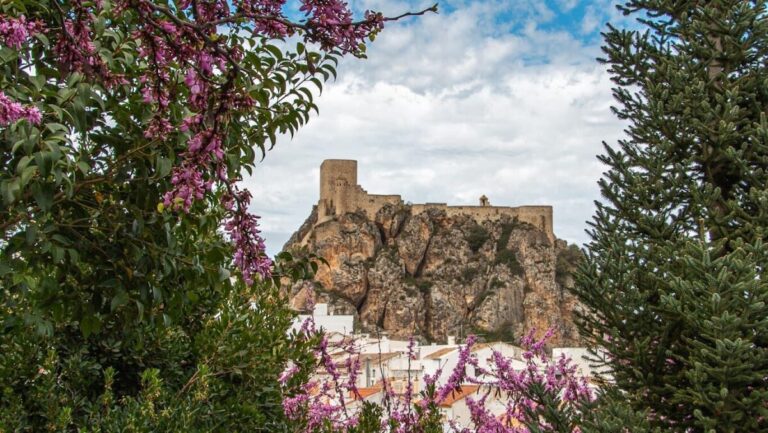
Castillo de la Estrella occupies approximately 25,000 square metres on a height of about 600 metres above sea level. Its position commands views across the Antequera plain and toward the entrance to the Serranía de Ronda. The fortress is organized as two walled enclosures, with the space between them forming the original settlement area of Teba. It was built to defend dispersed communities and farmsteads around the Guadalteba and Venta rivers.
Walls, towers, and entrances
Outer defenses
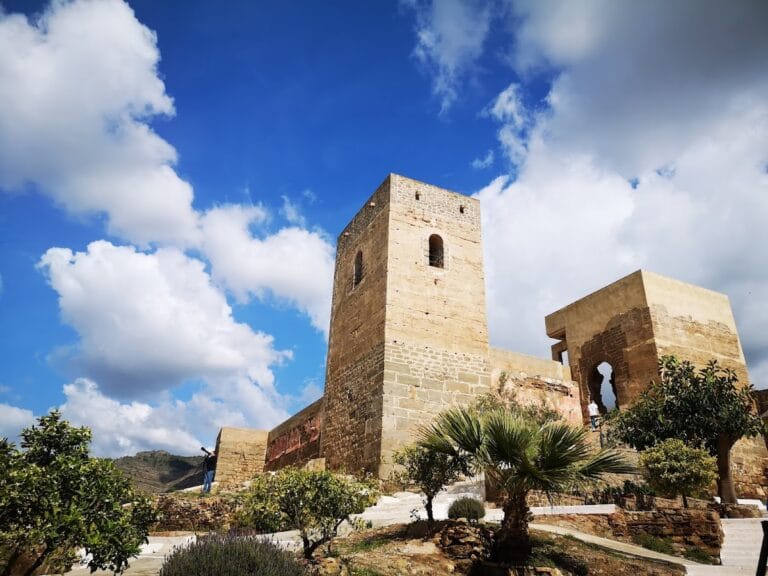
The northeastern defenses form a barbican, an advanced fortified enclosure protecting an entrance or part of a larger fortress. The fortifications include sixteen square towers, one circular tower, and one octagonal albarrana tower. An albarrana tower projects beyond the main wall and is connected to it for defense. Three entrance gates provide access through the walled complex.
Inner enclosure and water supply
The fortress also contained a large alcázar, a fortified palace or royal residence, together with at least seven cisterns. These elements occupied the enclosed complex alongside the defensive structures and helped organize the settlement and stronghold within the two lines of walls.
Christian buildings
Keep
The keep, the principal fortified tower of a castle, is a Christian-period feature within the older fortress. Looting removed masonry from the structure and weakened its foundations. Its surviving fabric therefore reflects both its role in the Christian-period stronghold and the later damage caused by the removal of building material.
Original church
The remains of the original church also belong to the Christian period. The building has been restored and contains the interpretation centre A Crusade in Guadalteba, devoted to the Battle of Teba. Its surviving presence adds a religious building to the military and residential elements preserved inside the fortress.