Castelvecchio Bridge: A Fortified Medieval Crossing in Verona
Site at a Glance
- Popularity
- High
- Country
- Italy
- Primary era
- Medieval
- Eras represented
- Medieval
- Civilizations
- Holy Roman Empire
- Site type
- Military
- Remains
- Fortified Bridge
On this page9 sections
History
Construction and purpose
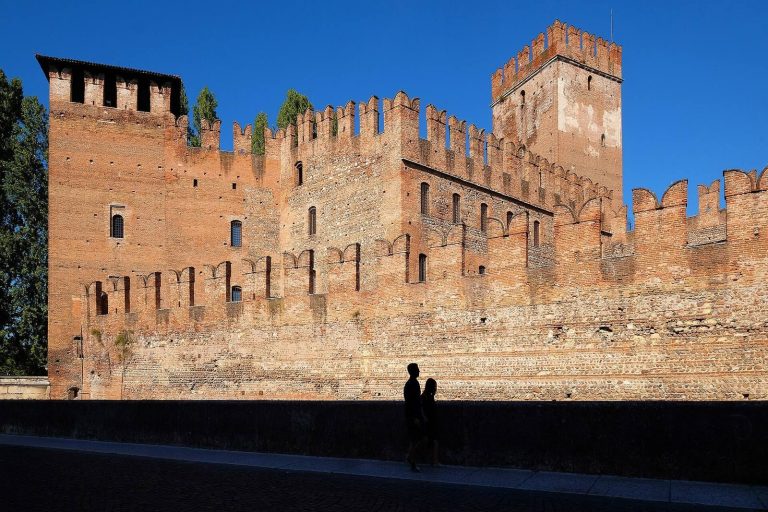
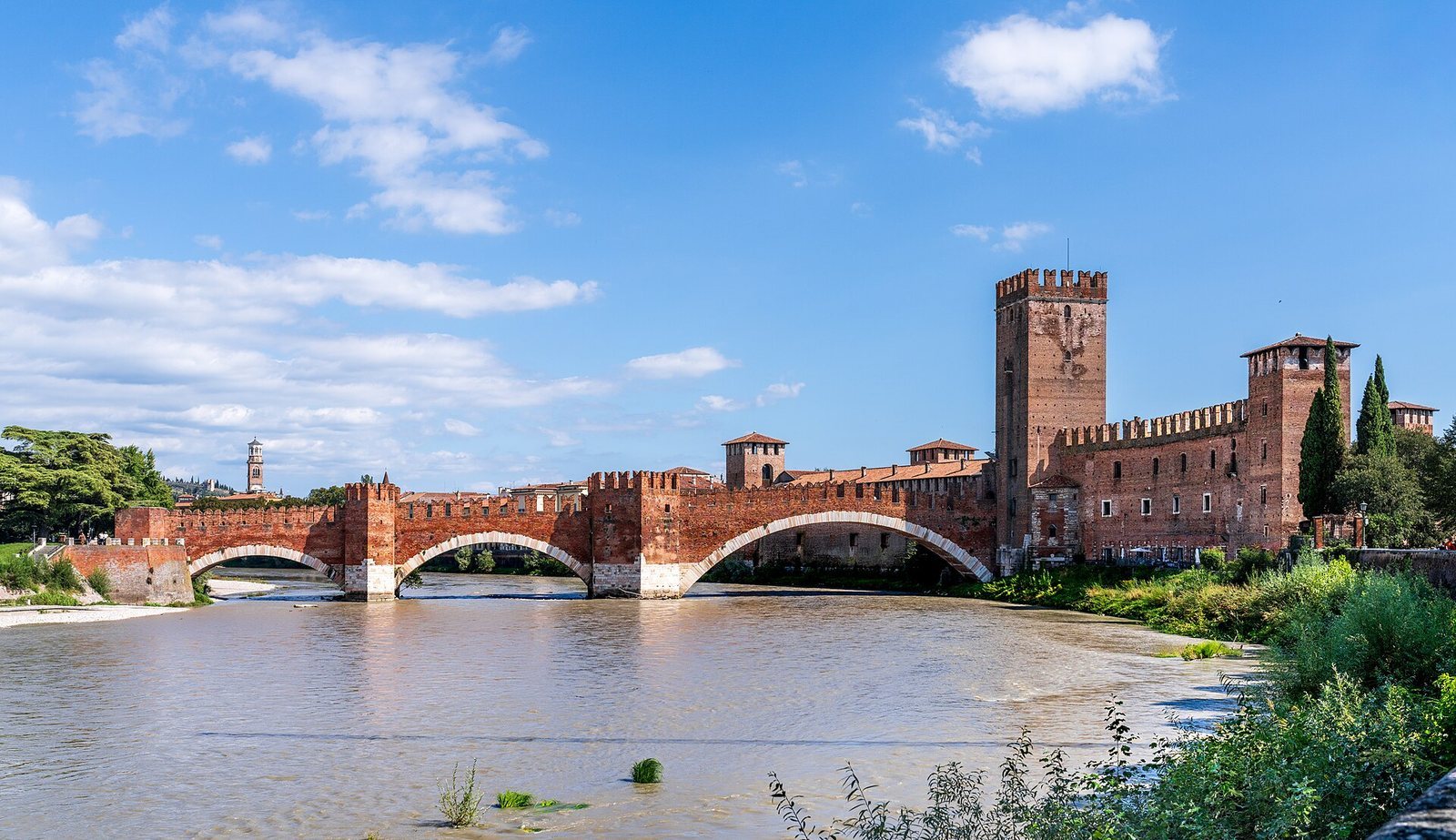
Castelvecchio Bridge is a fortified medieval crossing over the Adige River in Verona, Italy, built as part of Castelvecchio, the city’s medieval castle. It was probably constructed between 1354 and 1356 under Cangrande II della Scala, a ruler of the Scaliger family, which governed Verona during the medieval period. The bridge provided a protected route for escape toward Tyrol and, beyond it, Germany, should a hostile faction rise against Cangrande in Verona. It also served as a fortified entrance for people approaching the city from the north.
The bridge’s original designer and builder are not known with certainty. A document dated 1495 appears to name Guglielmo Bevilacqua as its author, while another proposal credits Giovanni da Ferrara and Giacomo da Gozo jointly, citing similarities to the Ponte delle Navi. Later legends linked Bevilacqua to a sword believed to have belonged to Saint Martin of Tours, a Christian bishop venerated as a saint. In the story, Cangrande gave him the sword after it had been kept in a church inside the castle. Another tale says the designer kept a horse ready in case the bridge failed.
Military use and later changes
For several centuries the bridge was reserved for military passage. The castle’s towers had been adapted to carry cannon batteries used during the Veronese Easter of 1797. In 1802, French troops occupying Verona after the 1801 Treaty of Lunéville, a European peace treaty, partly dismantled the tower at the countryside end and removed the battlements as they adapted the defenses for artillery. After Verona became part of Italy and military restrictions gradually eased, civilian passage was allowed toward the end of the nineteenth century.
Destruction and reconstruction
On April 24, 1945, retreating German troops destroyed Castelvecchio Bridge along with Verona’s other bridges, including the ancient Ponte Pietra. Public support favored rebuilding it, in part because substantial portions had survived the explosions. The Verona Superintendency, a state office responsible for protecting heritage, chose to restore the bridge’s former appearance rather than replace it with a new design.
Work began in late 1945 with the clearing of debris from the riverbed. A further stage started in 1949, and reconstruction was completed on July 20, 1951. The project returned recovered stonework to its original positions and used replacement materials chosen to match the surviving medieval fabric.
Remains
Overall layout
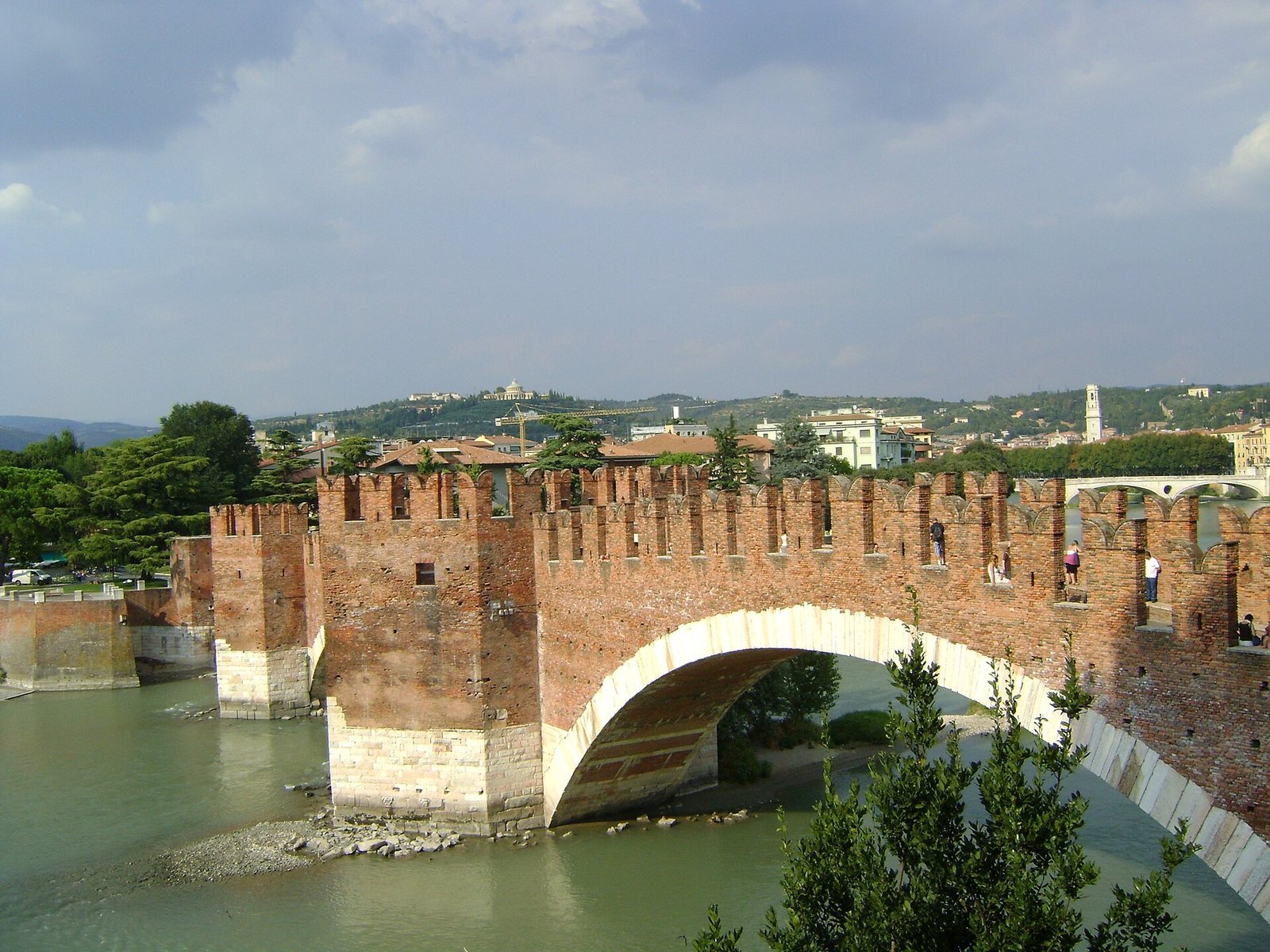
The bridge crosses the Adige as a fortified structure about 120 m long and 6 m wide. Its three arches are unequal in span, and two substantial piers rise from the river to support them. Stone forms the bridge’s lower portions, including the arch rings and pier bases, while red brick makes up the upper structure.
Arches and piers
The arches span 48.69 m, 29.15 m, and 24.11 m. The largest span was a record for its period. Each of the two massive piers has five sides, with a beak-shaped projection facing upstream to help the water flow around it. Their different sizes and the unequal arch spans accommodated changing currents in this bend of the river, where sudden floods could occur. The larger pier measures 19.40 by 12.10 m, and the smaller 17.30 by 6.30 m. The larger pier also carries fifteen Corinthian capitals, the ornate tops of columns, and fragments of Roman relief carvings.
Defensive features
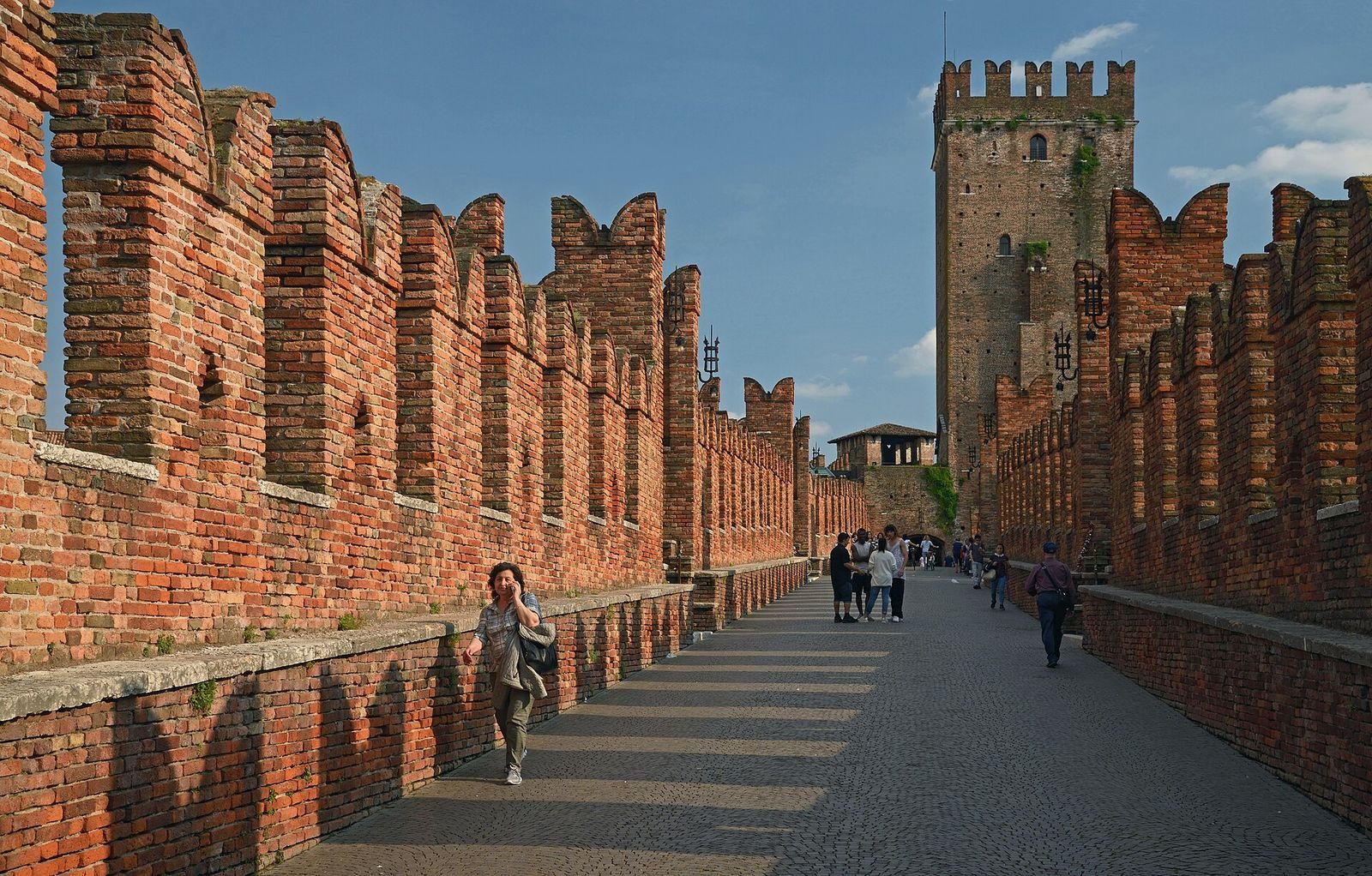
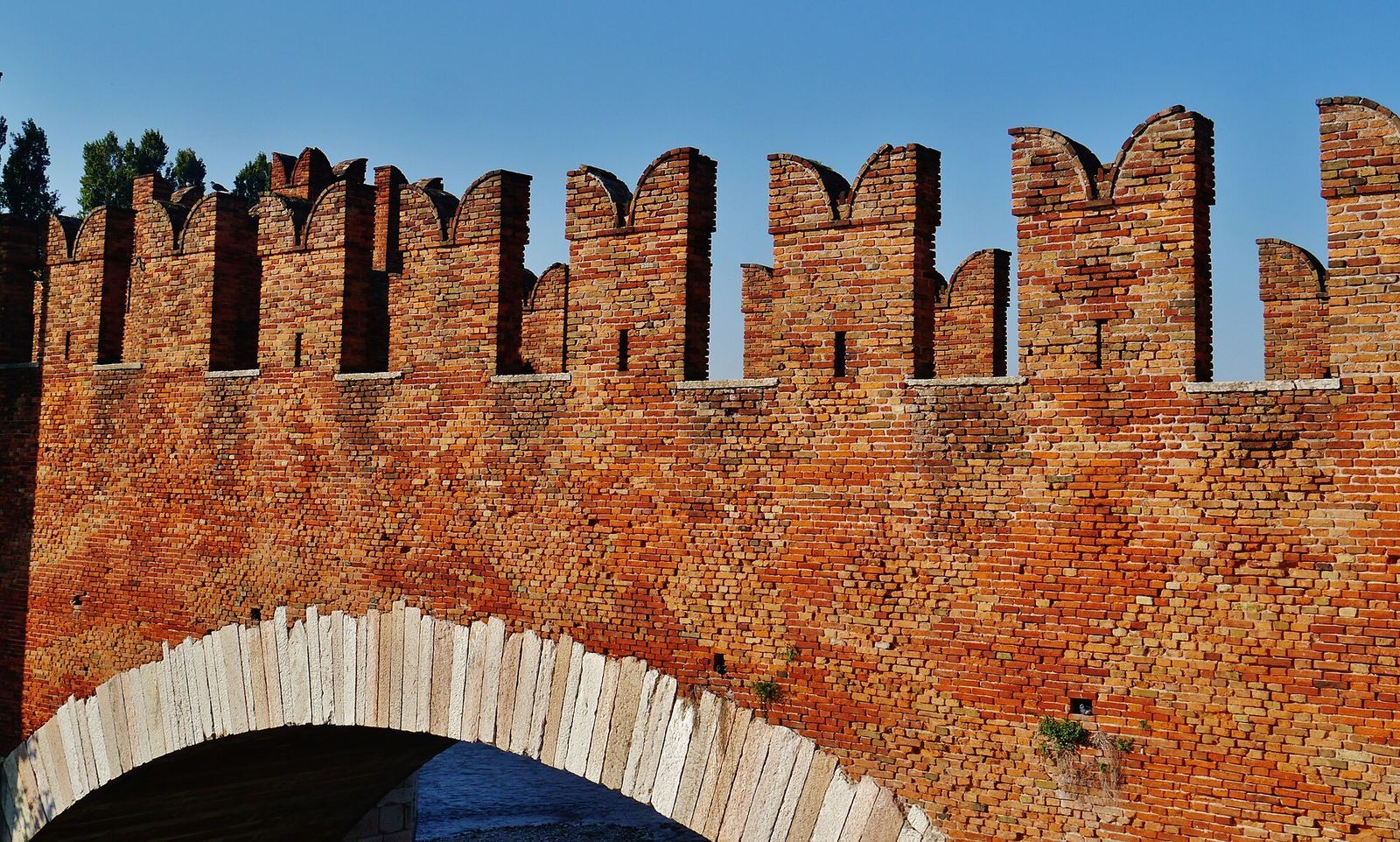
Swallowtail-shaped battlements crown the walls bordering the walkway, which also has paths along the walls and loopholes, narrow openings in a defensive wall. A prominent fortified tower stands toward the city, while another tower formerly stood at the countryside end. The countryside tower was partly dismantled by the French in 1802 and was not rebuilt after the bridge’s reconstruction.
Reconstructed materials
During the postwar work, intact blocks recovered from the riverbed were placed back in their former positions, guided by pre-destruction photographs and a survey. The color of the surviving stone helped identify a medieval quarry in the territory of San Giorgio di Valpolicella, which supplied stone to replace damaged pieces. Replacement bricks came from demolition work and kilns in Verona and Mantua; the original bricks varied in color and were uneven in size. The reconstructed outer bands of the arches use red, pink, and pale varieties of Veronese marble from Valpolicella.