Castello di Santa Maria Coghinas: A Medieval Doria Fortress in Sardinia



Site at a Glance
- Rating
- 4.5
- Popularity
- Low
- Country
- Italy
- Primary era
- Medieval
- Eras represented
- Medieval
- Civilizations
- Genoese
- Site type
- Military
- Remains
- Castle
On this page9 sections
History
Castello di Santa Maria Coghinas is a medieval fortified structure in Italy, built by the Doria family around the twelfth century to secure its possessions and Genoese interests in northern Sardinia. Also known as Castello di Casteldoria, it controlled the historic Anglona region and the Coghinas valley, and later became involved in the conflicts between Genoa, Pisa, Aragon, and the Sardinian state of Arborea.
Doria and Malaspina control
Branca Doria is identified as the castle’s first owner. Its earliest written references belong to the period when Genoa and Pisa were competing for power in Sardinia. On 3 February 1282, the Malaspina family supported the Genoese side financially and acquired the curatoria of Anglona, a territorial subdivision within a Sardinian giudicato, or medieval state ruled by a judge. The transfer from Brancaleone Doria included Casteldoria, although the complex soon returned to Doria control.
In 1308, Brancaleone Doria and his son Bernabo, then vassals of the Crown of Aragon, formalized their possessions in an agreement called Castra et loca ac terras with James II of Aragon. The Crown of Aragon was the monarchy extending its authority over Sardinia during the late medieval period. The agreement confirmed the castle’s place within a changing network of lordships and royal claims.
The fortified settlement in the fourteenth century
Documents from 1321 reveal that Casteldoria was more than an isolated military tower. Brancaleone Doria’s Genoese notary and chancellor, Francesco da Silva, went to the castle with him to formalize the confirmation of a donation by Pietro de Barra, the castellan responsible for administering and defending the fortress. The donation granted the townspeople the locality of Gorgoiosa for cultivation within the castle’s wider enclosure. The same acts removed the inhabitants from the authority of the podestà of Coghinas, a civic or judicial official, and placed them under the castellan and the vicar of Anglona.
These arrangements supported the expansion of Casteldoria’s political and territorial role. The settlement extended beyond the tower and included houses, gardens, and cultivated fields. It is mentioned in the 1341 tithes, when its rector paid two pounds in alfonsini, a medieval coin or monetary denomination. A document from 1361 describes a fortified settlement with several entrances and a small chapel dedicated to Saint Nicholas. Thirteen individuals named in records from the same period were probably heads of families, placing the settlement’s estimated population at approximately 40 to 60 people.
War between Aragon, Genoa, and Arborea
Casteldoria was drawn into the conflict between Aragon and Genoa in 1354, when Rambaldo de Corbera occupied it and the nearby fortress of Chiaramonti for Peter IV of Aragon. The castle was restored that year. Brancaleone Doria attempted to recover it in 1357 through an agreement addressed to Peter IV, but the effort failed.
In 1361, Peter IV granted Casteldoria as a feudal holding to the Aragonese nobleman Poncio de Altarippa. Following a peace treaty that year, the territories around the Coghinas passed to Mariano IV of Arborea. Arborea was one of the medieval Sardinian giudicati, states ruled by judges. In 1366, Brancaleone Doria allied with Peter IV against Mariano IV in an attempt to regain his lost domains.
A document preserved in Barcelona records that the Doria and Arborea factions arranged a political marriage around 1367 between Eleonora of Arborea and Brancaleone. Casteldoria formed part of Eleonora’s dowry. Eleonora was the leading ruler of Arborea and is associated with the state’s late medieval resistance and legal administration. The castle remained practically under her control until the early fifteenth century.
Decline and later traditions
Cassano Doria later took possession of Casteldoria. In 1417, William III of Narbonne, the judge of Arborea, acquired the castle while in conflict with the Genoese family. In 1420, its subjects rebelled together with those of the castles of Osilo and Monteacuto. After passing among several rulers and political powers, Casteldoria declined during the fifteenth and sixteenth centuries. At the beginning of the eighteenth century, settlers from Piedmont looted the site and demolished or damaged many parts of the complex.
Several traditions became associated with the ruins. One legend describes an underground passage linking the fortress with the chapel of Saint John of Viddaeccia, now Viddalba, across the Coghinas River. It supposedly allowed the Doria family to attend church during religious festivals, but the passage is not established as historical fact. Grazia Deledda presented the best-known literary tradition connected with the tower in her 1894 Sardinian Tales.
Local stories also connect a nearby depression called the “Bowl of the Coin” with supposed Doria coin minting, a buried golden bell, and underground chambers containing treasure. These accounts remain legends. Gallurese tradition identifies Andrea Doria as the last prince associated with Casteldoria and suggests that he may have recovered the possessions from the Spanish in 1527, although this identification is uncertain.
The site is designated Italian national heritage. Its surviving remains are in a semi-abandoned condition and are undergoing restoration.
Remains
Hilltop fortress and Doria Tower
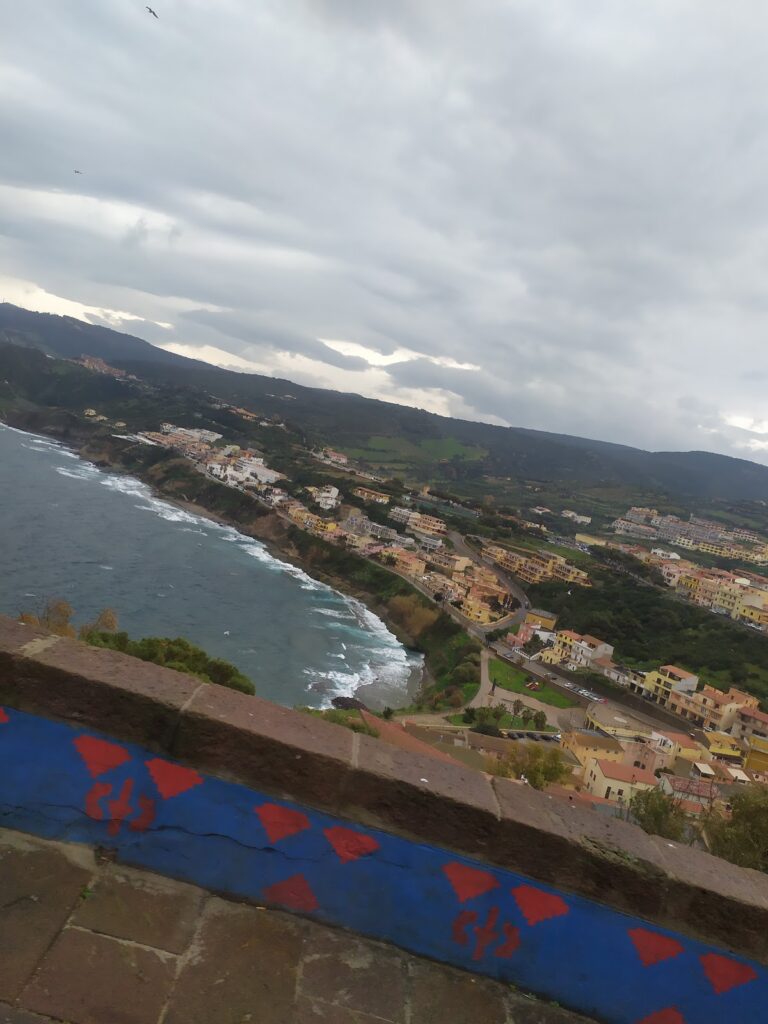
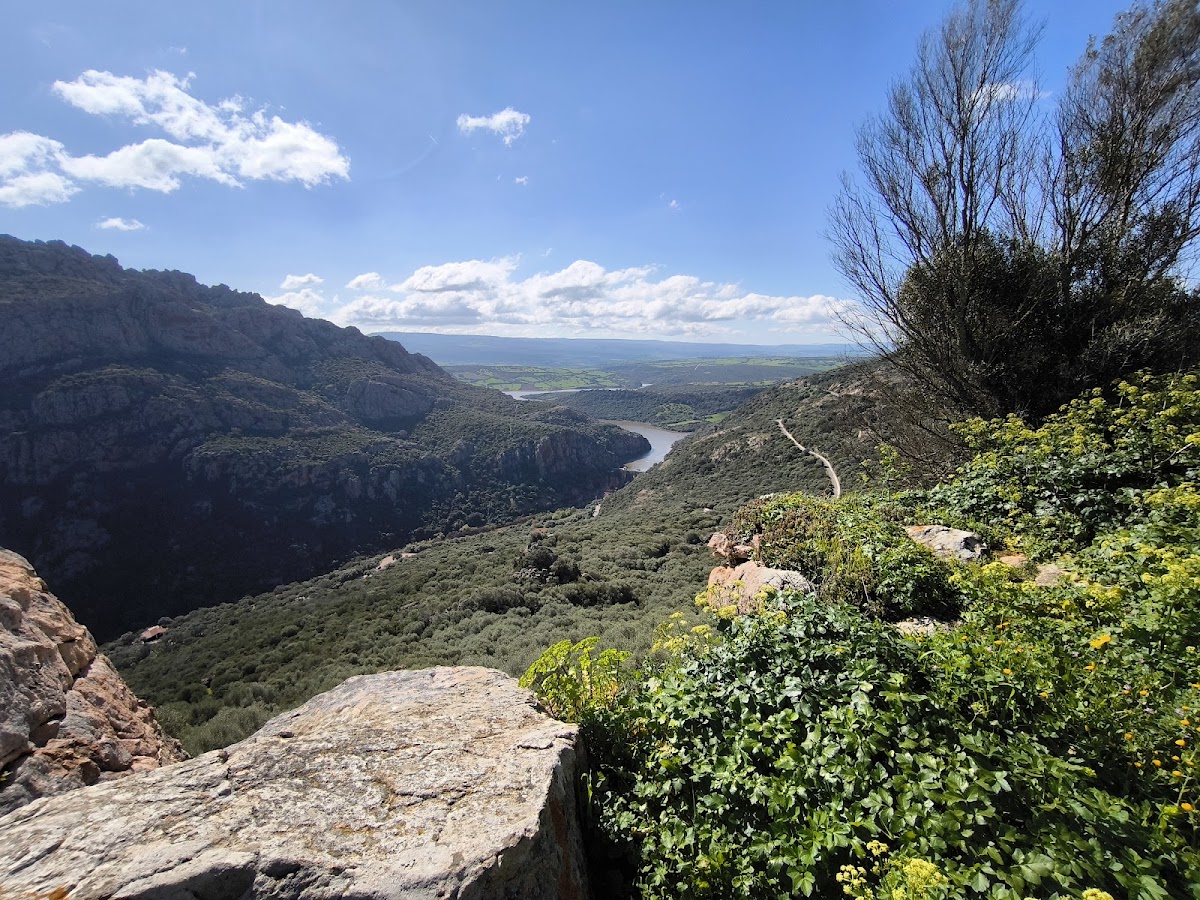
The fortress stands at approximately 220 metres above sea level on a granite hill called Monti di lu Casteddu or Monte Urtigiu. Beside the Monte Ruju hill range, it overlooks the plain, the Coghinas River, and Lake Casteldoria. The elevated position also looks toward the Gulf of Asinara coast and the Castelsardo area. The surrounding plain provided fertile land, while the lake and river zone supported maritime traffic from the Roman period.
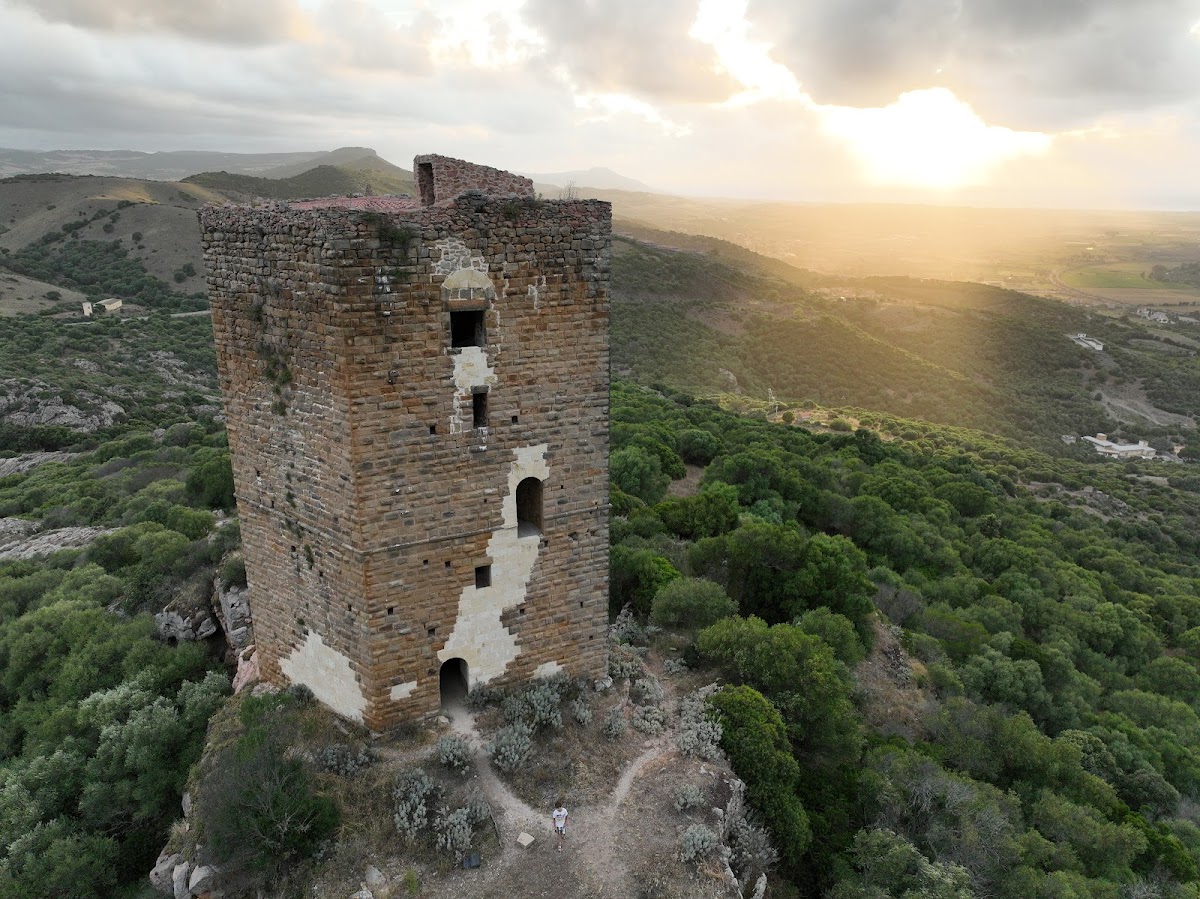
Only limited ruins of the medieval complex survive, with the Doria Tower as the most substantial structure. The pentagonal tower rises more than 20 metres. Its north-eastern side contains a doorway and two large openings that are not aligned with one another, while a large first-floor window opens on the north-western side.
Three wooden levels survive within the tower, followed by a roof level with a walkway and roof tiles. A vault separates the ground floor from the first floor, and a passage on the eastern side leads to the access stairway. Before the upper terrace, the third floor was formed by a wooden mezzanine. Traces of its original supporting beams remain, and the exterior shows both ancient and more recent repairs.
Large rectangular granite blocks bonded with mortar form the tower. The interior walls use the same stone, while the rubble core, the inner filling between the outer faces of a thick masonry wall, consists of granite flakes and waste produced while shaping the exterior blocks. The circular base is built from local granite masonry without binding material.
Walls and settlement
Sections of the perimeter walls and scattered building remains extend across the fortified hill. The castle settlement probably developed at the same time as the fortress during the second half of the thirteenth century. Its surviving traces indicate a village that spread beyond the tower and included houses, gardens, and cultivated plots. Several entrances provided access through the wider fortified settlement.
Mortared structures survive in the terraces around the tower and in rooms between the tower’s north-western vertex and the water-storage cistern. Together with the perimeter walls, these remains show that the complex included a network of spaces across the hill rather than only the standing tower.
Cistern and chapel remains
A large cistern supplied the fortress with water. Its position among the remains, near the rooms and terracing associated with the tower, forms part of the surviving infrastructure of the stronghold. A separate legend describes a cistern filled with stones and associated with a supposed golden bell, but that story is not established as an archaeological fact.
The complex also contained a small chapel dedicated to Saint Nicholas. Its remains survive among the ruins of the fortified hill. The chapel is distinct from the chapel of Saint John of Viddaeccia across the Coghinas River, which appears in the tradition about the alleged underground passage.