Castello dei Conti d’Aquino: A Medieval Fortress in Italy


Site at a Glance
- Rating
- 4.3
- Popularity
- Low
- Country
- Italy
- Primary era
- Medieval
- External website
- Open
- Eras represented
- Medieval
- Civilizations
- Lombard
- Site type
- Military
- Remains
- Castle
On this page11 sections
History
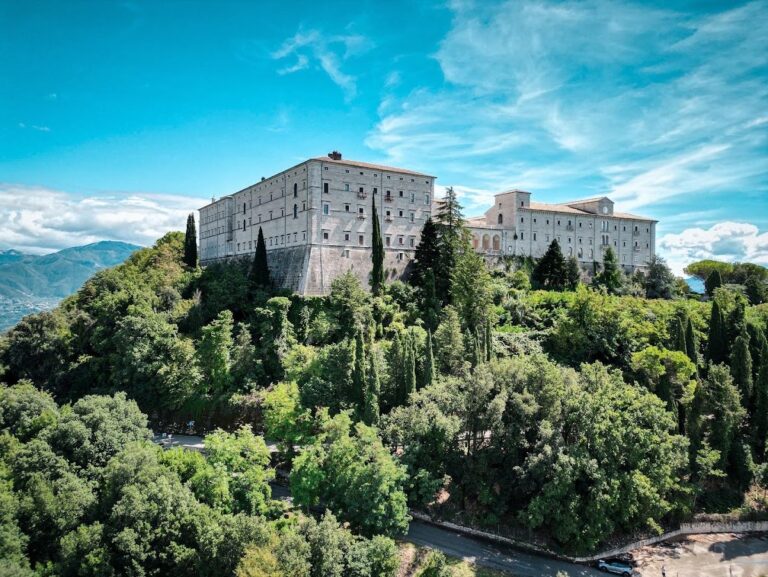
Castello dei Conti d’Aquino is a ruined medieval fortress at Roccasecca in Italy, built on Mount Asprano during the tenth century for the D’Aquino family and the defense of the surrounding valleys. Its construction is generally dated to that century, with a specific foundation initiative recorded in 994, when Mansone, abbot of Monte Cassino, approved the project in cooperation with the family of Pontecorvo. From its elevated position, the stronghold controlled the lower Sacco-Liri valley and the adjoining Melfa valley.
Lombard Origins and Early Reconstruction
The castle emerged within a political landscape shaped by the Lombards, a Germanic people who established rule across much of Italy during the early medieval period. Their settlement at Aquino, probably during the eighth or ninth century, preceded the appearance of the first Aquinan lords. These Lombard nobles established the dynasty and the County of Aquino, whose authority became closely connected with Roccasecca and its fortress.
Count Adenolfo III destroyed the castle in 996. It was rebuilt shortly after 1000, beginning a long cycle of destruction and reconstruction. The repeated rebuilding reflected the continuing military value of the site, which occupied a strategic position above routes through the Sacco-Liri and Melfa valleys.
The D’Aquino Fortress in the Twelfth and Thirteenth Centuries
The County of Aquino declined after the Norman victory associated with the Peace of San Germano in 1139. The Normans were rulers and military forces who expanded their power in southern Italy during the eleventh and twelfth centuries. Although the county eventually ended, Landolfo and Rinaldo II d’Aquino later rebuilt the castle on a larger scale. Their fortress included a cylindrical tower and resisted the siege of forces belonging to Henry VI of Swabia in 1197. Henry VI was the Holy Roman Emperor whose army attacked the castle during the struggle for power in southern Italy.
Frederick II, the medieval Holy Roman Emperor who ruled a wide realm in Italy and central Europe, stayed in the fortress for several days during the thirteenth century. He was related to Thomas Aquinas, the Dominican theologian and philosopher who became one of the most influential thinkers of medieval Christianity. Some historians identify the castle as Thomas’s birthplace in 1225, in rooms still traditionally known as the House of St Thomas. Tradition also holds that he was imprisoned there after his confinement at Monte San Giovanni Campano.
Landone IV was the last legitimate holder of the title of Count. His sons, Pandolfo and Rinaldo, established two separate branches of the family. Late thirteenth-century records refer to Roccasecca as an Universitas hominum, a medieval communal form of local administration. The title indicates that the settlement possessed autonomous administration while remaining under the authority of the D’Aquino lords.
Later Lords and Military Conflicts
In 1414 Roccasecca returned to Queen Joanna II of Naples. In 1442 Alfonso I granted the fief to Francesco II. The castle was besieged in 1447 by the army of Pope Callixtus III, after which Roccasecca was returned to the D’Aquino family.
The stronghold faced further conflict during the Italian wars. Forces commanded by Charles VIII of France plundered Roccasecca in 1495. French troops besieged it again in 1503 but failed to occupy it. Francesco Guicciardini, an Italian historian and statesman, narrated this episode in his History of Italy. In 1504, Ferdinand the Catholic and Isabella of Castile granted Roccasecca to Ferdinand II.
During the seventeenth century, the castle lost control of the valley and became a minor feudal possession. The fief passed from the D’Avalos family to the Colonna and then to the Boncompagni families. French occupation in 1796 marked the later political history of the feudal estate. The castle is now a ruin, while the small Church of Santa Croce stands immediately outside the fortification.
Remains
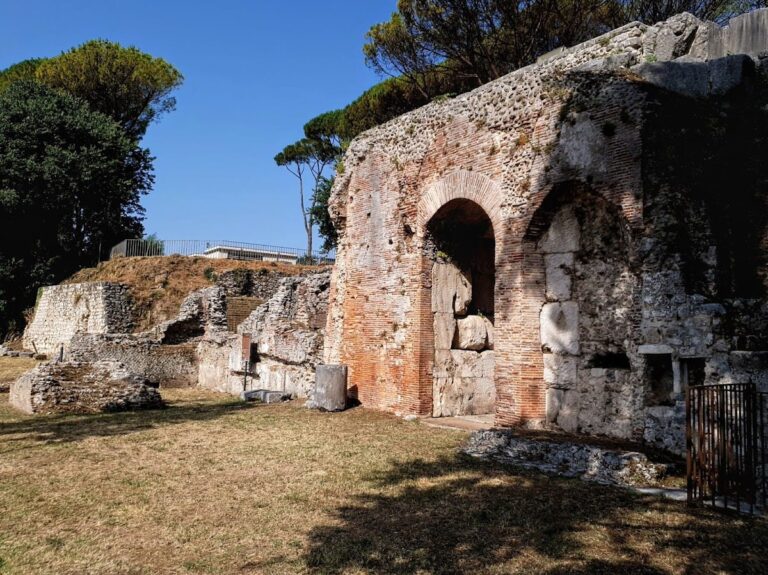
The surviving complex occupies Mount Asprano and includes the remains of a roughly quadrangular fortified enclosure. Its principal entrance was placed on the western side of the curtain wall, the connecting defensive wall between towers. The ruined walls, towers, and enclosed court preserve the basic arrangement of a mountain fortress whose defenses extended across the summit and along the slopes.
Enclosure and Interior
Walls and Towers
Towers occupied the north-eastern and north-western corners of the enclosure. A keep, the castle’s principal fortified tower, and an additional tower stood at the south-eastern corner. These structures controlled the small Church of Santa Croce, which lies immediately outside the fortification. The walls were strengthened with quadrangular and semicircular bastions, projecting fortifications designed to reinforce corners and wall lines.
Several curtain walls carried crenellations and were marked by additional semicircular, crenellated towers. One crenellated wall extended eastward toward an isolated tower described as a later construction. Other walls ran along the western side of the mountain and enclosed the partly ruined medieval settlement known as the Castle. Together, these elements joined the defensive circuit to the built-up area within the fortress.
Rainwater Cistern
A large cistern stood inside the court. It collected rainwater for the needs of the fortress, providing an essential internal water supply within the defended enclosure.
Outer Defenses and Associated Forts
Cannon Tower
Outside the main walls stands the lookout tower known as the Cannon Tower. Its position beyond the principal enclosure formed part of the wider defensive system associated with the castle.
Colle Granaro Fort
Farther down the mountain, on Colle Granaro at the last rise toward the plain, are the remains of a medieval fort. It was connected with the castle of Monte Sant’Angelo and guarded the nearby bridge over the Melfa, known as the Old Bridge. The ruins were interpreted as those of ancient Duronia, linking this lower defensive position with an earlier understanding of the landscape.