Castell de Torlanda: A Medieval Frontier Castle in Spain

Site at a Glance
- Rating
- 4.4
- Popularity
- Very Low
- Country
- Spain
- Primary era
- Medieval
- External website
- Open
- Eras represented
- Medieval
- Civilizations
- Unclassified
- Site type
- Military
- Remains
- Castle
On this page7 sections
History
Castell de Torlanda is a medieval castle in Spain, standing on a ridge south of Conesa in Tarragona. Built in the eleventh century as part of the frontier of the County of Barcelona, it overlooked the Torlanda valley, where a small settlement later developed around the fortress.
Segura and the Frontier of Barcelona
The site appears in records under the name Segura in 1038. In 1076, the sacramental testament of Ramon Berenguer I, Count of Barcelona, listed the fortress of Secura among the boundaries of the county’s frontier, or march. The County of Barcelona was a major medieval Catalan polity whose counts governed territories and frontier fortresses in northeastern Iberia.
In 1178, Bernat de Piles, his wife Saurina, and Berenguer Company donated the fortress to King Alfonso I, identifying it as the castle of Torlanda, formerly called Segura. Two days later, Alfonso granted it back to Bernat de Piles and Berenguer Company as a fief, meaning land or jurisdiction held from a superior lord in return for service and allegiance.
Lords, Castellans, and Feudal Rights
Arnau de Sespiles was probably the castle’s castellan, the official responsible for administering and defending it, in the mid-thirteenth century. In 1253, Ramon de Sespiles left ten sous to the church of Sant Andreu de Turlanda in his testament. In 1263, King James I claimed one-third of the rights to collect the questia, a feudal levy.
At the beginning of the fourteenth century, the castle belonged to Sibil·la, the wife of Bernat de Sanou. Bernat paid homage of fidelity to the king in 1301, formally expressing his allegiance. Galceran de Piles and Bernat de Conesa served as castellans at that time. In 1328, the castle was transferred as a fief to Pere d’Aguiló, and Marc de Pontons was its lord in 1329.
The Lordship of Santes Creus
Torlanda passed to the monastery of Santes Creus in 1379 through an exchange with King Peter III. The monastery transferred Sarral and Cabra del Camp in return for Torlanda, Conesa, and Forès. The castellan Berneguer de Montpaó had already paid homage of fidelity to the abbot of Santes Creus in 1375.
King John confirmed the monastery’s possession in 1388, and Ferdinand II ratified it in 1480. Santes Creus, a Cistercian monastery in Catalonia with extensive feudal lordships, retained control of Torlanda until the nineteenth-century disentailment, when ecclesiastical and other corporate properties were confiscated and sold or transferred.
The settlement around the castle was completely abandoned at the beginning of the twentieth century. Its location, together with the houses that once surrounded the fortress, preserves the pattern of a settlement established in the eleventh century when this area formed a frontier with Muslim-controlled territories.
Remains
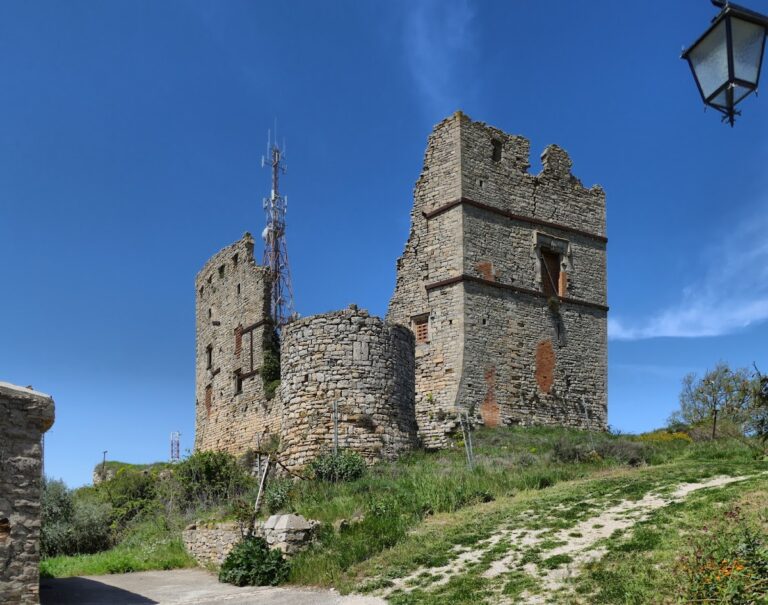
Castell de Torlanda occupied the summit of a ridge at approximately 704 metres above sea level, with a broad view over the Conca de Barberà plain. The surviving remains consist of a cylindrical tower, while the medieval dwellings probably occupied much the same area as the abandoned farmhouses around the site.
The Surviving Tower
The tower has an interior diameter of 190 centimetres and walls 175 centimetres thick. Its best-preserved northern side rises 3 metres. Medium-sized stone blocks form the structure, laid both horizontally and vertically. The roughly dressed stones are arranged in courses and bonded with abundant mortar.
These construction characteristics point to an eleventh-century date and are consistent with Romanesque architecture, a medieval tradition known for massive masonry, thick walls, relatively small openings, and rounded arches. In the modern period, the tower was apparently incorporated into a dwelling and reused as a wine vat for making wine.
The Former Settlement
The small medieval settlement grew around the castle. The houses formerly associated with it are represented by abandoned farmhouses that remain around the site, preserving the approximate area occupied by the settlement during the castle’s period as a frontier stronghold.
Nearby sites