Alcazaba de las Siete Torres: Medieval Fortress of Orce, Spain


Site at a Glance
- Rating
- 4.4
- Popularity
- Low
- Country
- Spain
- Primary era
- Medieval
- Eras represented
- Medieval, Early Modern
- Civilizations
- Crown of Castile, Nasrid, Spanish
- Site type
- Military
- Remains
- Castle
On this page7 sections
History
The Alcazaba de las Siete Torres, also known as the Castle of Orce, is a medieval fortress in Orce, Spain, built during the Nasrid period. An alcazaba was a fortified citadel associated with Islamic-period towns and military administration. Orce occupied an important defensive position in the Kingdom of Granada, the last Muslim-ruled kingdom in the Iberian Peninsula, because it stood close to the frontier with Castile.
Nasrid Fortress and Castilian Adaptation
The fortress was transformed after the Castilian conquest of Granada in 1492. It then belonged to the Enríquez family, a Castilian noble family, who adapted the principal tower and added residential buildings. These changes gave the complex its present Renaissance appearance, combining the earlier military enclosure with later domestic and representational functions.
Several surviving elements date from the sixteenth century, including the upper part of the keep, the vaults of its interior rooms, and sections of the walls built with dressed stone. The present entrance and part of the northern wall extending from the keep are recent additions. It remains uncertain whether an earlier entrance occupied the same position.
Ownership, Restoration, and Museum Use
A bourgeois owner acquired the fortress in the late nineteenth century. It passed into municipal ownership during the 1970s, after which a major restoration altered the complex. The intervention removed all dwellings attached to the exterior and added a new crenellated parapet. Its approach was highly aggressive, leaving a lasting mark on the appearance of the monument.
The keep later housed the Josep Gibert Orce Prehistory Museum. Its displays included the remains known as the Man of Orce, a name used for prehistoric human remains associated with the area. The museum was subsequently moved first to the Palace of Segura, a historic palace in Orce, and later to its present location. The fortress has been protected as an Asset of Cultural Interest in Spain since 1985.
Remains
Fortified Courtyard and Towers
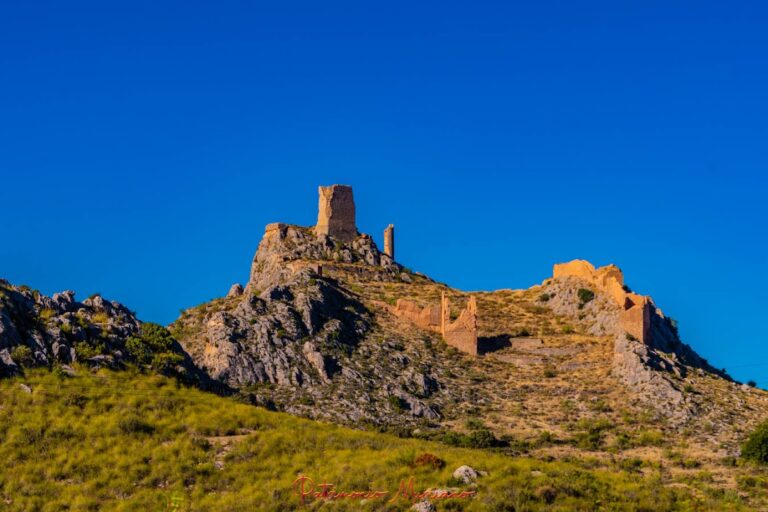
The complex is organized around a military courtyard enclosed by a wall and seven towers, the feature that gives the fortress its name. The wall and most of the towers were built using rammed earth, a technique in which compacted earth is formed into solid walls within temporary shuttering. Six towers are hollow, square structures measuring approximately 8 by 8 metres and reaching about 25 metres in height. One of the seven towers has lost its upper section.
Keep
The keep, or principal tower of the castle, has a slightly rectangular plan measuring approximately 20 by 17 metres and rises to nearly 50 metres. It contains five internal storeys. The lower two-thirds are made of rammed earth, while the ground floor has reinforcement in regularly cut and dressed stone blocks. The upper third is built from large, carefully finished ashlar blocks.
Several openings pierce the keep, which has two entrances. One is at ground level, while the other is on the first floor and is reached by an exterior staircase. The upper part of the tower and the vaulted ceilings of its interior rooms belong to the sixteenth-century transformation associated with the Enríquez family.
Underground Cistern
A substantial underground cistern occupies part of the courtyard. It measures approximately 12 by 5 metres and formed an important water-storage feature within the fortified enclosure.
Nearby sites