Castel Corona: A Medieval Cliff Fortress in Italy


Site at a Glance
- Rating
- 4.2
- Popularity
- Very Low
- Country
- Italy
- Primary era
- Medieval
- Eras represented
- Medieval
- Civilizations
- Holy Roman Empire
- Site type
- Military
- Remains
- Castle
On this page8 sections
History
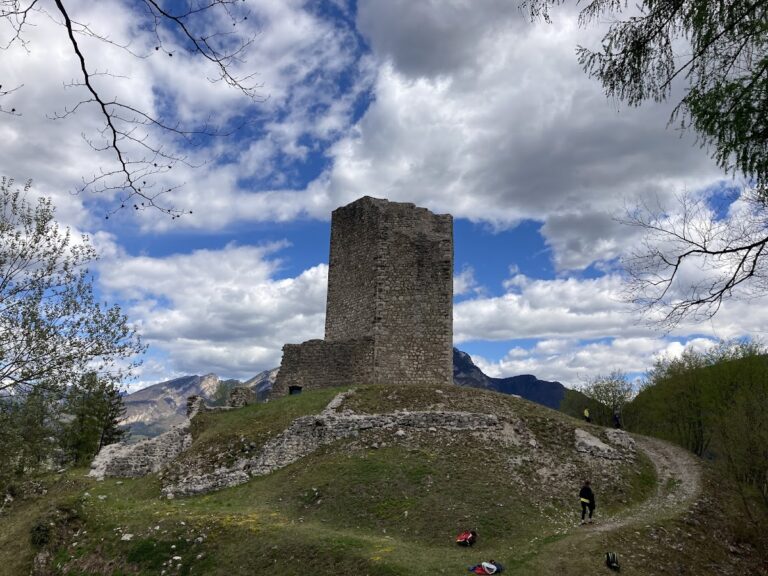
Castel Corona is a ruined medieval fortress in Italy, near Cunevo in Trentino and within the municipal territory of Denno. Probably built between the twelfth and thirteenth centuries for defense, it first served as an appendage of Castel Denno and later of Castel Flavon. Its position in a cleft high in the rock gave it a broad view across the surrounding valleys and made it suitable for observing movement.
Early references and episcopal control
The place appears in a document of 1215 as “in pratis sub corona Tremunno.” The first recorded reference to the castle dates from 1217, when Federico Vanga, the prince-bishop of Trento, granted Giacomo, Ropreto, and Ottolino, sons of Olurandino de Enno, permission to build a fortress.
The grant followed the family’s punishment for the killing of Federico, son of Ulrico, Count of Appiano, in 1204. The Enno family lost its allodial ownership, meaning land held outright, and the surrounding corona became an episcopal fief, property granted by a superior authority in return for allegiance or service. The family also surrendered property at Rumo, or possibly Dermulo, as security for a fine of 1,000 Veronese lire.
Transfer to the Tyrolean counts
During the expansion of Mainardo II, the medieval count of Tyrol and Gorizia, Castel Corona probably passed to the Count of Tyrol in 1276. It thereafter remained a Tyrolean fief. The transfer was formalized in 1293, when Alberto of Metz sold the castle, together with Castel San Gottardo, to Mainardo for 1,500 Veronese lire. Alberto had probably received the property as a pledge from the last Enno owner.
Fourteenth-century records call the fortress Corona Flaoni, including a reference from 1389. Elisabetta, daughter of Nicolò de Corona Flavon, married Matteo of Castel Sporo in 1344. Her family appears to have descended from the notary Walter, known as Preto, who served as vicar to the Tyrolean captains in the Non and Sole valleys in 1302, rather than from the descendants of Olurandino de Enno.
Conflict, succession, and changing lords
Enrico da Corona was the last recorded lord of Castel Corona. In 1389 he was also recorded as the owner of Castel Flavon, which he sold that year to Pietro of Sporo. In 1415, during Pietro’s repeated provocations against Federico IV of Habsburg, the Duke of Austria, Pietro seized Castel Corona from Enrico. After Pietro died in 1424, the castle returned to its legitimate owner, Johann Payr of Termeno, who had married Enrico’s daughter Lucia.
The Payr family adopted the Corona coat of arms, a white-and-blue shield divided by a line and bearing a gold star. In 1481, Johannes, son of Oswald of Salzburg, was recorded as captain of the castrum Corone de Flaono. The Payrs did not retain the fortress for long. After a short period under the Thun family, Federico II Thun received it in 1456, and Archduke Maximilian I of Habsburg, later Holy Roman Emperor, granted it as a fief to Graziadeo Spaur in 1490.
Deterioration and abandonment
The castle’s declining condition appears in sixteenth-century records. Ulrico Spaur appealed to Innsbruck in 1524 because of its poor state and renewed the appeal in 1529, describing the fortress as unsafe and ruinous.
In May 1656, Archduke Ferdinand Charles donated Castel Corona to Marco Antonio Bertelli of Caderzone, who acquired the title “von Ossana und Corona.” Osvaldo of Sporo and Flavon later acquired the property and, in 1684, granted it in perpetual lease to Leonardo and Blasio Ricci of Denno. The Ricci family, which had moved to Trento, leased the castle in 1747 to Francesco Bortolameo Job of Cunevo, who held it until 1775.
Castel Corona lost its military importance as political stability took hold and was abandoned after the seventeenth century. A 1617 rent roll, an inventory of goods or dues owed to a lord, shows that the fortress was still inhabited during at least the first two decades of that century. In 1784, the mason Andrea Castelli of Como climbed to the site with ladders and found rooms and chambers, but the collapsed roof made him unwilling to attempt the ascent again.
During the first half of the nineteenth century, ownership passed from the Spaur family to the Cabrini family of Pinzolo, who were related to the de Ferrari family of the Bronzolo branch. The Cabrini were the last owners and united Castel Corona with nearby Castel La Santa. The municipality carried out thorough restoration work in 2003.
Remains
Rock-cut fortress
Castel Corona occupies a recess or cleft in a rocky cliff. Defensive walls blocked the entrance toward the valley, turning the natural rock formation into an integrated fortress. The name is linked to the local term “crona” and the German term “Lueg,” both associated with this type of mountain cave or cleft.
The elevated position provided a wide field of observation. From the castle, movement could be watched across the Piana Rotaliana, northward toward Castel Altaguardia, and eastward toward the mountains dividing the Val di Non from the Adige Valley. This setting explains the fortress’s defensive purpose and its role in monitoring the surrounding area.
Rooms and archaeological finds
The castle contained rooms and chambers that were still accessible in 1784. By then, however, the roof had collapsed, and the surviving fortress is now in ruins.
Two bronze crab-tail fibulae were found at the foot of the castle. These objects date to the fourth century BC and belong to the La Tène Culture, an Iron Age culture of central and western Europe conventionally dated from about the fifth to the first century BC.
Nearby sites