Casa dei Cavalieri di Malta: A Fortified Tower House in Bitetto, Italy
Site at a Glance
- Popularity
- Very Low
- Country
- Italy
- Primary era
- Medieval
- Eras represented
- Medieval, Early Modern
- Civilizations
- Kingdom of Naples, Spanish
- Site type
- Military
- Remains
- Castle
On this page7 sections
History
Casa dei Cavalieri di Malta is a fortified tower house, a residence with a tower-like form, in Bitetto, Italy. It is generally dated to the late 13th or early 14th century, although construction may belong to the 14th century. Its French-influenced details are associated with the Angevin period, when the Angevin dynasty ruled southern Italy.
Medieval origins and Hospitaller tradition
Local tradition connects the house with the Knights Hospitaller, a medieval religious and military order whose members later became known as the Knights of Rhodes and then the Knights of Malta. According to this tradition, the house sheltered knights travelling through Bari before continuing to the Holy Land on crusade. The proposed connection remains unconfirmed. The Hospitallers held rural properties in Bitetto’s Bavotta district, including a farmstead called Calcara alla Bazia. An octagonal cross at the entrance to the nearby former Hospital of St James, a few metres from the house, has also been cited in support of the tradition.
The Della Marra family wore the order’s habit, its distinctive clothing, in 1381. Giovanni della Marra was Bitetto’s feudal lord from 1305 until his death in 1311. These associations do not establish ownership of the house.
Later ownership and use
A façade shield dated 1608 has been attributed to Ottavio de Nicolò. He fought in the Portuguese Restoration War, the 17th-century conflict in which Portugal regained independence from the Spanish crown, and later served as vice-admiral of the navy of Giovinazzo. The date is understood to indicate an adaptation of the complex in that year.
In the 17th century, the noble Sylos-Labini family occupied the house and placed its coat of arms on a wall. The building also accommodated some members of the seminary of Conza, an institution for educating and preparing clergy. The seminary operated for 38 years and closed in 1648.
A property administrator was still housed in the building in 1753. By 1912, the house was also known as Casa Fazio.
Remains
Layout and construction
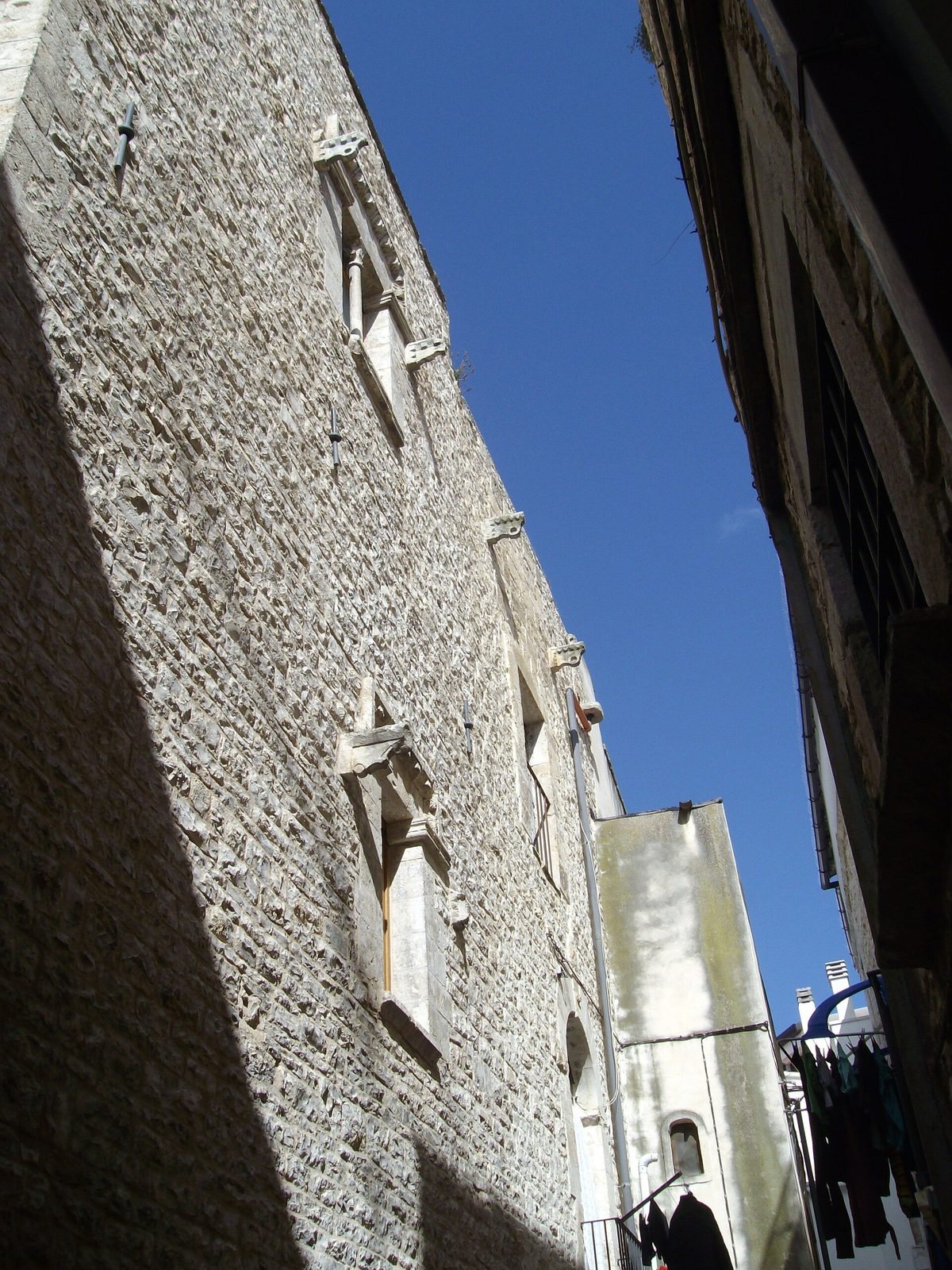
The intact building stands where Via San Antonio meets Via Leonese, with its main façade facing Via Leonese. Amber-colored stone blocks form a three-level structure arranged around an internal courtyard. Two sides follow the intersecting streets and meet at a right angle. A service court at the rear reveals a T-shaped plan: a two-storey wing projects across from the main block and is partly concealed by later buildings.
Entrances and windows
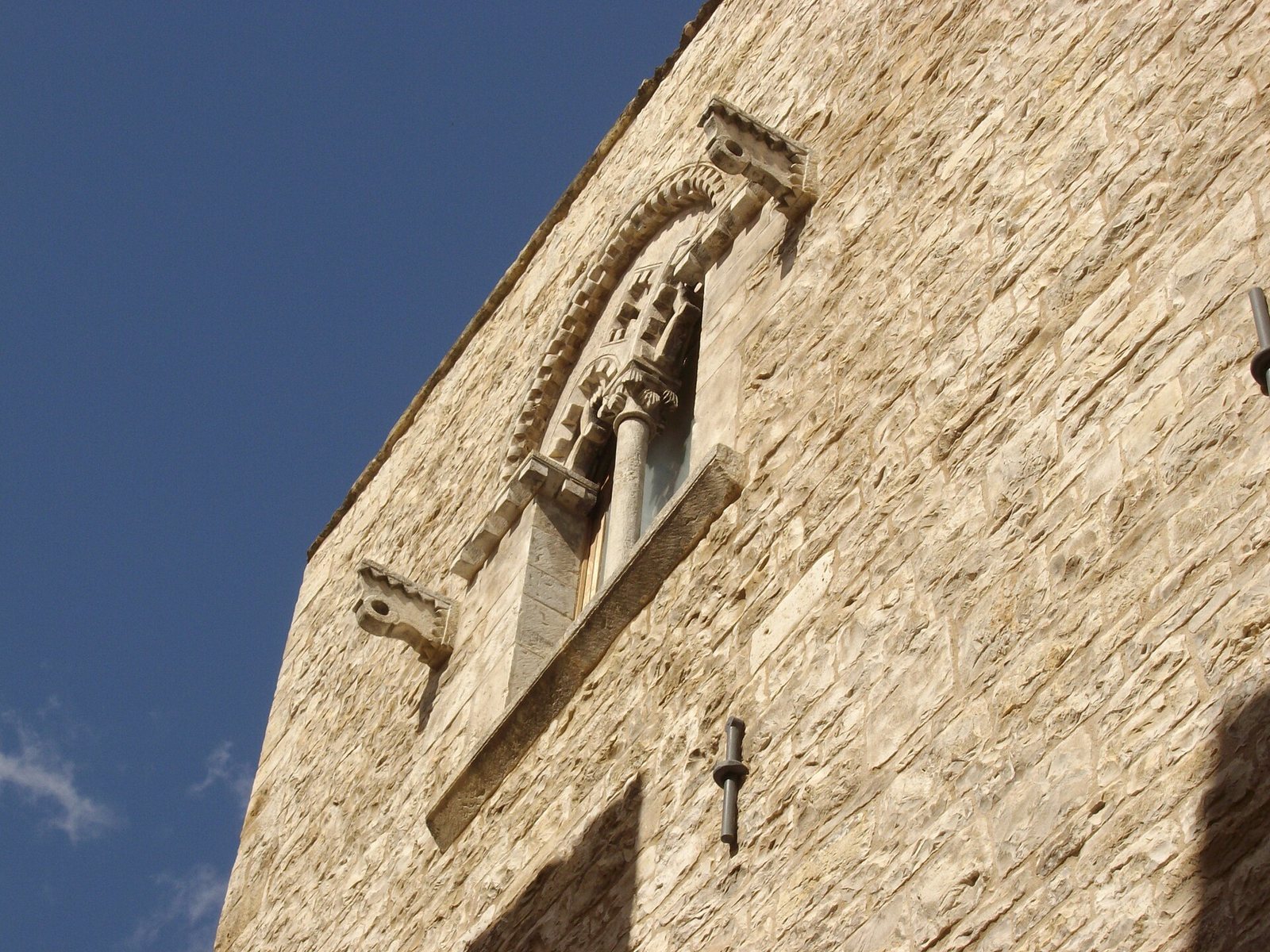
An external staircase leads to the main entrance on the first floor. Its stone architrave, the horizontal frame above the opening, sits beneath a projecting cornice with a sawtooth edge. Two pointed-arched entrances open at ground level on the eastern façade. The upper windows have stone architraves decorated with geometric designs. Two mullioned windows, divided into openings by vertical supports, occupy the top level. One has two openings with three-lobed heads beneath a pointed arch bordered by a decorative band, with a diamond-pierced panel within the arch. Decorated, perforated corbels, or projecting supports, flank the pointed window on the main façade. The mullioned windows have been judged contemporary with the final reconstruction of Bitetto Cathedral.
Coats of arms and inscription
A coat of arms on the façade is divided into sections showing a castle with two towers beside the sea, a bearded face, and a lily. It bears the initials O. N.; the castle device matches an emblem in the courtyard of Bitonto Cathedral. Beneath a coat of arms, an inscription reads, “Let those who seek to live purely enter in safety.” It refers to people preparing for religious life and bears the date 1610, which may have been added later. The inscription repeats a line from the ancient Gate of Capua, destroyed in 1557.