Cappella del Miracolo del Sacramento: A Chapel of Eucharistic Devotion in Florence
Site at a Glance
- Popularity
- Medium
- Country
- Italy
- Primary era
- Medieval
- Eras represented
- Medieval, Early Modern
- Civilizations
- Grand Duchy of Tuscany, Republic of Florence
- Site type
- Religious
- Remains
- Chapel
On this page14 sections
History
The Cappella del Miracolo del Sacramento is a Roman Catholic chapel in the church of Sant’Ambrogio in Florence, Italy. Consecrated in 1481, it commemorates a Eucharistic miracle traditionally dated to 30 December 1230. In Catholic teaching, the Eucharist is the sacrament in which bread and wine are understood as the body and blood of Christ. According to the chapel’s founding tradition, the elderly priest Uguccione found blood in his chalice the day after celebrating Mass, after failing to clean it thoroughly. The blood was understood as a sign of Christ’s divine incarnation.
The miracle and early devotion
The blood was placed in a crystal container and drew popular devotion, but Bishop Ardingus initially approached the event cautiously. He kept the container at the episcopal palace for a year while it was investigated, then returned it to Sant’Ambrogio after Franciscan friars interceded. An early reliquary is attributed to his episcopate, from 1231 to 1247. Tradition connected its creation with an exhortation Ardingus received in a dream.
The church’s restrained response, and the limited papal response, unfolded amid religious and political tensions. Indulgences were granted in 1257 and 1266. Eucharistic miracles affirmed Christ’s real presence in the sacrament, which Cathars and Patarines denied; some Ghibelline families, members of one of medieval Italy’s rival political factions, supported Cathar ideas. The miracle attracted less attention than the Eucharistic miracle of Bolsena. Early skepticism coincided with the height of Ghibelline prestige, before the Battle of Benevento on 26 February 1266.
Patronage and public observance
In 1279, Beatrice of Capraia, a member of the Guidi family, gave 20 lire toward decorating the container for the blood and donated nearby land for pilgrims. From 1317 to 1344, the Guild of Judges and Notaries helped pay for annual celebrations, partly to dispel suspicion that the devotion supported Ghibelline ideas. During a severe plague in 1340, the blood was carried in procession in an effort to avert the disease. Five years later, the wool merchant Turino Baldesi, a distant Guidi descendant, gave 3,000 gold florins toward a chapel for the relic, for the souls of himself and his brother Giannotto.
The Dominicans of Santa Maria Novella took charge of organizing Corpus Christi, the feast devoted to the Eucharist, and Sant’Ambrogio’s miracle became less prominent. In 1405, the Officials of the Mercanzia, Florence’s tribunal for guild and commercial affairs, chose to attend Sant’Ambrogio’s annual feast before the war against Pisa. In 1425, the Signoria, Florence’s governing body, instead selected a procession at Santa Maria Novella before the wars against Milan. Sant’Ambrogio’s Benedictine nuns increasingly favored the celebration of the Immaculate Conception. In 1431, their prior, Francesco Maringhi, commissioned Filippo Lippi’s Coronation of the Virgin for the high altar, where the container of the blood had stood for more than a century.
Chapel and later history
In 1468, Domenico Maringhi built a chapel to the right of the church entrance, with a shrine for the ampulla. The present chapel was arranged in 1481 to the left of the high altar, in a space under the patronage of the Zati family. Mino da Fiesole was commissioned to make a new marble tabernacle. The contract, dated 22 August 1481, set a price of 160 florins and an eight-month deadline, although the work took about three and a half years. The chapel’s consecration is also dated to 1481. Cosimo Rosselli painted its frescoes from May 1484 to August 1486.
The present reliquary dates to 1511 and is attributed to the goldsmith Bartolomeo di Piero Sasso, though it is uncertain whether he made it anew or adapted an earlier object. A fire damaged Rosselli’s frescoes in 1595, and the Florence flood of 1966 caused more severe damage. Conservator Lidia Cinelli restored them in 2017, leaving them in excellent condition.
Remains
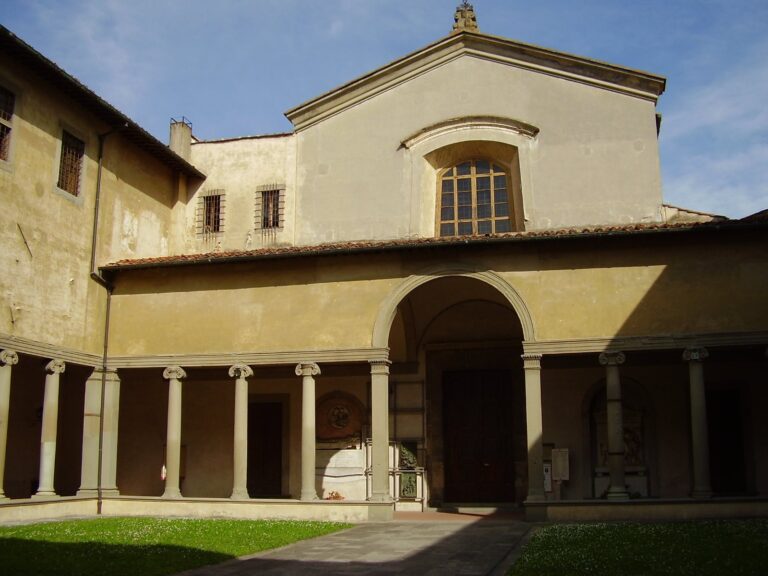
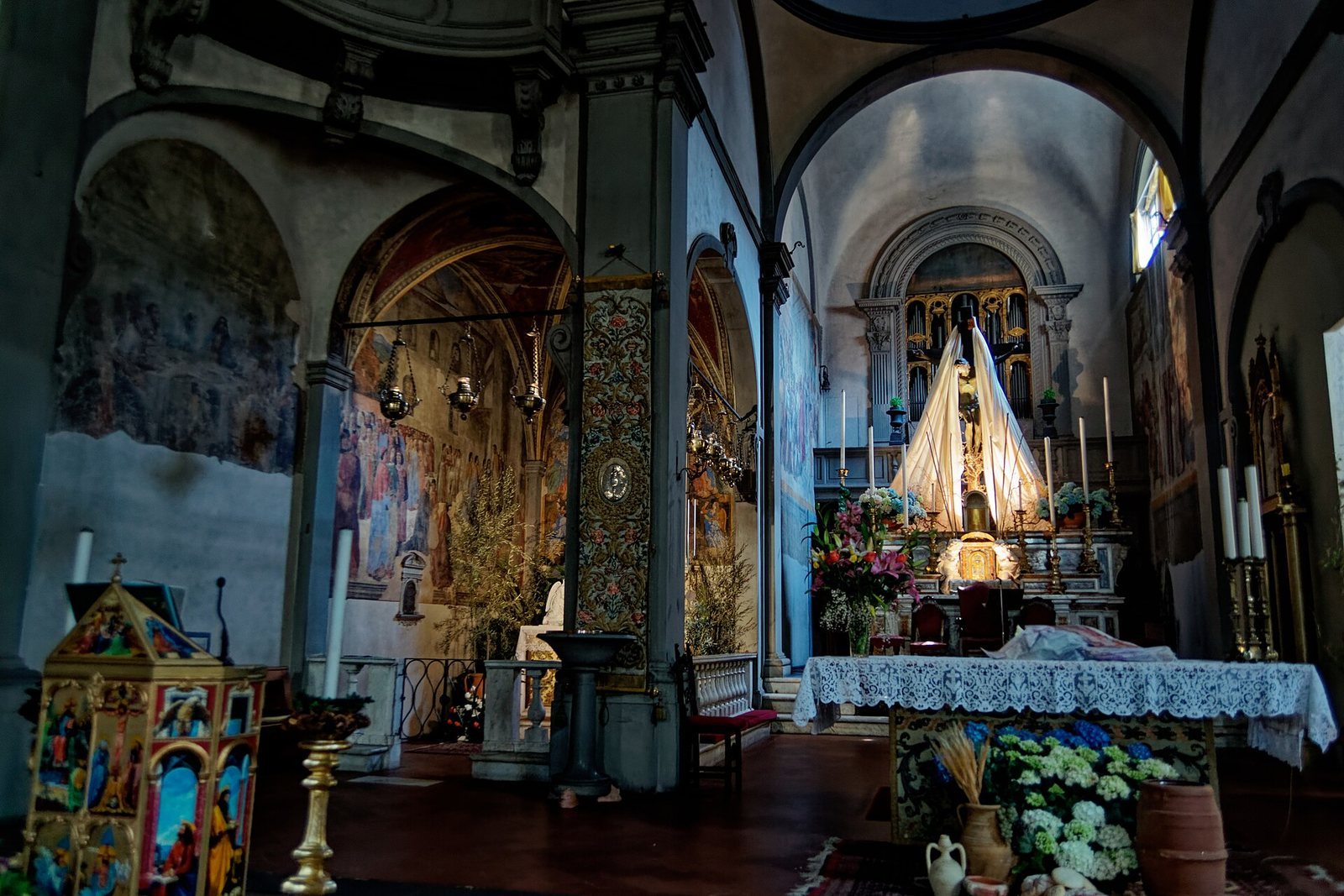
The chapel occupies the area to the left of the presbytery, the sanctuary space raised by several steps. Its rectangular floor plan is open on two sides, with a marble balustrade enclosing the space. That barrier dates from the late seventeenth or early eighteenth century. Mino da Fiesole’s marble tabernacle fills the back wall and forms the chapel’s central sculptural focus.
The chapel and marble tabernacle
Tabernacle structure and sculpture
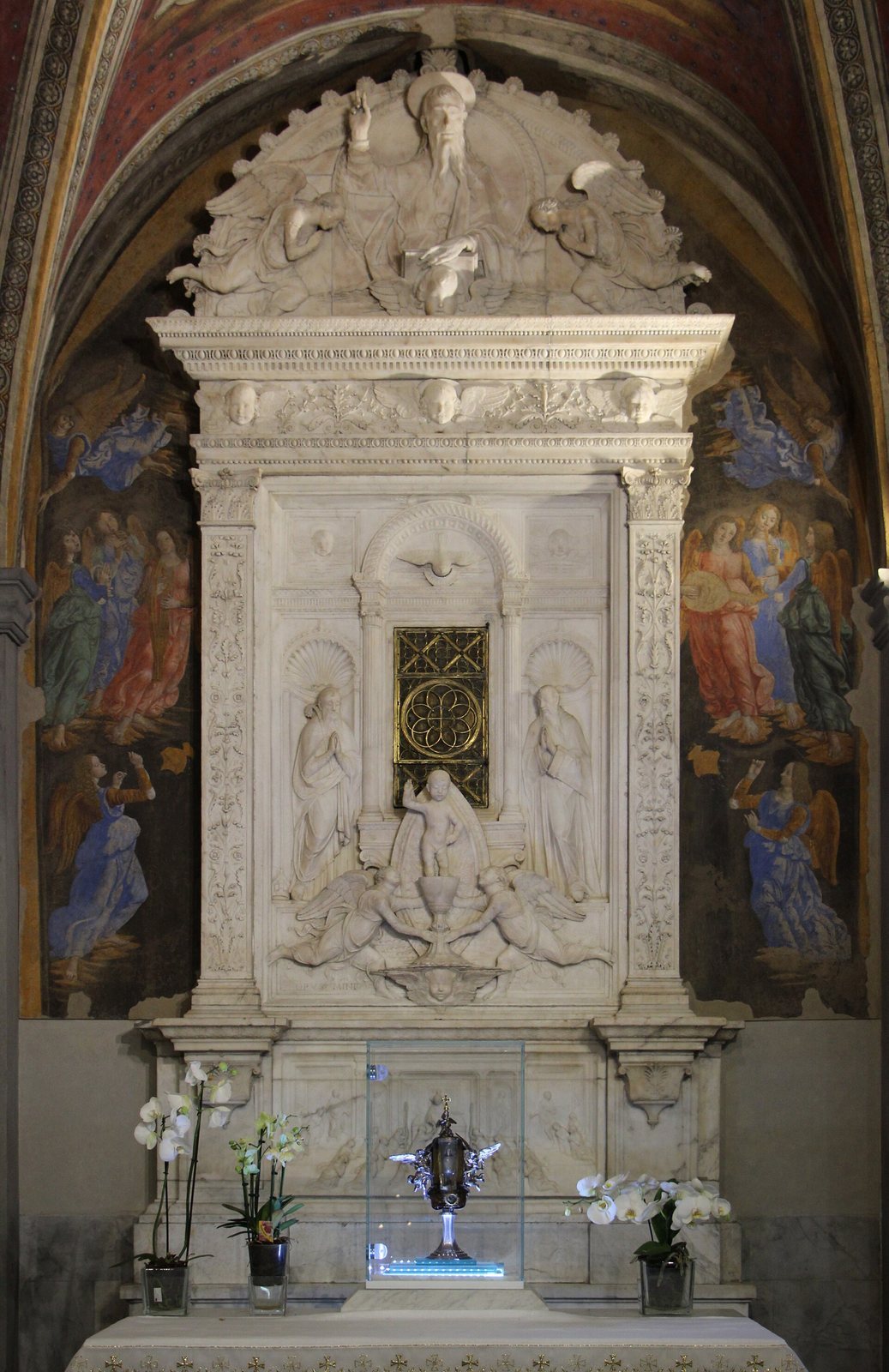
The tabernacle is approximately the size of an altarpiece. Its central panel is framed by small pilasters, shallow wall-mounted columns with plant forms carved in low relief, and decorated capitals. Above them, a horizontal band of cherubs supports an arched panel showing God the Father giving a blessing between two angels and a cherub. At the center, a shrine-like structure for the sacred object is set within a shallow recess carved to create an illusion of depth. Side niches hold symmetrical praying figures of Saints Ambrose and Benedict. Above them, a dove representing the Holy Spirit appears between two panels of cherubs.
Two flying angels below hold the miracle’s chalice above a cherub, while the Christ Child appears blessing within an almond-shaped halo. The child’s pose echoes that of God the Father above; together with the dove, the figures form an image of the Trinity and connect the Eucharist with Christ as nourishment for humanity. The arrangement draws inspiration from Desiderio da Settignano’s ciborium, a shrine-like structure, at San Lorenzo.
Metal door and altar figures
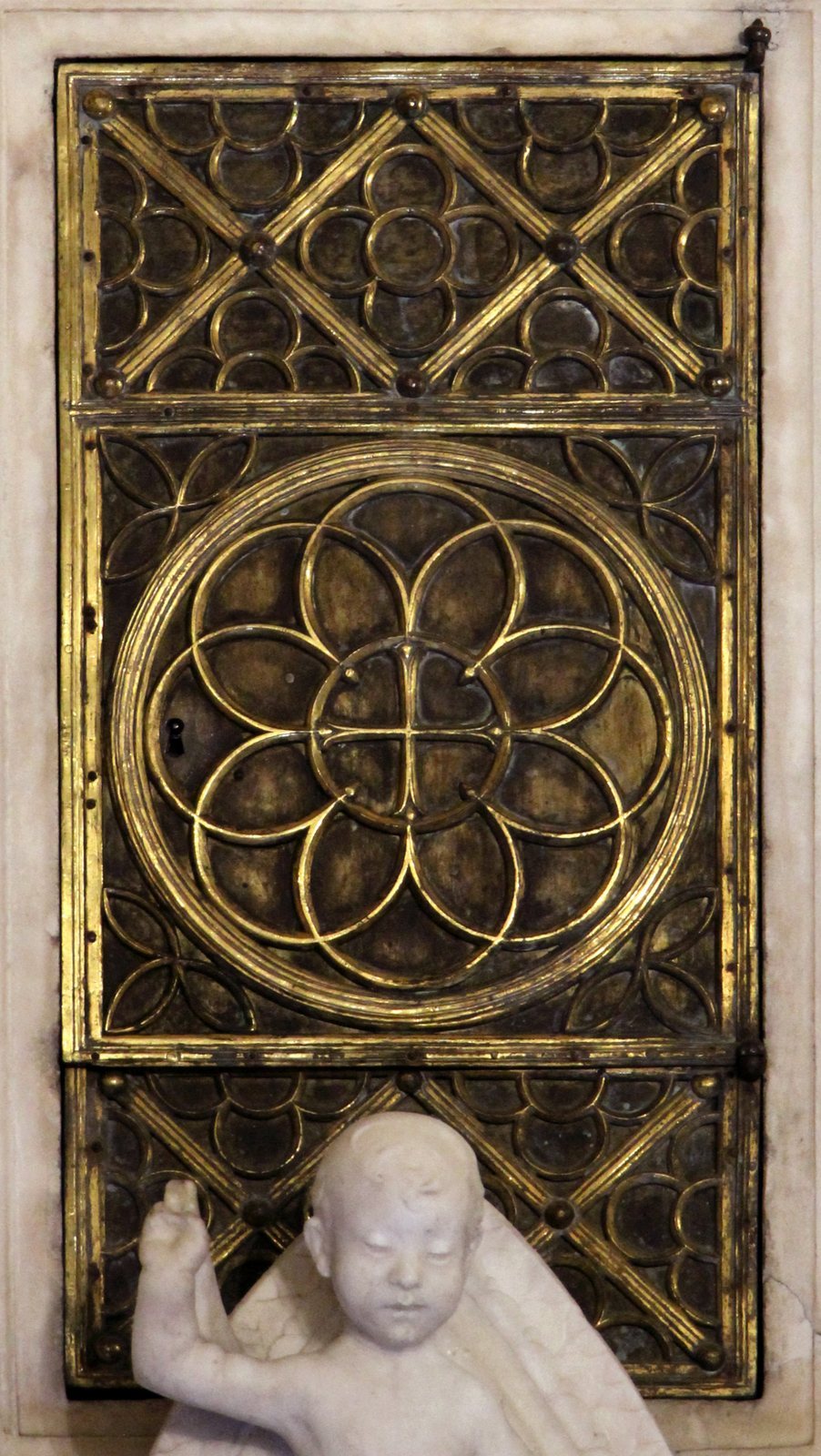
A metal door made by Giusto da Firenze in 1483–1484 closes the tabernacle. Its lower carved panel shows Uguccione handing the relic to Sant’Ambrogio’s abbess, amid kneeling worshippers that include nuns and prominent figures. Two women open doors through which further kneeling people enter. The work has a northern European character and bears the signature Opus Mini; traces of its original gilding survive. Shallow-carved figures of Faith, holding a chalice, a plate and a cross, and Hope, with joined hands, occupy niches at the sides of the altar.
Frescoes and preparatory drawing
Vault and painted decoration
Rosselli’s frescoes include musical angels beside the tabernacle and Doctors of the Church in the vault, set against a starry sky. The sky is red today but was originally blue. The paintings were once more vivid and included gold finishing, qualities compared with Rosselli’s work in the Sistine Chapel.
The Miracle of the Chalice
The left arched panel depicts the miracle in the square before the church. On the right is the churchyard; a palace appears in the center background, while a building at the left includes a woman hanging out laundry, with the Florentine hills beyond. Priests and nuns gather around the ampulla, displayed by a bishop. Rosselli included small naturalistic touches, such as a nun’s shadow on the church’s white façade and a painted window whose stone frame indicates the position of a real opening. Clothing, hairstyles and women’s headwear are rendered with care. The scene probably represents the public display of the relic in 1340, associated with the attempt to avert plague. Giorgio Vasari considered it Rosselli’s finest work in Florence.
A young woman leading two children by the hand turns toward the viewer; added after the preparatory drawing, she directs attention toward the central action. The procession is divided between men and women and includes numerous portraits. Rosselli’s self-portrait appears at the far left. Three young men at the center are identified as the philosopher Marsilio Ficino, the humanist Giovanni Pico della Mirandola and the poet and scholar Agnolo Poliziano. Pico, in green, stands between the other two, and his portrait was copied for Paolo Giovio’s gallery of notable men. Their interlaced hands may allude to controversy over Pico’s philosophical theses, presented to the pope around this time. His thirteenth thesis concerned the Eucharist; in 1488 he was excommunicated and briefly imprisoned. Three elderly men kneel in front of the churchyard. One prominent figure in black may be a member of the Medici family. At the church door, Francesco di Stefano della Torre receives the reliquary, with the abbess Maria de’ Barbadori behind him.
The scene also shows the earlier reliquary as an ivory chest decorated with purple fabric and inlays of gold sheet. A detached preparatory drawing for the fresco is displayed on the wall immediately before the chapel. It preserves perspective lines for placing the buildings and figures, with some bodies sketched without clothing to clarify their forms beneath the drapery. It also reveals changes made during the work: the kneeling man before the chalice was first planned as Saint Benedict, with a beard, a shaved crown and monastic clothing, while Pico’s portrait was initially placed among the three young men at the left. The scene’s lines and gazes lead toward the marble tabernacle.
Reliquary and other works
The present reliquary
The blood is held in an ampulla protected by a cylindrical crystal casing. Its partly gilded silver reliquary resembles a stand for displaying a sacred object. The elongated hexagonal base has a punched border of egg shapes and a smooth moulding separating it from the stem. A niche above contains the fitting that joins the crystal case to the stem, supported by two slightly notched metal rings. Two flying angels, formed in raised and engraved metal, hang at the sides. A smaller angel on top holds an elongated finial that supports a circular ornament with angel heads, rays and clouds. That upper ornament is a modern addition.
Earlier altar works
Alesso Baldovinetti’s panel shows angels and Saints Ambrose, Lawrence, John and Catherine of Alexandria in adoration. It once framed the earlier tabernacle made for the ampulla and is now on an altar in the church’s left aisle. Two candle-holding angels made of colored glazed terracotta by Giovanni della Robbia, dated 1513, also belong to the chapel’s works.