Thespiae: An Ancient Greek City-State in Boeotia
Site at a Glance
- Popularity
- Very High
- Country
- Greece
- Primary era
- Classical
- Eras represented
- Iron Age, Classical, Medieval
- Civilizations
- Ancient Greek, Roman
- Site type
- City
On this page21 sections
History
Thespiae was an ancient Greek city in southern Boeotia, Greece, at the eastern foot of Mount Helicon. It probably developed from several settlements in the late Geometric or Archaic period, and its foundation is placed before about 750 BCE. The city rivaled Thebes and played an active part in the changing alliances of central Greece.
Early settlement and the rise of the city
People inhabited the area in the Neolithic period, and a mound from the late Neolithic era lies within the later city’s area. Thespiae itself seems to have taken shape from settlements east of its later urban center. Greek traditions described the Boeotians as migrants from Thessaly who settled their namesake region over several generations after the mythical Trojan War, with Thespiae occupied at a later stage. Other traditions connected the Boeotians with Mycenaean origins. Homer mentions Thespiae.
The city’s early position remains uncertain. It may first have grown around Apollo’s temple at Toumboutsi and shifted to its later location after the Persian Wars. Local stories linked Thespiae to Narcissus, who fell in love with his reflection, and to Heracles’ encounter with the Lion of Cithaeron. In another tale, Menestratus killed a dragon that demanded a youth each year by wearing spiked armor and allowing the creature to swallow him. Traditions also connected Mount Helicon with the Muses, Pegasus, and the spring Hippocrene, and offered different explanations for the city’s name: King Thespius or Thespia, a water nymph abducted by Apollo.
Regional power and the Persian Wars
In the late seventh century BCE, much of Thespiae’s land and wealth belonged to a small group of nobles. Many could not afford the equipment of hoplites, heavily armed infantry who fought in close formation, so the city relied on Thebes for protection. Thespians destroyed Askra sometime between 700 and 650 BCE and later settled Eutresis, probably between 600 and 550 BCE. They may also have taken control of Creusis, Siphae, Thisbe, and Chorsia late in the sixth century BCE. In the Classical period, their territory included Lektra and Eutresis.
The Boeotian League, a federation of cities in Boeotia, formed around 520 BCE under Theban leadership. A Thessalian invasion that reached Thespiae before the second Persian war may have encouraged the city to join. Herodotus’ narrative suggests that Thespiae belonged to the federation for as long as Thebes did. Its control of smaller cities and harbors, including Siphae, offered access to a sea route that avoided passage through the lands of powerful states such as Athens. Thespiae could also choose among alliances with Athens, Sparta, and nearby Plataea. After the Persian Wars, it supplied two Boeotarchs, military and political leaders of the League, rather than one. One may have represented the city and the other its dependent districts.
In 480 BCE, about 700 Thespian hoplites fought beside the Spartans at Thermopylae against the Persian army of Xerxes I. Tradition holds that they remained until the battle’s final day; another possibility is that they withdrew with other Greek forces and were overtaken and killed on their way home. Thebes sided with Persia, leaving Thespiae and Plataea among the few Boeotian cities aligned with the Greeks. Xerxes’ forces burned both cities. Thespiae’s survivors later contributed 1,800 men to the Greek army at Plataea, and their city was rebuilt.
Struggles with Thebes and fourth-century rebuilding
During the Athenian invasion of Boeotia in 424 BCE, Thespian forces suffered heavy losses at Delium. The following year, Thebes dismantled Thespiae’s walls, accusing the city of supporting Athens. The action may also have been intended to forestall a democratic revolution. When such a revolution took place in 414 BCE, Thebes helped suppress it.
Thespiae first joined the alliance against Sparta during the Corinthian War. At Nemea in 394 BCE, its contingent fought the Pellenes from Pellene to a standstill while the Boeotians defeated other Spartan allies. Thespiae then allied with Sparta and became a staging point for Spartan campaigns in Boeotia. The King’s Peace of 386 BCE, a treaty that ended the Corinthian War and recognized the autonomy of Greek cities, dissolved the Boeotian League and made Thespiae autonomous.
Thespiae retained its independence until 373 BCE, when Thebes ended its autonomous status and expelled its citizens from Boeotia. In 371 BCE, Thespians joined a force marching against Sparta at Leuctra, but the Theban general and statesman Epameinondas allowed them and other anti-Theban Boeotians to leave before the battle. Thebes soon destroyed Thespiae and expelled its inhabitants. They returned in 346 BCE, after the Peace of Philocrates, and rebuilt the city.
Alexander, Rome, and the changing countryside
In 335 BCE, Thespiae allied with Alexander the Great against Thebes, which Alexander then destroyed. A tradition credits the Thespian-born courtesan Phryne with offering to pay for the rebuilding of Theban walls on condition that an inscription name both Alexander as their destroyer and her as their restorer. Thespian soldiers who campaigned in Asia with Alexander dedicated a tripod to Zeus the Thunderer in memory of their ancestors.
Thespiae supported the Roman Republic in its war against Mithridates VI, king of Pontus, and received the status of a free city within the Roman Empire. Roman merchants formed a substantial community there until Corinth was refounded in 44 BCE. The writer Strabo counted Thespiae as one of only two settlements in the region that could be called a city. Military lists dating from the 260s to about 146 BCE show a sharp fall after 180 BCE in the number of twenty-year-olds liable for service, usually to fewer than twenty. Administrative changes may explain part of the decline, but a falling population is also considered likely.
In Late Antiquity, the transition from the ancient Roman world to the medieval era, Thespiae had numerous churches. Some villages and rural settlements abandoned during the Roman period were occupied again between the fourth and seventh centuries. Rural sanctuaries sometimes continued to function as farms after losing their religious role. Farming became more market-oriented than in the largely self-sufficient Classical era, with greater emphasis on olives, grain, pulses, and fodder, and settlements increasingly concentrated on fertile alluvial soils.
Byzantine and later settlements
During the Byzantine period, the Eastern Roman Empire and its continuation, the territory was probably reorganized around a network of similarly sized villages. The old city-state boundaries lost their former importance. Erimokastro remained a bishopric, an ecclesiastical district under a bishop, during the Frankish period that followed Western European conquest, and its settlement belonged to a monastery. Under Ottoman rule, the settlement moved west to a more defensible location called Neu-Erimokastro, now Thespies. Albanians founded Kaskaveli, also known as Leonari, in the fourteenth or fifteenth century.
Exploration and commemoration
Three houses still stood on the ancient city site in 1802, but they were later abandoned. William Martin Leake visited in 1802 and 1806. Panagiotis Stamatakis excavated at the site in 1882, and Paul Jamot led excavations from 1889 to 1891. Anthony Snodgrass and John Bintliff surveyed the area in 1989–1991. In 1997, Greece dedicated a monument at Thermopylae to the Thespians who died there, beside the older Spartan memorial.
Remains
The ancient city occupied a plain among hills at the eastern foot of Mount Helicon, near a river and an old route leading north into Greece. A road connected Thespiae with its harbor at Creusis. The urban footprint changed over time, while the area of the ancient city remains largely free of modern construction.
Urban plan and fortifications
City extent and acropolis
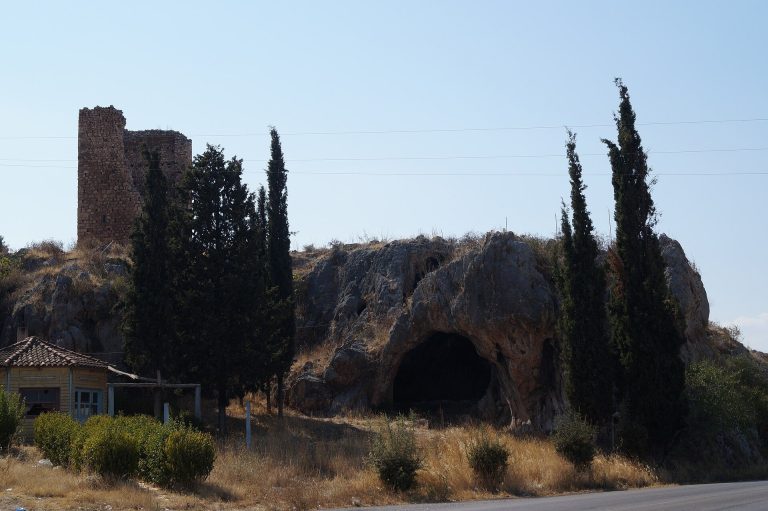
At its greatest extent in the late Classical period, the closing phase of Classical Greek history, the settlement covered about 95 hectares. It later contracted and shifted its focus eastward. The probable acropolis, the city’s fortified high area, is marked by an oval line of fortifications. Foundations extend east and south of the enclosure. Leake considered its outline unusual and suggested that buildings may also have stood beyond its walls.
Later fortified enclosure
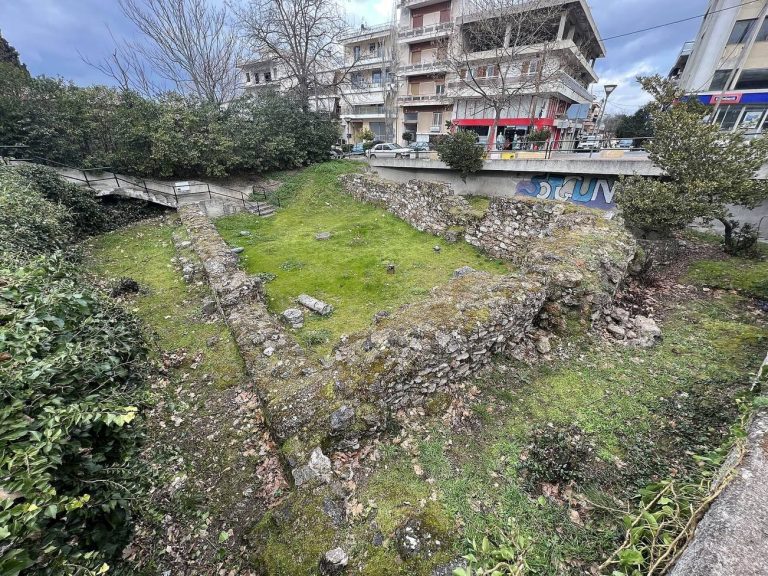
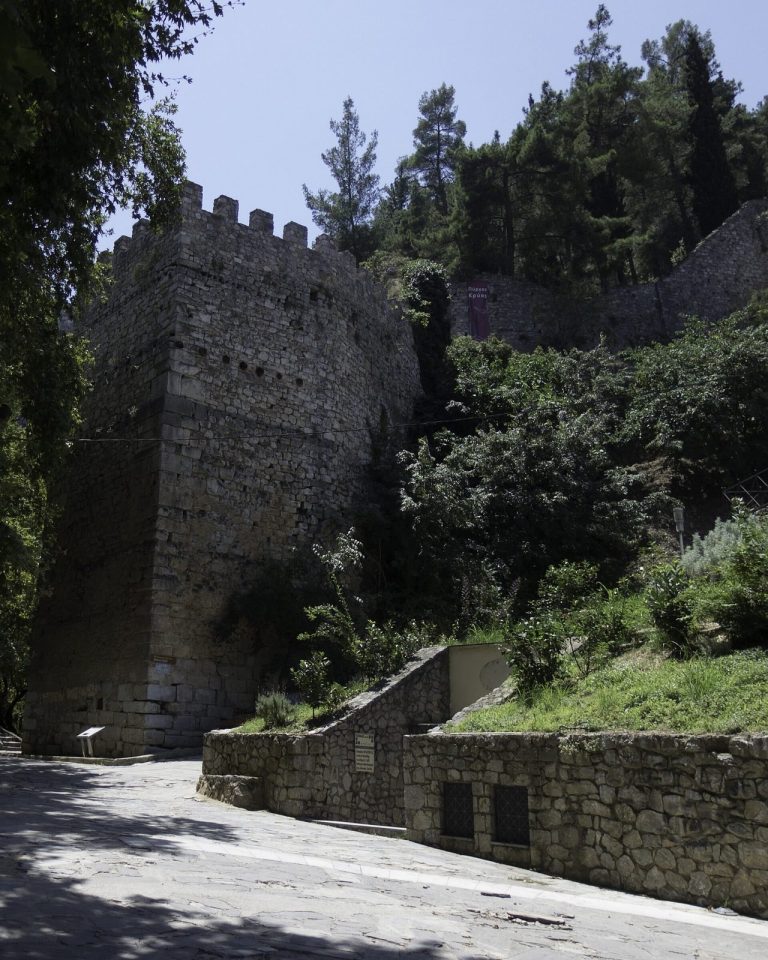
A fortified area of about 12 hectares was established within the city in the fifth century or later. Its construction reused blocks from the Classical city wall and other earlier remains, including a statue of Vettius Agorius Praetextatus, a governor in the late fourth century. Brick finds indicate that numerous new buildings were also put up in the Roman period. The Roman settlement covered about 42 hectares.
Burial grounds
Cemeteries
Cemeteries lay outside the Archaic city, especially beside roads. In the Classical period, burial grounds surrounded the settlement. Thespiai West stood about half a kilometer to the west; part of this cemetery was built over during the Roman period, when the area became a focus of settlement.
Communal tomb on the road to Leuctra
A communal tomb discovered on the road to Leuctra dates to the second half of the fifth century BCE. It contained cremated remains associated with a pyre that had been built at the site, seven burials, and a colossal stone lion. The tomb is usually identified as the burial place of Thespian soldiers killed at Delium in 424 BCE.
Rural settlements and sacred places
Farms and settlements
Thespiae’s surroundings included large farms, villages, small towns, isolated farmsteads, and rural sanctuaries. Askra, in the Valley of the Muses, covered about 11–12 hectares. Papoutsi, also called Toumboutsi or Topitsi, stood near a bridge over the Askis Potamos.
Temples and the Valley of the Muses
Papoutsi had a Classical-period temple to Apollo, excavated by Jamot. It may be the temple of Apollo Archegetas named in an inscription. The Valley of the Muses also contained a shrine to the Muses, while a sacred grove on Mount Helicon hosted a festival. A Temple of the Muses on the mountain was associated with boys’ dancing in honor of the goddesses.
Sculpture and the cult of Eros
Images of Eros
Pausanias described Eros as the deity most worshipped at Thespiae. The earliest image he described was an unworked stone. The sculptor Praxiteles made a marble statue of Parian stone, and Lysippos created a bronze image. Praxiteles’ statue drew visitors in antiquity. Caligula took it to Rome, Claudius returned it to Thespiae, and Nero later removed it again.
Aphrodite and Hera
Praxiteles also made an Aphrodite associated with Thespiae. The Venus of Arles is thought to have been modeled on that work. A statue of Cithaeronian Hera was also associated with the city.
Church remains
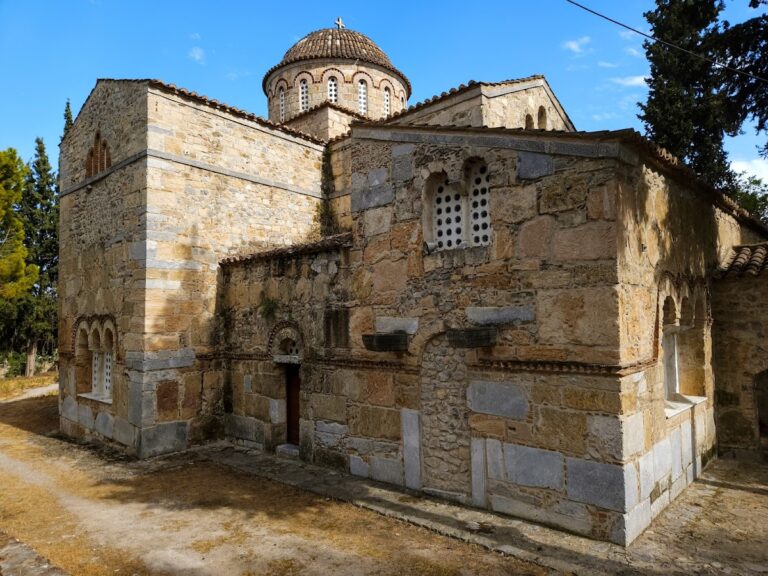
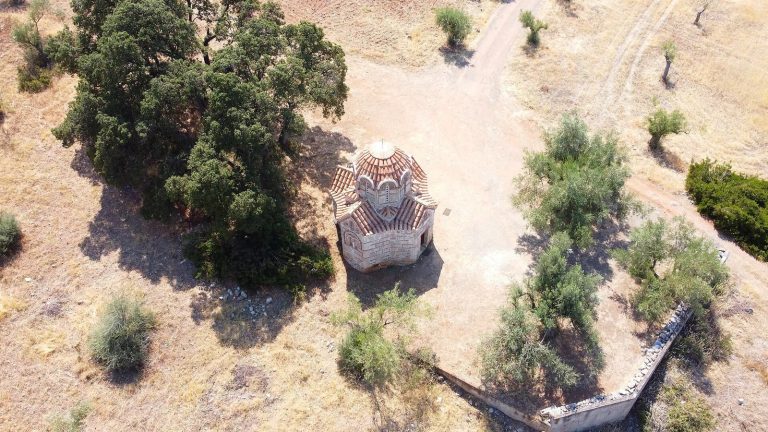
Ruins of numerous Late Roman churches were still partly visible in the nineteenth century. Leake also noted early Christian and medieval church remains, together with sections of the Roman city wall.