Buttforde Church: A Romanesque Lutheran Church in Germany


Site at a Glance
- Rating
- 4.8
- Popularity
- Very Low
- Country
- Germany
- Primary era
- Medieval
- External website
- Open
- Eras represented
- Medieval, Early Modern, Modern
- Civilizations
- Holy Roman Empire
- Site type
- Religious
- Remains
- Church
On this page15 sections
History
Buttforde Church is a Protestant Lutheran church in Buttforde, a district of Wittmund in Germany, built around 1230 in the Romanesque period. Its parish can be traced to the first half of the thirteenth century and is now affiliated with the Evangelical Lutheran Church of Hanover. The church stands on an artificially raised mound beside a sandy Geest outcrop, a raised area in the otherwise low-lying landscape of northern Germany.
Medieval parish and church
During the Middle Ages, the parish belonged to the ecclesiastical court district of Stedesdorf and to the Archdiocese of Bremen. Its territory comprised the farming community of Buttforde, also known as Oberrott, and Endzetel, also known as Niederrott. The beginnings of settlement at Buttforde remain uncertain. A wooden predecessor on the church mound is considered probable, although it has not been established whether the present building directly replaced an earlier church.
Several objects predate the current structure and support the possibility of earlier worship on the site. They include three Romanesque gravestones, a granite baptismal font probably made in the late twelfth century, and a Romanesque holy-water basin. The present church later received its dedication to Mary. Its free-standing brick bell tower also belongs to the thirteenth century.
Reformation and early modern changes
A stone rood screen, the barrier between the nave and choir, was built in 1450. In the medieval church, its upper level provided a place for liturgical readings, while its side niches served altars. After the Reformation, the screen was adapted to Protestant use. In 1681 it received an organ, a balustrade, and painted Baroque emblems. The central section bears the alliance arms of Count Christian Eberhard of East Frisia and his first wife, Eberhadine Sophie of Oettingen-Oettingen.
Structural problems brought major repairs during the seventeenth century. The west wall was rebuilt in 1636, and the apse, the semicircular end of the church, was almost entirely reconstructed in 1685 after part of it collapsed. Brick was used in these repairs, whereas the original main building consists almost entirely of granite blocks. A porch was added at the west entrance in 1672. The former Romanesque round-arched portals in the north and south walls were then blocked.
The church’s furnishings also developed during this period. A pulpit basket was made in 1655 in the Early Baroque style. Its decoration includes the donor’s arms and paintings of Martin Luther, the central reformer of the Lutheran Reformation, and John the Evangelist. In 1695, a staircase showing the other three Evangelists and a gallery displaying Moses and the prophets Isaiah, Jeremiah, Ezekiel, and Daniel were added.
The 1681 organ was made by Joachim Richborn, a seventeenth-century North German organ builder. It is the only instrument by him that remains largely preserved and is regarded as having international artistic and musical importance. Its sound remains close to that of the late seventeenth century despite its almost equal temperament. Alfred Führer extensively renovated the instrument in 1949, after its wing doors had been removed and replaced with carved wooden ears by Gerhard Janssen Schmid in 1803.
Modern preservation
Further major repairs and renovations took place in 1898 and 1955. A comprehensive restoration followed between 1977 and 1981. The church is protected as a monument and is included in the list of historic churches in East Frisia. Its surviving furnishings preserve evidence of the building’s medieval origins, its adaptation after the Reformation, and its continued use in the early modern period.
Remains
Church structure and bell tower
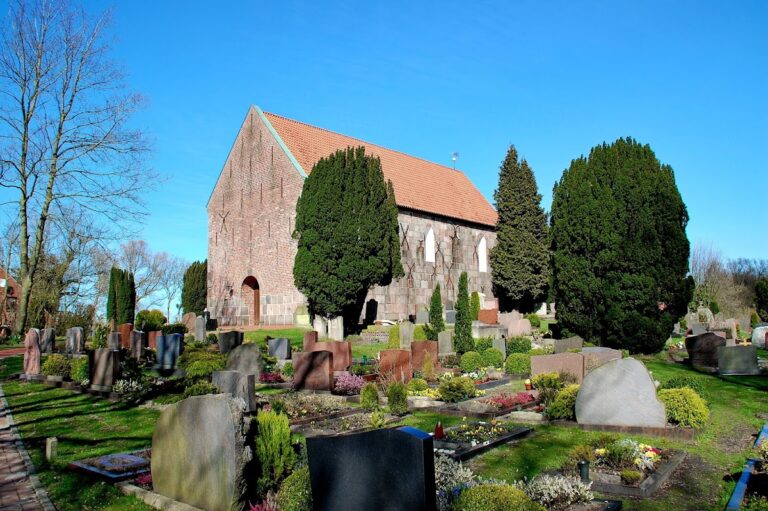
Buttforde Church is a Romanesque hall church with a recessed semicircular apse. Each long wall has three round-arched windows. The north wall retains the blocked former women’s door, while the south wall retains the blocked men’s door. The original interior was divided into three bays covered by a domical vault. After that vault collapsed, it was completely removed and replaced by a flat timber ceiling, and the walls were lowered by approximately one metre. Fragments of the original transverse arches survive.
Bell tower and medieval bell
A free-standing bell tower stands southeast of the church. Built of red brick on a square plan, it has a pyramidal roof and almost completely enclosed walls with rectangular sound openings beneath the eaves. Its bell originally hung in the free-standing tower of the former Mary Magdalene Church in Fulkum. Berend Klinghe of Bremen cast it beside that church, and it was later brought to Buttforde. The inscription names the bell Maria, identifies Klinghe of Bremen, and gives the year 1475. It also names saints, and the bell is said formerly to have carried an image of Mary Magdalene.
Rood screen and altarpiece
Stone rood screen
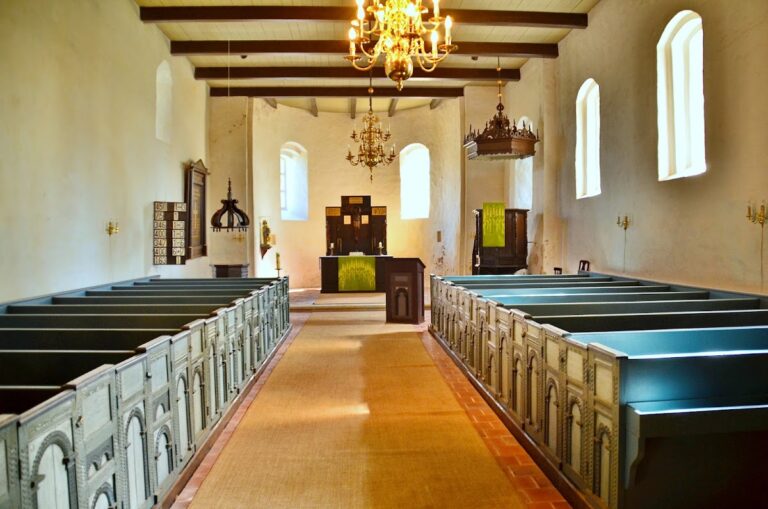
The choir and nave are divided by a three-arched stone rood screen, one of only three surviving stone rood screens in East Frisia. Its central passage remains open. The two side niches are walled at the rear and functioned as ciboria, canopy-like structures associated with side altars. The upper level was used for reading liturgical texts. The later organ, balustrade, and Protestant Baroque emblems form part of the screen’s post-Reformation adaptation.
Late Gothic winged altar
The carved altarpiece is a small, nearly complete winged altar dating from approximately 1450 to 1480. Its three high-quality reliefs portray episodes from the life of Mary: the Nativity, the Adoration of the Magi, and the Circumcision of Jesus. It is one of seven surviving late-medieval carved altarpieces in East Frisia.
The case has coloured diagonal stripes that are probably original, while its gold background is a modern addition. It stands within a larger construction containing a bench-like predella, the raised base beneath an altarpiece, with Baroque paintings of the Evangelists; a back wall with folded-pattern panels; and a projecting canopy. The canopy’s underside carries a 1656 inscription containing the Lord’s Prayer, the words of institution, and the Creed. Openwork seventeenth-century scrollwork runs along both sides of the case.
The relationship between the altarpiece’s components is partly uncertain. The larger surround appears to reflect a later enlargement, probably at the beginning of the sixteenth century. The dates of the reliefs, folded-pattern panels, and canopy cannot all be securely assigned to the same phase.
Furnishings and devotional objects
Seating, organ, and gallery
The Renaissance church seating is well preserved, with turned-bar grilles and carved cheek pieces. Some doors retain their original paint and the date 1667, revealed during the most recent renovation. Later Rococo ornament was renewed on other benches. Many seats bear house marks of old Buttforde families, indicating that they were once privately owned. Turned kneelers made by P. Alken in 1670 are also preserved. At the west end is the church patron Edzard von Specht’s gallery, known as the Junker’s Seat, whose painted balustrade dates from 1703.
Sarcophagus lids and baptismal furnishings
In the southeast corner of the choir stands an upright Romanesque former sarcophagus lid made of red sandstone. Consecration crosses show that it was temporarily used as the slab of a side altar. In 1642 it was reshaped as a gravestone for Friedrich Hinrichs Hilgemann and given a new border inscription.
The vestibule contains another trapezoidal red-sandstone sarcophagus lid, prepared in 1646 as the gravestone of the preacher Conradinus Grashuis. Remains of an earlier Gothic inscription show that it had already served as a gravestone. A third lid, made of yellow sandstone, stands beside the southern projection of the apse. It retains its original decoration of a three-peaked motif with three crosses, including a prominent club-shaped cross.
The plain granite baptismal font probably dates from the late twelfth century. The church also contains a Romanesque holy-water basin. Late-medieval wooden figures stand on wall consoles and in the window reveals. They include a fourteenth-century enthroned Madonna, a Madonna on the crescent moon, and a Pietà from around 1500. A Pietà represents the Virgin Mary mourning over the dead Christ.
Chalices and communion vessel
A chalice donated in 1693 by the pastor of Bunder, Cadovius, and his wife was made by Johann Iderhoff, a master from Esens. Another chalice replaced a lost sick chalice in 1706. The principal sacred vessel is a hexagonal communion box with small lion feet. Made in Emden in 1649 by Jacob Tobias Johanns or his grandson Tobias Janssen Kremer, it is regarded as unique.
Paintings and memorials
Three paintings depict the Conversion of Paul, Daniel in the Lions’ Den, and Christ. The Conversion of Paul probably derives from a mirror-image copy of a painting by Peter Paul Rubens. The other two works date from the eighteenth century. Two funeral shields, dated 1664 and 1652, hang on the walls, together with epitaphs for Anna Magdalena Hoyer, dated 1682, and Margareta Brunken, dated 1691. The latter includes a painting of the deceased. Two brass chandeliers in the central aisle date from 1650 and 1693.