Beningaburg Dornum: A Medieval Water Castle in Germany


Site at a Glance
- Rating
- 3.9
- Popularity
- Low
- Country
- Germany
- Primary era
- Medieval
- Eras represented
- Medieval, Early Modern
- Civilizations
- Holy Roman Empire
- Site type
- Military
- Remains
- Castle
On this page8 sections
History
Beningaburg Dornum is a medieval water castle in Germany, in the town of Dornum, whose origins are connected with the local chieftain families of East Frisia. Its construction date remains uncertain. Tradition places its building between 1375 and 1380 under Olde Hero Attena, while another dating assigns the construction to 1428. Around 1400, Dornum had three chieftain’s castles, the Westerburg, the Norderburg, and the Osterburg, which preceded the later Beningaburg.
From the Osterburg to the Attenas
In 1410, the Osterburg passed by inheritance to Enno, the son of Olde Hero Attena. Enno’s son Sibold, also known as Olde Sibo, married Frauwa, the daughter of Enno Edzardisna and Gela of Manslagt. Frauwa was also the sister of Ulrich and Edzard Cirksena, members of a family that became prominent in East Frisian rule.
Sibold probably died in the Battle of Bargebur in 1433. His son Sibet Attena later married Onna of Stedesdorf and became the father of Hero Omken the Younger. Sibet supported Ulrich Cirksena, a fifteenth-century East Frisian nobleman who received the rank of imperial count, meaning that he held his territory directly from the emperor of the Holy Roman Empire. Sibet was knighted during the ceremony at the Gasthaus Church in Emden at which Ulrich received the Imperial County.
Conflict and the Kankena succession
During Ulrich Cirksena’s conflict with Tanno of Wittmund, Sibet captured the Kankenaburg in Wittmund on Christmas night in 1457 and built a new castle there. A settlement reached in 1461 required Tanne Kankena to surrender his Wittmund castle, while he received the Osterburg in Dornum as compensation.
Sibo Attena died in 1473, and his son Eger Kankena inherited the castle. Eger’s third son, Remmer Kankena, later became its lord. Remmer died without children, possibly in 1545, and the Osterburg then passed to his sister Nona. She was married to Folkmar I Beninga of Grimersum, linking the castle to the Beninga family.
The Beninga period
Nona and Folkmar I died of the plague. Their son Garrelt, who had married Cäcilie of Closter in 1533, became the owner and died in 1546. His son Folkmar II Beninga, who died in 1572, strengthened Beninga control of the property. The Dornum branch of the family shaped the castle’s history for almost two centuries, until 1717. During this period, the former Osterburg became known as Beningaburg, and the adjoining road took the name Beningalohne. The Lantzius-Beninga family later succeeded the Beningas.
The final male succession of the Beningas ended with the death of Folkmar Eger Beninga in 1717. Through the female line, the castle retained its aristocratic character until 1802. It entered private ownership in 1814 and again in 1817, and its sale in 1817 began a succession of further private changes.
Restoration and later use
In 1971, the Dornum merchant Erich Appelkamp acquired Beningaburg in a ruinous condition. Restoration and conversion continued for almost eight years and were completed in 1978. The work concentrated on detailed reconstruction while preserving as much of the historic building fabric as possible. The restored castle became a hotel and restaurant, a use it continues to have.
Remains
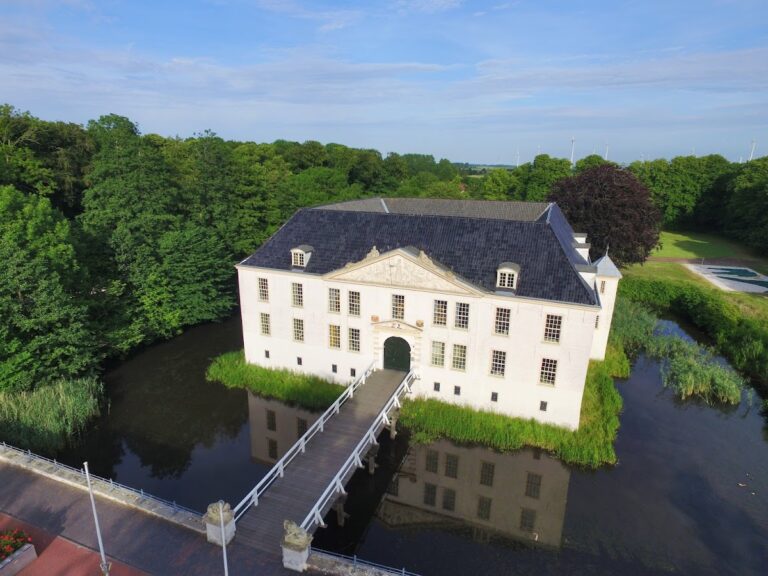
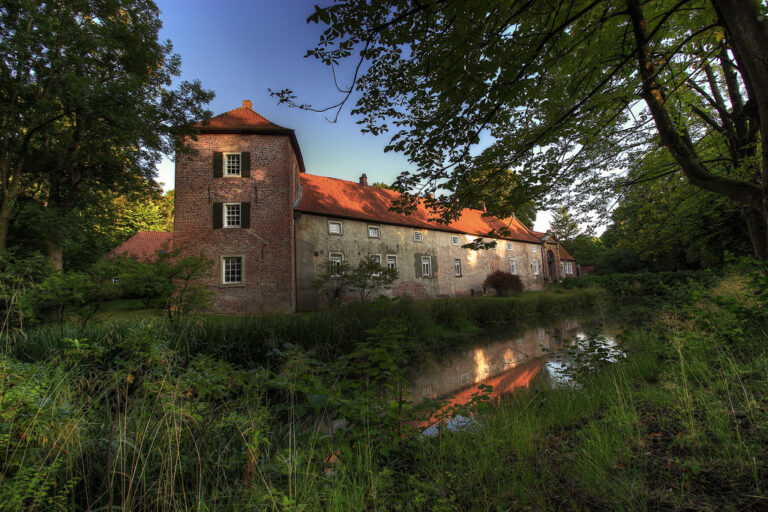
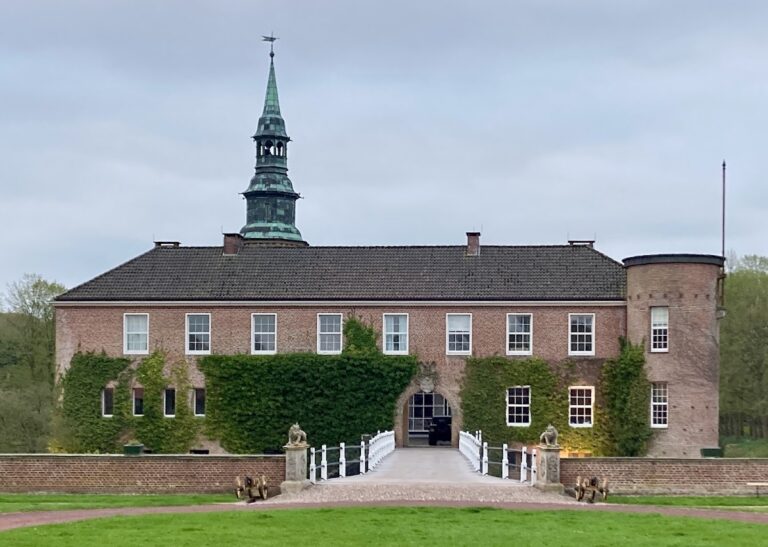
Beningaburg survives as a medieval lowland castle, or Niederungsburg, built on relatively flat ground, with the defensive setting of a surrounding moat. Old trees remain around the castle. The original Osterburg, later called Beningaburg, consisted of three wings, of which two survive.
Gatehouse and surviving wings
The two-storey gatehouse has a rounded gateway and was built in 1567 by the knight Folkmar Beninga. The east wing had been destroyed in 1547 and was reconstructed in the same year as the gatehouse. The south wing was renewed in 1669 under Boyung Beninga. Above a door from this period is a shared Beninga–Ehrentreuter coat of arms.
Interior rooms and restored fabric
An ancestral hall contains portraits representing the succession of the Beninga family. The restoration carried out between 1971 and 1978 adapted the historic structure for hotel and dining facilities while retaining as much of the existing fabric as possible. The building therefore combines surviving medieval and early modern elements with its later restored interior use.