St. Ägidius: Baroque Parish Church in Gmund am Tegernsee


Site at a Glance
- Rating
- 5
- Popularity
- Very Low
- Country
- Germany
- Primary era
- Early Modern
- External website
- Open
- Eras represented
- Medieval, Early Modern
- Civilizations
- Duchy of Bavaria, Electorate of Bavaria, Holy Roman Empire
- Site type
- Religious
- Remains
- Church
On this page15 sections
History
St. Ägidius is a Roman Catholic parish church in Gmund am Tegernsee, Germany, whose present Baroque building was constructed between 1688 and 1692 by Lorenzo Sciascia, a builder from Roveredo in Graubünden. The church was dedicated in 1693 to Ägidius, or Saint Giles, identified here as a Benedictine abbot and traditionally associated with the cult of the Fourteen Holy Helpers.
Early parish and medieval church
Gmund was already an original parish in the Tegernsee area before Tegernsee Monastery was founded in the eighth century. The settlement and its parish priest, Gerwig, are mentioned around 1075, during the tenure of Tegernsee Abbot Eberhard II, who held office from 1068 to 1091. By 1087, a stone church dedicated to the Archangel Michael stood on the site. Masonry from this building remains incorporated in the lower part of the present tower.
Baroque rebuilding and monastic furnishings
The present church was erected from 1688 to 1692 in the Baroque style and consecrated the following year under the patronage of Ägidius. Its furnishings were closely connected with Tegernsee Monastery, a Benedictine monastery in Bavaria. Much of the interior equipment came from the monastery either soon after the church was completed or during the middle of the eighteenth century.
Further furnishings arrived after the monastery was dissolved in 1803. The Gmund parish priest Buchberger, who had formerly belonged to its convent, brought additional objects to the church. This history accounts for the presence of several pieces associated with Tegernsee Monastery, including the high altar, the pulpit statuettes, and the oratory.
Damage, repair, and continuing use
Lightning struck the tower on 16 July 1817, severely damaging its masonry, steps, and organ. Repairs and renovations followed in 1835, 1857 to 1860, 1900, 1953 to 1954, 1975, and 1998 to 2001. The interventions included repainting the interior, repairing stucco, redesigning the interior shell, shortening the high altar, removing finishes from the pulpit, oratory, and pews, and restoring the interior.
An organ and organists are known at the church from the seventeenth century. The present organ was built in 1985 by Anton Staller of Grafing near Munich. Its four electric combination setters and couplers II/I, I/P, and II/P serve the instrument installed on the upper level of the gallery.
The church belongs to the Gmund-Bad Wiessee parish association in the Miesbach deanery of the Archdiocese of Munich and Freising. The Old Cemetery surrounds the church and contains 352 graves. The parish also administers the New Cemetery, established behind the school in 1904, with 156 grave plots.
Remains
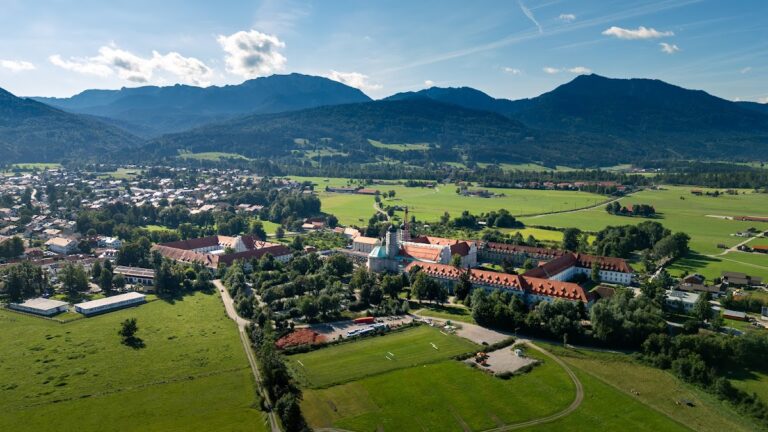
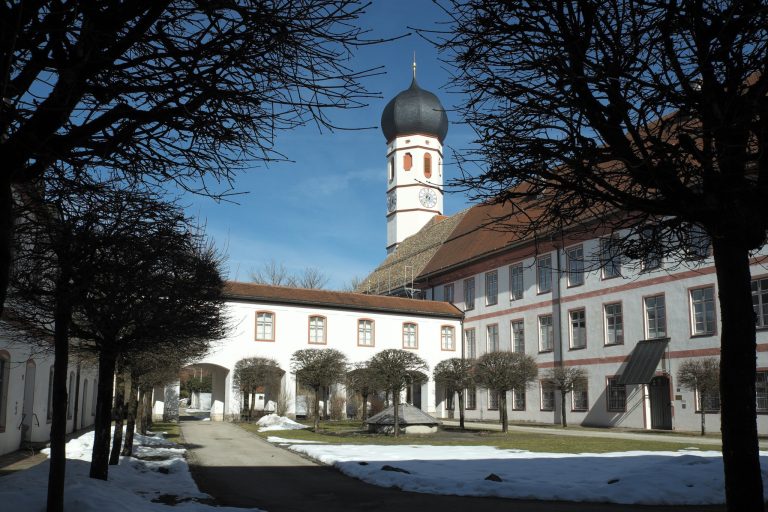
St. Ägidius stands on elevated ground above the settlement of Gmund, on the southern bank of the Mangfall. Its restrained exterior is not oriented eastward. The four-bay nave and slightly narrower one-bay choir form the principal body of the church, with the choir ending in a semicircular apse. Gabled roofs cover the nave and choir, while the apse has a half-conical roof.
Church body and tower
Nave, choir, and entrance
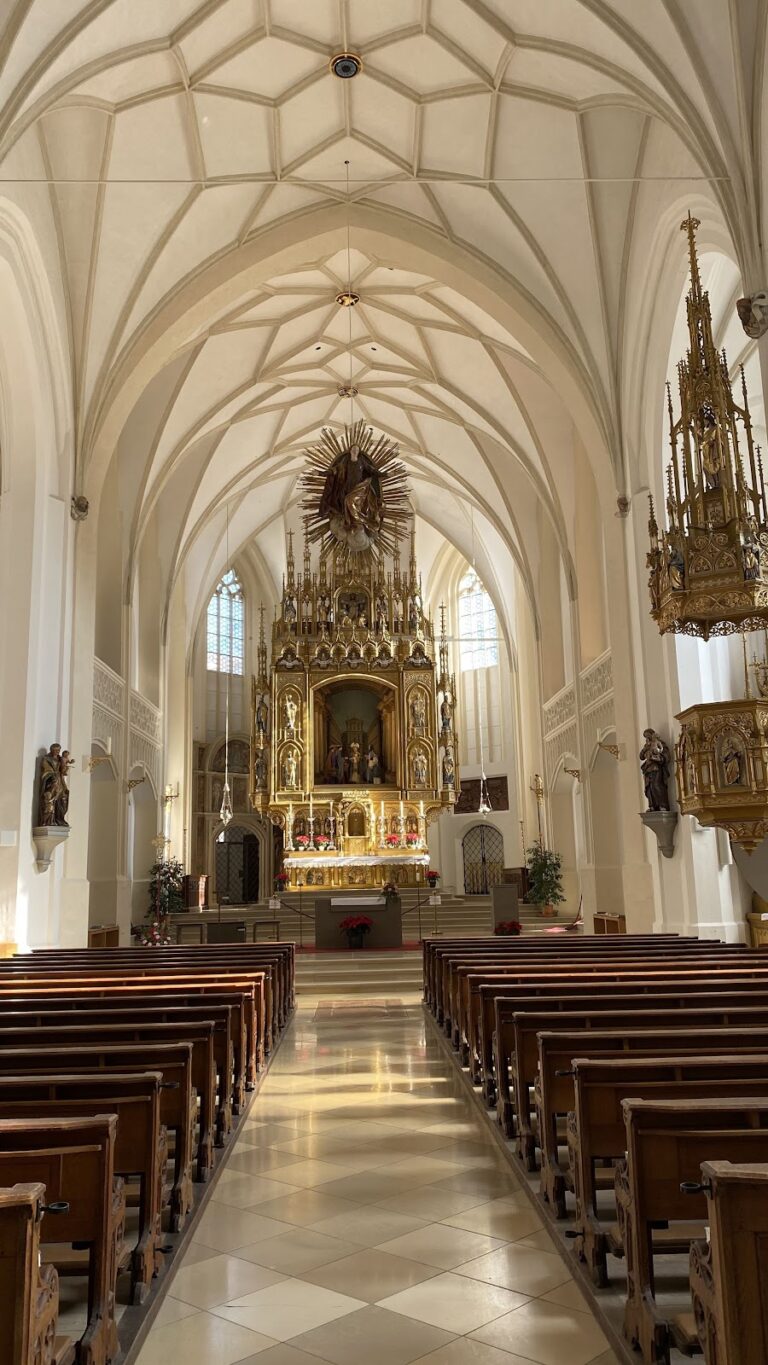
A porch protects the entrance portal on the south-eastern side of the nave, and a two-storey sacristy is attached to the same side. Inside, the building is a wall-pillar church, a form in which substantial wall piers support the vault and organize the interior bays. Transverse and shield arches frame the vault surfaces, which are enriched with stucco decoration.
The nave has a barrel vault with lunettes, smaller curved vault sections that cut into the main vault above the window axes. In the apse, a quarter-spherical vault rises above the semicircular end. Transverse oval windows are placed above the large round-arched windows. A two-storey gallery stands before the south-western gable wall, with the 1985 organ occupying its upper level.
Tower and mortuary chapel
A multi-storey tower rises centrally before the south-western gable of the nave. Its lower masonry incorporates remains of the stone church built by 1087. The uppermost storey is octagonal and houses five bells. Above it, a bulbous dome carries a papal cross and a weather vane.
A mortuary chapel is attached to the southern corner of the tower. Several niches within the chapel contain built-in bones. The tower’s bell installation includes a steel bell frame with cranked yokes. The four largest bells form the principal peal, while the oldest and smallest is used alone as a death bell.
Altars and devotional furnishings
High altar and side altars
The high altar was made in 1640 as a confraternity altar for Tegernsee Monastery and acquired for St. Ägidius in 1692. Its painting, The History of Saint Ägidius, dates from 1692 and was made by Hans Georg Asam. Two side altars stand at the chancel arch, the structure separating the nave from the choir. They date from 1761, and the altarpiece on the right depicts Saints Nicholas and John the Baptist, also in a work by Hans Georg Asam.
Pulpit, font, and oratory
The Baroque pulpit was made in 1691 by a cabinetmaker from Lenggries and has a sounding board. Its statuettes, made by Hans Halders, originally belonged to the former choir stalls of Tegernsee Monastery. The baptismal font is formed from plain Tegernsee marble as an octagonal chalice, with a wooden cover topped by a group showing the Baptism of Christ.
An oratory, a small private or semi-private prayer space, is installed on the right side of the choir, directly behind the wall pillar of the triumphal arch on the first upper floor. It is reached through the upper floor of the sacristy and also came from Tegernsee Monastery.
Painted and movable devotional works
Twelve Apostle sculptures are painted white with gilded details. The Stations of the Cross consists of fourteen painted panels set in Baroque frames. A movable Mount of Olives scene made in 1827 contains painted scenery and movable figures. Lenten devotions connected with it have been held since 1744 and continue until Maundy Thursday.
The present Holy Sepulchre, a devotional installation representing Christ’s burial place, dates from around 1820. An earlier example made around 1740 by the Kochel painter Philipp Gugelhör is also associated with the church’s devotional furnishings.
Bells and cemeteries
Bell collection
Joseph Obermayr recorded four consecrated bells in 1868. Before the First World War, five bells hung in the tower, with the notes E-flat 1, G 1, B-flat 1, E-flat 2, and G 2. Their listed weights were 1,440 kilograms, 775 kilograms, 418 kilograms, 170 kilograms, and 100 kilograms.
The 1646 Marienglocke and the smallest bell survived from the bells recorded in 1868. Two others were recast in 1872 by Anton Oberascher of Reichenhall to produce three bells. The present group consists of five bells. The Marienglocke was cast in 1646 by the Munich founder Bernhard Ernst, while three further bells were cast in 1949 by Karl Czudnochowsky of Erding and consecrated on 6 January 1950. The maker of the small death bell is unknown.
The inscriptions preserve several layers of the bell collection’s history. The largest bell was recast in 1844 by the Munich founder Hubinger. The 1646 bell carries an inscription by Bernhard Ernst and the Latin words “Gloria in excelsis Deo, et in terra pax hominibus bonae voluntatis,” meaning “Glory to God in the highest, and on earth peace to people of good will.” Another bell bears “O rex gloriae, Christe, veni cum pace,” or “O King of glory, Christ, come with peace,” while the smallest carries “Maria hilf!”, meaning “Mary, help!” The Gloria inscription is written in Gothic minuscule lettering.
Burial grounds
The Old Cemetery forms the burial ground around the church, while the New Cemetery occupies a separate site behind the school. The two cemeteries are administered by the parish as distinct burial grounds, with the Old Cemetery containing 352 graves and the New Cemetery providing 156 grave plots.