Burgstall Oberntüchersfeld: A Medieval Hill Castle in Germany
Site at a Glance
- Rating
- 4.6
- Popularity
- Very Low
- Country
- Germany
- Primary era
- Medieval
- Eras represented
- Medieval
- Civilizations
- Unclassified
- Site type
- Military
- Remains
- Castle
On this page10 sections
History
Burgstall Oberntüchersfeld is the remains of a high-medieval hill castle in Tüchersfeld, Germany, probably built around 1240 on behalf of local medieval lords. It formed part of a pair of castles overlooking the Püttlach valley and a road crossing, alongside Lower Tüchersfeld. The site later became an administrative castle of the Bishopric of Bamberg, the ecclesiastical principality governed by the bishop of Bamberg.
A castle controlling the road through Tüchersfeld
A medieval route ran from Gräfenberg through Hiltpoltstein, Obertrubach, and Gößweinstein to Tüchersfeld. After crossing the Püttlach valley, it continued through Oberailsfeld and Waischenfeld towards Hollfeld. The two castles at Tüchersfeld were probably established to oversee this route and its river crossing.
The first surviving historical reference dates to 26 November 1243. It names a person as Friderici quondam de Thvchervelt, connecting the Tüchersfeld name with the castle community at an early stage. The two fortifications were distinct, although later records trace both through the changing feudal and territorial arrangements of the region.
Transfer to the Bishopric of Bamberg
On 27 May 1262, Bishop Berthold of Leiningen acquired one of the castles. The seller is not identified, but the property was probably the castle of Frederick of Tüchersfeld. In 1269, the bishop received the second castle as a gift from Duke Louis of Bavaria and Count Palatine of the Rhine. Louis had apparently redeemed it from Count Frederick of Truhendingen, who held it as a fief, a property granted by a lord to a vassal in return for service and allegiance. Before Frederick, Burkhard of Ahorn had held the castle in the same way.
The second castle remained subject to a dispute with Henry, Duke of Bavaria and Count Palatine of the Rhine. In a treaty dated 26 February 1287, Henry renounced his claim to the castle at Tüchersfeld. Both castles then belonged to the Bishopric of Bamberg. The episcopal register of 1323/27 lists the two Tüchersfeld castles among the bishop’s possessions.
Administrative use and division into two parts
Before the 1323/27 register was compiled, Upper Tüchersfeld had already become the seat of a small Bamberg administrative office. By 1386 at the latest, a revenue and treasury office had also been established there. This office managed episcopal income and supplies, and Walter Hauger of Rattelsdorf served as its administrator. The office had moved to Waischenfeld by 1399.
By the fifteenth century, the site consisted of an episcopal administrative castle and the Upper House, probably located on the northern part of the rock reef. From 1442, the administrative castle was consistently called a castle residence. The Upper House was held as an episcopal fief by the Groß family of Trockau. Eberhard Groß possessed half of its castle estate in 1422, while Jorg Groß held half of the Upper House in 1429.
Destruction and the later castle site
The Upper House had apparently been destroyed by 1445. An enfeoffment document from that year described it as the “Upper House of Tüchersfeld, known as the castle site.” The destruction probably took place during the Hussite Wars, the fifteenth-century conflicts associated with the religious reform movement founded by Jan Hus, in 1430. Later documents used the term burgstall, meaning a castle site whose buildings had largely been destroyed or levelled.
From 1461, documents refer to a house that Sittig Groß was said to have built, although its position in relation to the former castle site is uncertain. In 1480, Sittig sold the ruins to his nephews Andreas, Fritz, and Hieronymus of Seckendorff-Rinhofen because he needed money for his support. In 1481, Albrecht, Jakob, Eberhard, and Michael Groß again held the site as a fief, and the Groß family’s possession is recorded until 1628.
The part known as the Upper House was apparently not rebuilt after its destruction. The bishop continued to grant the castle site as a fief, while the former Upper House itself remained in its destroyed state. The Bavarian State Office for Monument Protection classifies Burgstall Oberntüchersfeld as a medieval castle site and a protected archaeological monument under designation D-4-6234-0037.
Remains
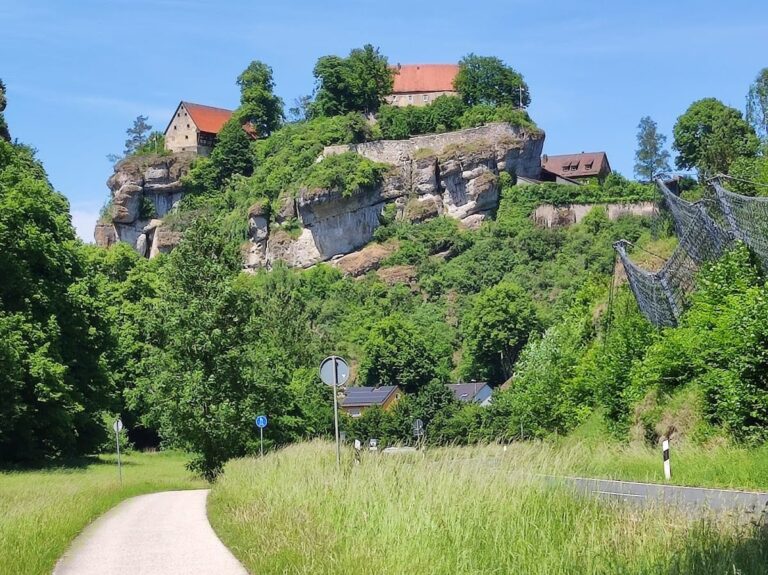
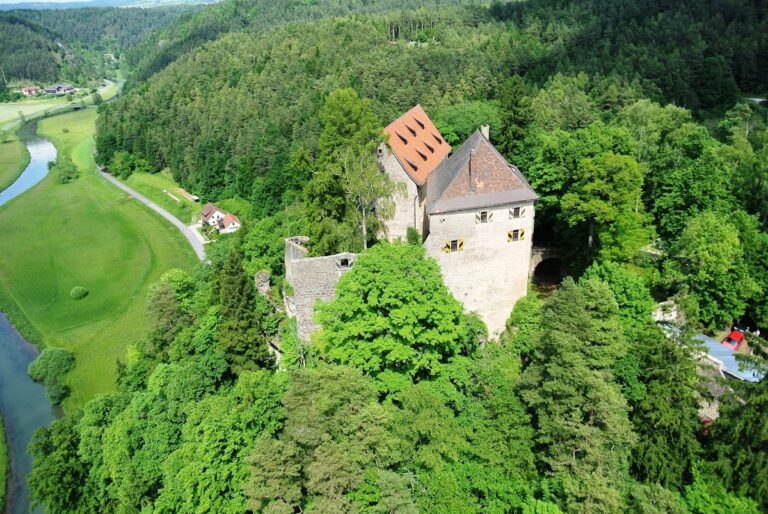
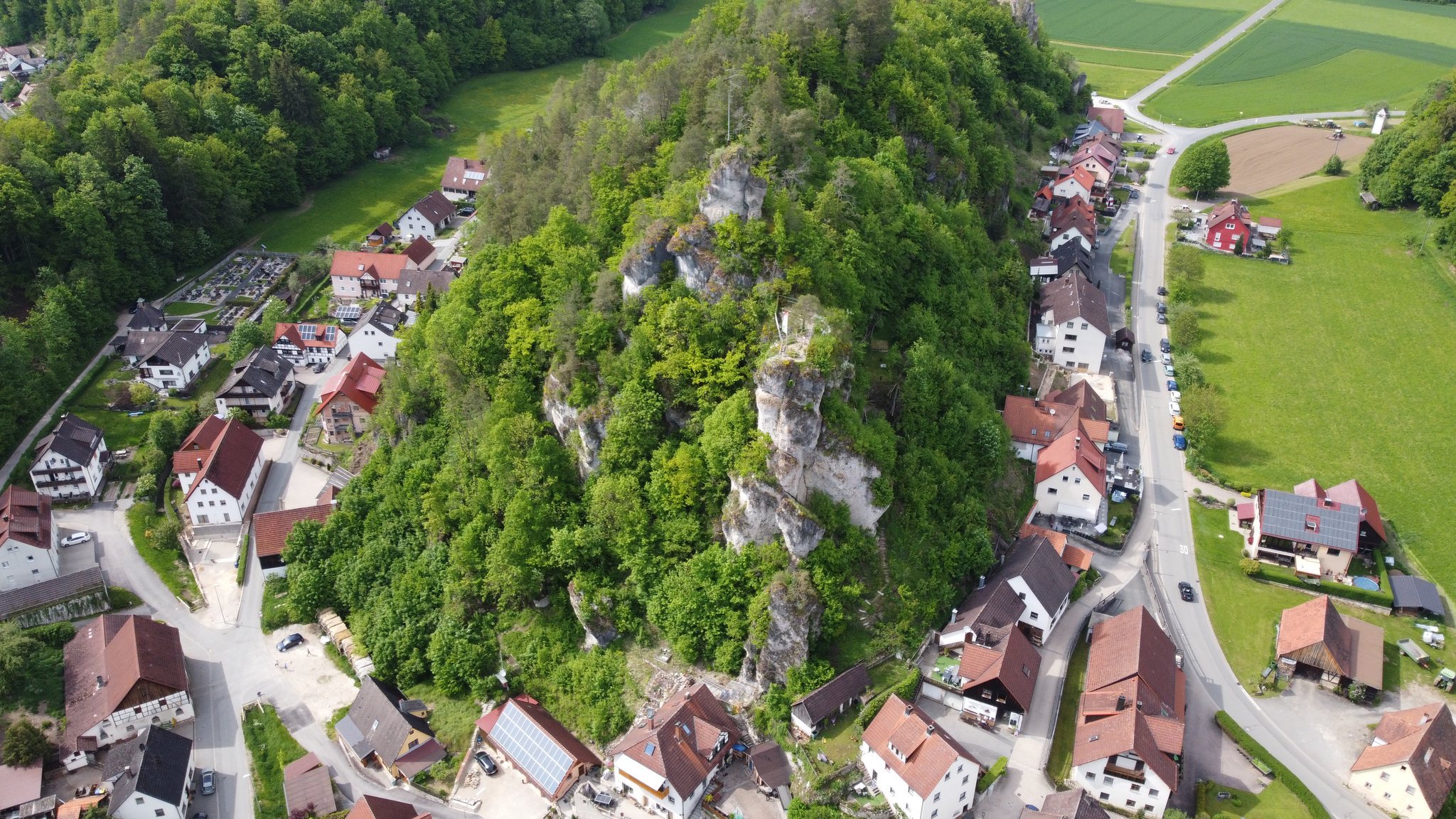
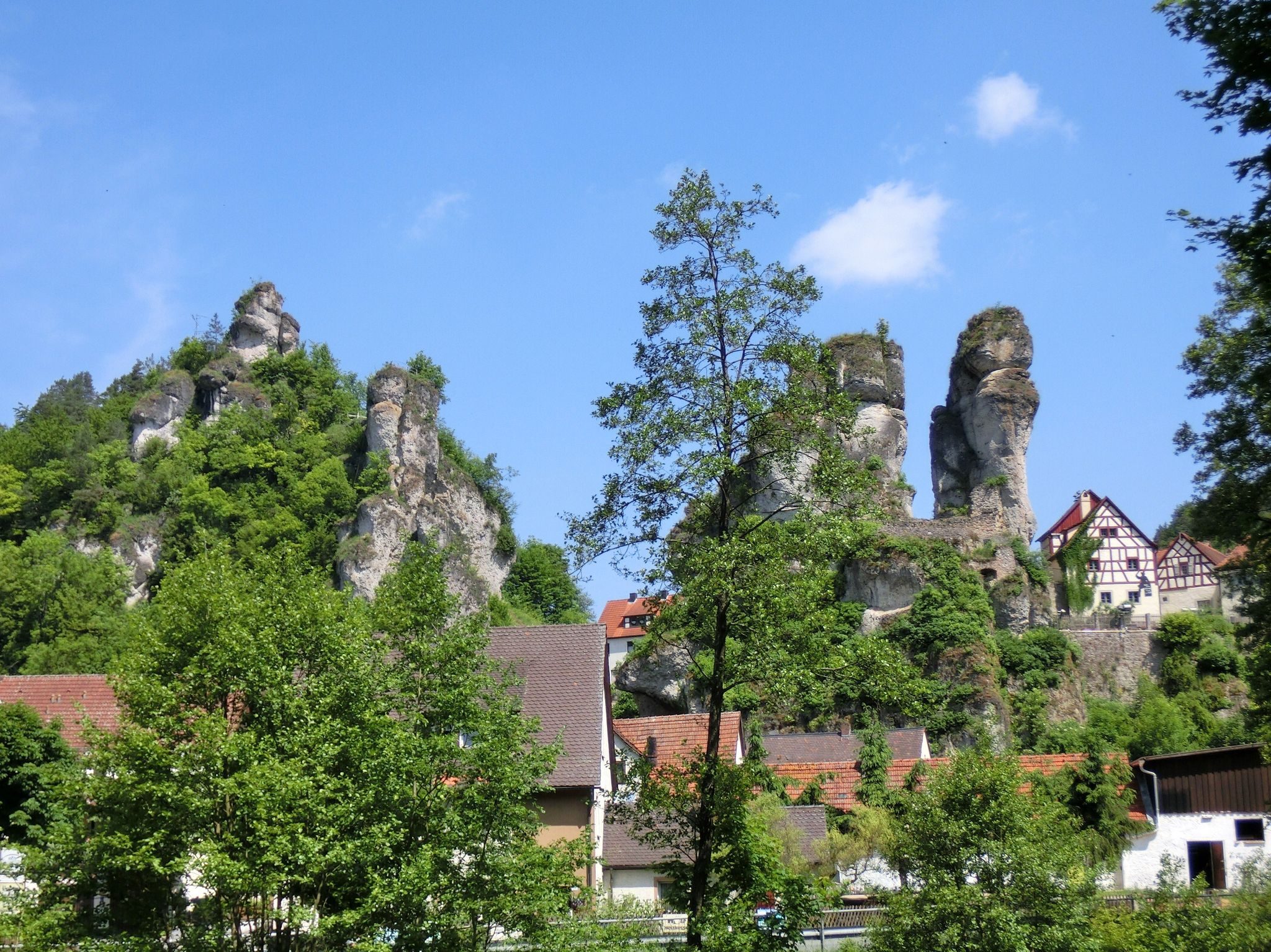
Burgstall Oberntüchersfeld occupies a spur of the Mittelberg above the Püttlach valley, at approximately 455 metres above sea level in the centre of Tüchersfeld, within the municipality of Pottenstein in Bavaria’s Bayreuth district. The hill castle was built on a rock spur or reef, with the complex divided between an episcopal administrative castle and the Upper House. The Upper House stood on a narrow, pointed summit, probably at the northern end of the rock formation.
Rock spur and surviving layout
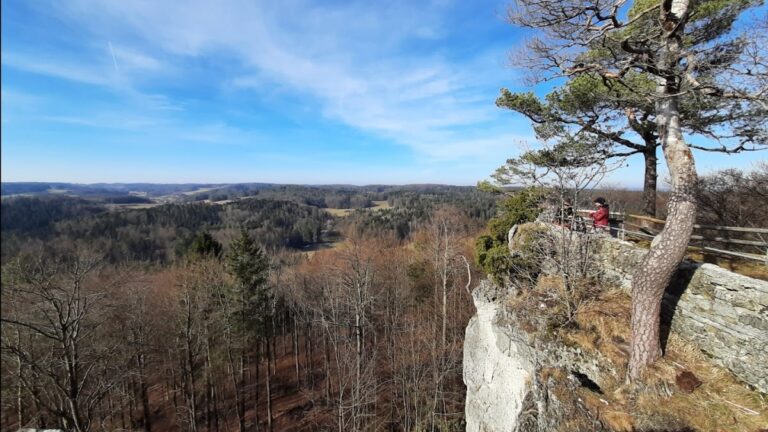
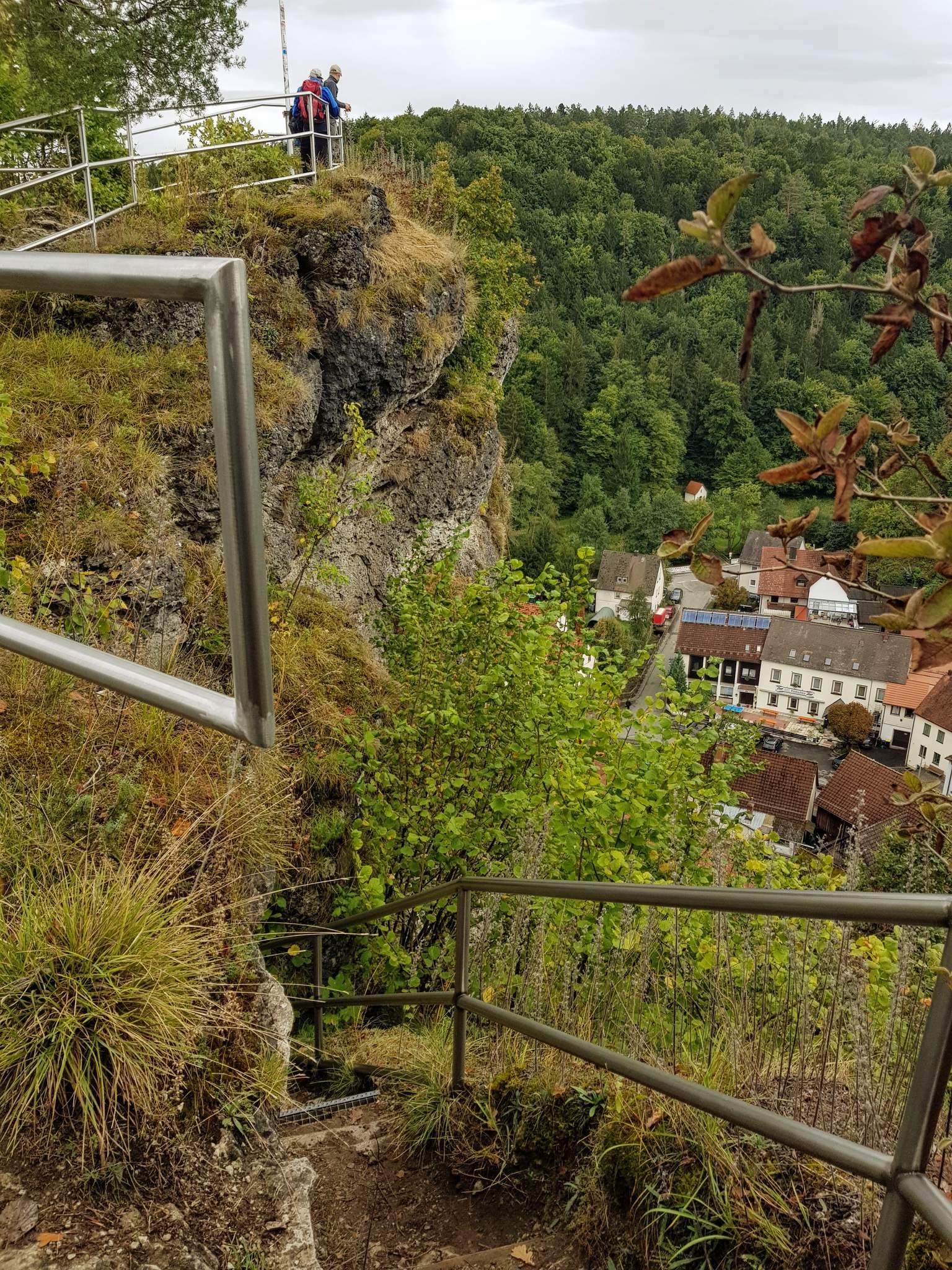
The former castle area is partly covered by dense woodland. The southern tip of the rock reef remains largely open to large trees and serves as a viewpoint. This exposed rock forms part of the surviving terrain of the castle site and helps convey its spur position above the valley.
Surviving architectural features
Passage cave and rock tower
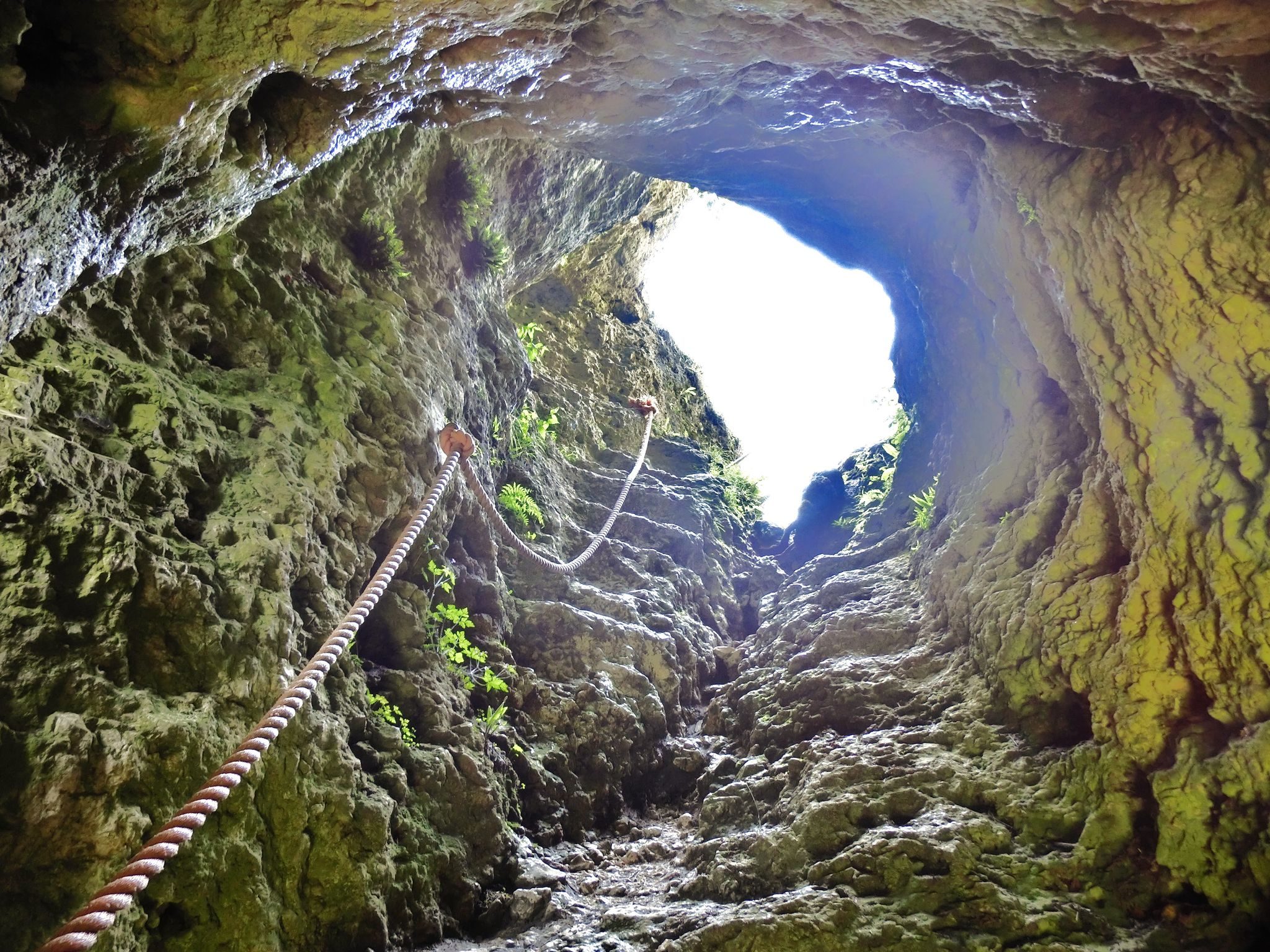
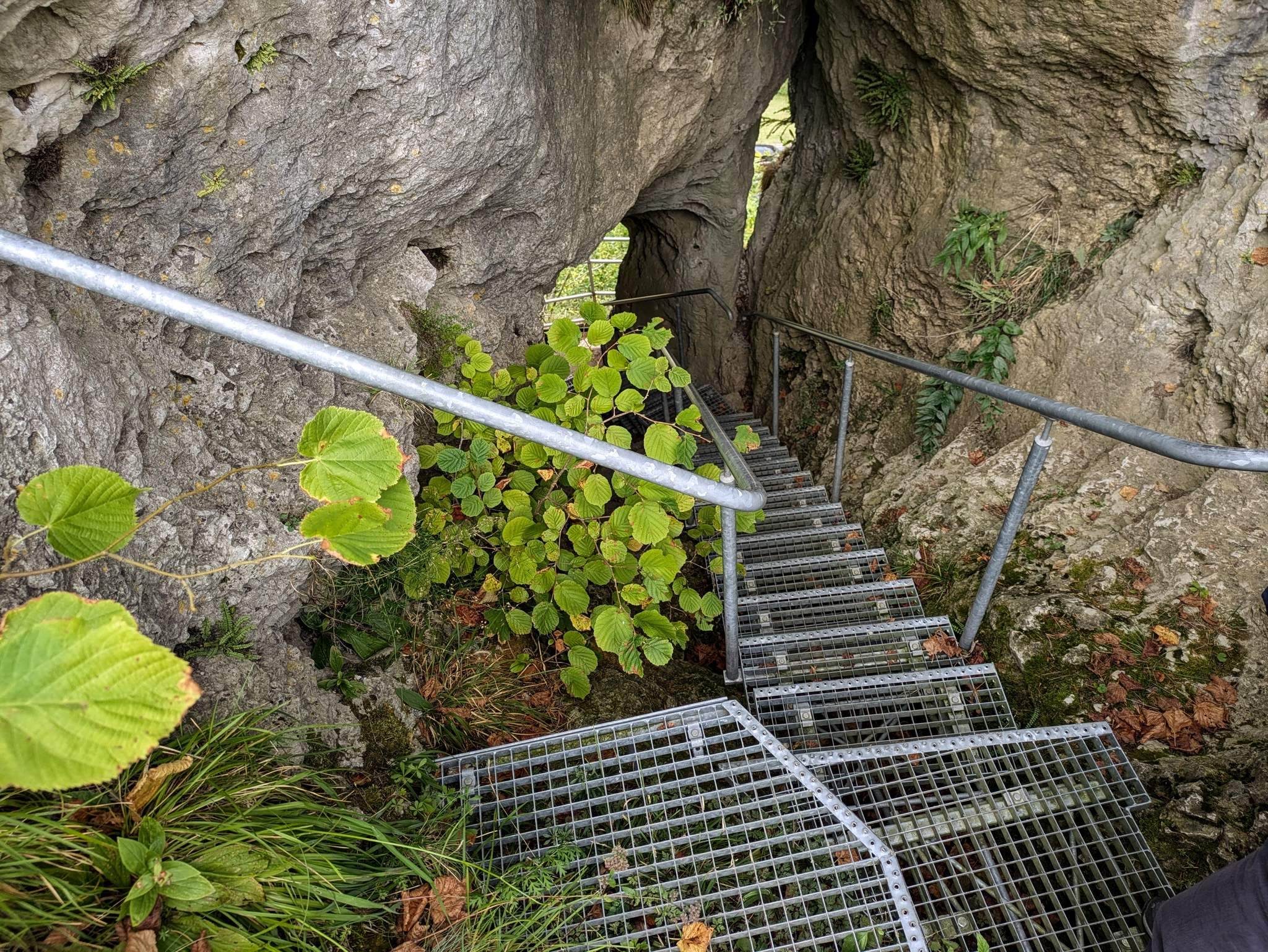
At the entrance to the southern tip, a small passage cave contains steps cut directly into the rock. The rock tower can be reached by a metal ladder. These features preserve traces of how the rocky terrain was incorporated into access to the former castle.
Castle plateau and foundations
Several remains of foundation walls are visible on the castle plateau. Together with the rock formations and the levelled character of the site, they represent the surviving physical evidence of the former buildings. The castle is classified as a burgstall, and its present remains consist chiefly of terrain features, rock-cut traces, and foundations rather than substantial standing structures.