Schloss Weinfelden: A Castle and Former Bailiff’s Residence in Switzerland


Site at a Glance
- Rating
- 4.3
- Popularity
- Very Low
- Country
- Switzerland
- Primary era
- Medieval
- External website
- Open
- Eras represented
- Medieval
- Civilizations
- Habsburg, Holy Roman Empire
- Site type
- Domestic
- Remains
- Castle
On this page8 sections
History
Schloss Weinfelden is a historic castle in Switzerland, built and expanded through successive medieval and early modern phases by noble families whose ownership was tied to the lordship of Weinfelden. The earliest builder of the first castle, recorded as Castrum Winvelde, is unknown.
Medieval ownership and expansion
In 1180, Hartmann von Kyburg transferred one-third of the castle to Berthold von Bussnang, Bishop of Constance. This division of ownership made agreement between later owners difficult. The castle became a Habsburg fief in 1339, meaning a holding granted under the feudal authority of the Habsburg dynasty, when Friedrich von Bussnang received it.
Neither Friedrich nor his son Albrecht lived at Weinfelden. Both resided at Neuenburg Castle, while Weinfelden served as a widow’s residence, property assigned to support and accommodate Friedrich’s wife, Kunigunde. The Bussnang family was responsible for expanding the castle.
The lordship from the fifteenth to the seventeenth century
After the ancestral castles of Bussnang and Neuenburg were destroyed, Hans von Bussnang sold Weinfelden Castle and the lordship of Weinfelden to Berthold Vogt of Constance in 1435. A lordship was a territory whose owner exercised jurisdiction and other rights. Vogt built a bridge over the Thur for Weinfelden, established his own court, and granted the community several liberties. The wars of the period later left him impoverished.
Following several changes of ownership, the Constance-based Muntprat family acquired the castle and lordship in 1498. The family allowed Weinfelden to appoint a municipal council in 1514, undertook a major renovation in 1541, and consolidated the entire holding in 1542. They sold it to Hans Dietrich von Gemmingen in 1551.
Jakob Fugger of Augsburg acquired the lordship in 1555, followed by Arbogast von Schellenberg in 1572. In 1577, Eberhard, Reinhard, and Hans Walter of an evangelical branch of the von Gemmingen family acquired it. They had the territory administered by Thomas Kesselring, a chief bailiff of the Reformed tradition, a Protestant movement that developed during the sixteenth-century Reformation.
The city of Zurich purchased the castle and lordship in 1614 and again made the castle a bailiff’s residence, the administrative seat of an official representing the ruling authority.
From lordship to private property
The legal subjection of the community to the lordship ended in 1798. Weinfelden subsequently acquired the extensive forests on the Ottenberg. During the nineteenth and twentieth centuries, the castle changed owners several times and progressively fell into disrepair.
When the property was offered for sale again in 1972, Munich banker August von Finck senior was the only financially capable prospective buyer. The Federal Department of Justice and Police authorized the purchase on 1 December 1972 despite nationwide criticism. The decision concerned the Lex von Moos, a Swiss restriction on the sale of real estate to foreign purchasers.
Working closely with Thurgau’s heritage-preservation authorities, von Finck rebuilt the castle in the condition it was considered to have had around 1700. The tower regained its pointed roof, and the main building was made habitable. A further renovation in 1997 redesigned the interior. After August von Finck junior’s death in 2021, the property passed to a community of heirs. Schloss Weinfelden is listed as a Class B Swiss cultural property of regional significance and is designated particularly valuable in the canton of Thurgau.
Remains
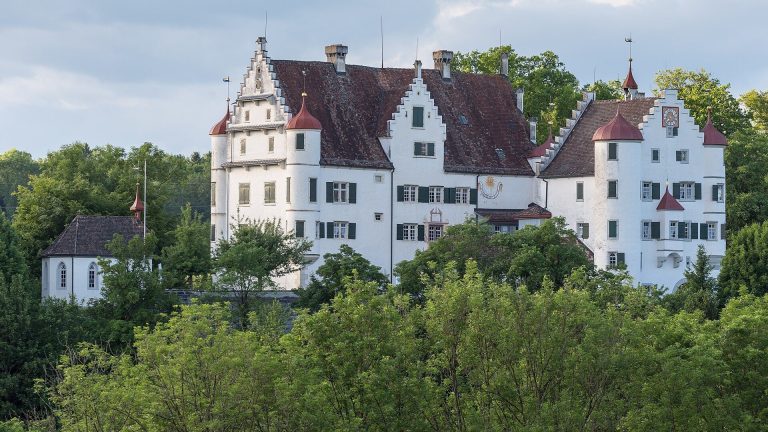
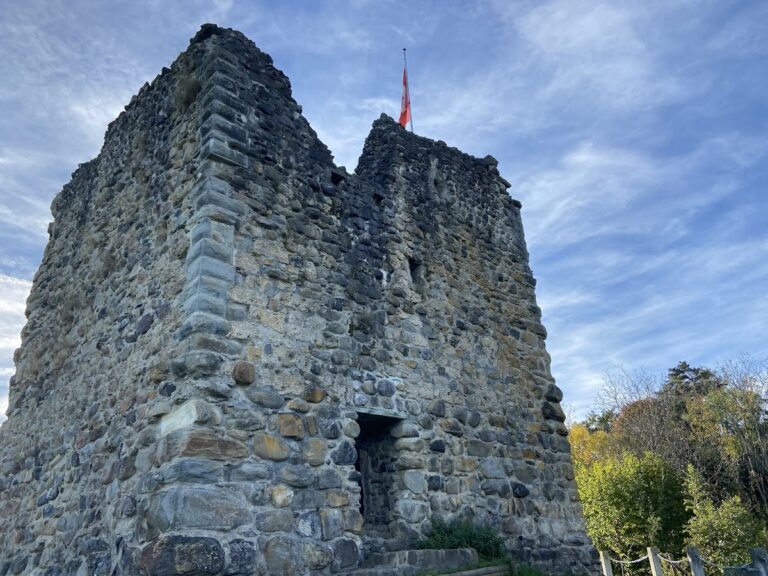
Schloss Weinfelden stands on the southern slope of the Ottenberg above Weinfelden in the canton of Thurgau. The surviving complex consists of a tower and a main building. Its present form reflects the reconstruction based on the condition attributed to the castle around 1700, together with the interior redesign carried out in 1997.
Main structures
Tower
The tower forms one of the two principal elements of the complex. During the twentieth-century reconstruction, it received a pointed roof intended to restore its appearance around 1700.
Main building
The main building is the second principal element of Schloss Weinfelden. It was made suitable for habitation during the reconstruction, and its interior was redesigned in 1997.