Schloss Damtschach: A Baroque Castle and Estate in Austria


Site at a Glance
- Rating
- 4.2
- Popularity
- Very Low
- Country
- Austria
- Primary era
- Early Modern
- External website
- Open
- Eras represented
- Early Modern, Modern
- Civilizations
- Habsburg, Holy Roman Empire
- Site type
- Domestic
- Remains
- Castle
On this page15 sections
History
Schloss Damtschach is a historic castle and estate complex in Austria, at the western edge of Damtschach in the municipality of Wernberg, Carinthia. Its core dates from the early sixteenth century, while later owners developed it into a Baroque ensemble with an adjoining church, manorial farm, and landscaped park.
From Aichelberg to the Khevenhüllers
The estate grew from a lightly fortified agricultural courtyard belonging to Aichelberg Castle. That castle was destroyed during the wars between Frederick III, the fifteenth-century Holy Roman Emperor, and Matthias Corvinus, the king of Hungary whose reign brought him into conflict with the Habsburg emperor. Afterward, Emperor Maximilian I permitted the castle lord Augustin Khevenhüller to enlarge the courtyard. Khevenhüller established a residence there, although the family preferred their nearby castles at Wernberg and Landskron. Stewards therefore administered Damtschach.
In 1629, the Protestant Freiherr Paul von Khevenhüller, who had to leave Carinthia, sold Damtschach, Aichelberg, and Wernberg, together with other properties, to Count Hans Sigmund von Wagensperg. Through the buyer’s granddaughter, the residence later passed to the Counts of Galler.
Baroque expansion and later ownership
The Galler family began shaping Damtschach as a coordinated Baroque architectural complex in 1684. After Clemens Ferdinand Count Kaiserstein acquired the estate in 1715, he substantially enlarged it with new agricultural buildings and a steward’s house. This phase strengthened the relationship between the residence and the working estate.
The Barons Jöchlinger von Jochenstein acquired Damtschach in 1817. Felix Wolfgang Reichsfreiherr Jöchlinger von Jochenstein established the English-style park in 1824, adding a landscaped setting with Biedermeier and Romantic furnishings. The Orsini-Rosenberg family has owned the castle and manorial farm since 1847.
The castle church
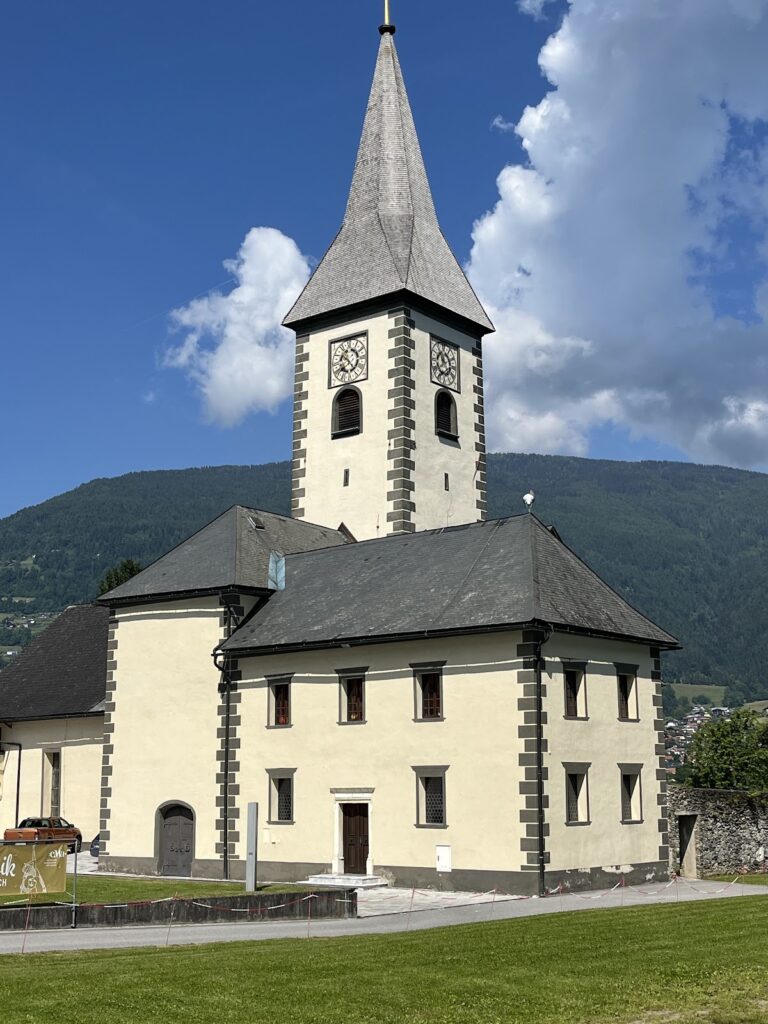
A sacred predecessor building on the site of the castle church was first documented in 1431. Countess Maria Isabella Galler, born Staudach, replaced it with the present church between 1684 and 1695. Dedicated to Saint John the Baptist, the chapel became a parish church in 1787 and retained that role until the consecration of a nearby new parish church in 2003.
Protection and restoration
The park and garden complex is legally protected as a historic monument and is regarded as one of Austria’s important garden-architecture monuments. Its ornamental park features were restored in 1997 using nineteenth-century illustrations as a basis.
Remains
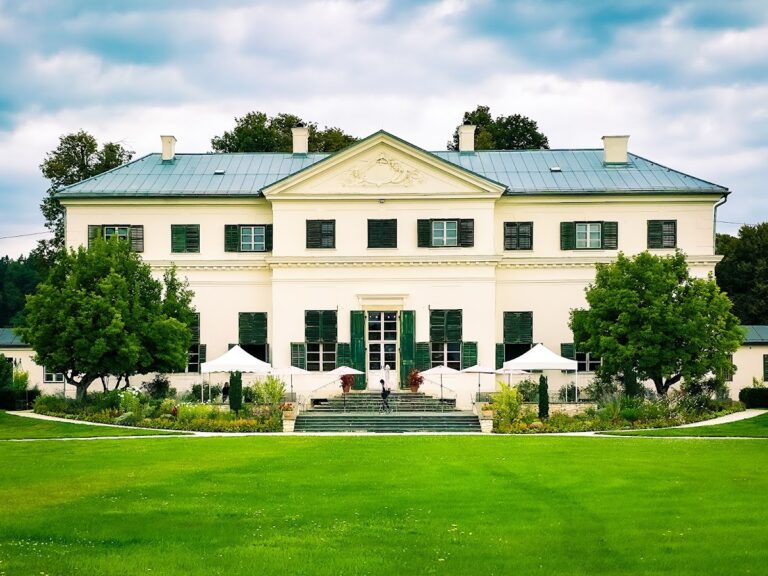
Schloss Damtschach consists of a castle and manorial farm arranged at the western edge of Damtschach. The principal building is a two-storey Baroque structure with three wings forming a horseshoe plan open toward the east, where it faces the castle park. The north and west wings retain sixteenth-century fabric. Because the ground falls steeply toward the south and east, retaining walls support the building on those sides.
Castle and courtyard
North and west wings
The eight-bay north facade contains a sixteenth-century ashlar portal with a sculpted keystone. The ground-floor rooms of the north and west wings also belong to the sixteenth century and have barrel-vaulted ceilings. A cornice canopy dates from approximately 1700, while the square ground-floor windows have stone surrounds.
Courtyard entrances and fountain
The courtyard entrance has a chamfered basket arch, a flattened and shallow arch form, beside which is the entrance to the house. On the south side of the courtyard, a small marble wall fountain made around 1600 has a basin beneath an arch supported by two small columns. Two angel heads occupy the spaces between the arch and its supports.
Garden portal
A pillar portal from the beginning of the nineteenth century separates the courtyard from the castle garden. Its entablature sections, the horizontal architectural bands above the supports, are crowned with vases.
Castle church
Church interior
The castle church occupies the south wing. It is a hall church, meaning that the nave forms one principal interior space rather than a taller central nave flanked by lower aisles. Pilasters, cornices, and a small rectangular altar niche shape the interior. The high altar dates from 1684, and Adam Claus’s oil altarpiece depicts the Baptism of Christ. The same subject appears in the medallion of the altar’s decorative frontal, or antependium.
Vault, chapel, and oratory
The church hall has a barrel vault with lunettes and notable ceiling stucco. Above the groin-vaulted side chapel on the right is an oratory, a private or semi-private prayer space, with nineteenth-century Neo-Gothic ornamental wall paintings. It contains a copy of a Byzantine image of the Virgin Mary wearing a gold crown.
Church tower and western portal
The church tower has round-arched sound openings, an onion dome, and a lantern, a small raised structure above a roof or dome that admits light. Its round-arched portal bears the date 1720. Immediately west of the church, another portal with a broken pediment, whose upper outline is interrupted at the center, dates from the last quarter of the seventeenth century. It displays the double coat of arms of the Galler and Staudach families.
Park and garden structures
The castle park was laid out in the English style in 1824 and contains Biedermeier and Romantic furnishings. Late Gothic door surrounds and Khevenhüller heraldic stones from the fifteenth and sixteenth centuries were incorporated into the garden wall as reused architectural elements.
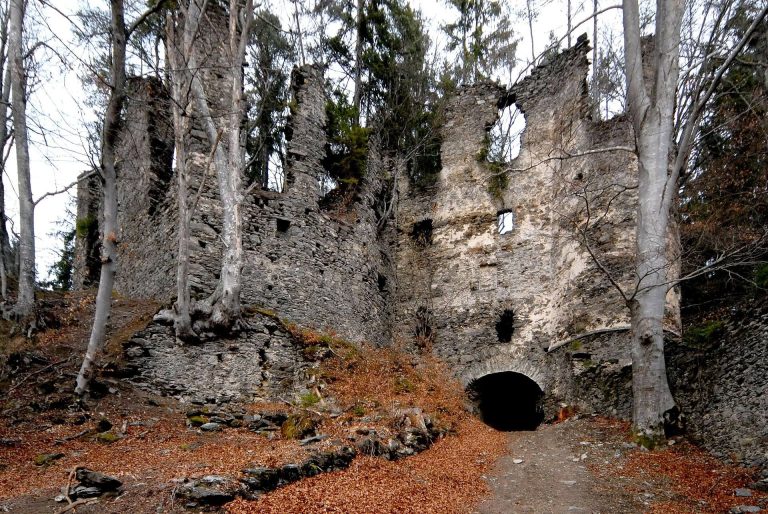
Other park structures include a fortified aqueduct, a bathhouse, bridges, and footbridges. A Neo-Gothic artificial ruin built of unrendered rubble masonry incorporates architectural elements reused from the ruins of Landskron Castle.