Burg Königsberg: A High-Medieval Imperial Castle Ruin in Germany


Site at a Glance
- Rating
- 4.6
- Popularity
- Low
- Country
- Germany
- Primary era
- Medieval
- Eras represented
- Medieval, Modern
- Civilizations
- Holy Roman Empire
- Site type
- Military
- Remains
- Castle
On this page8 sections
History
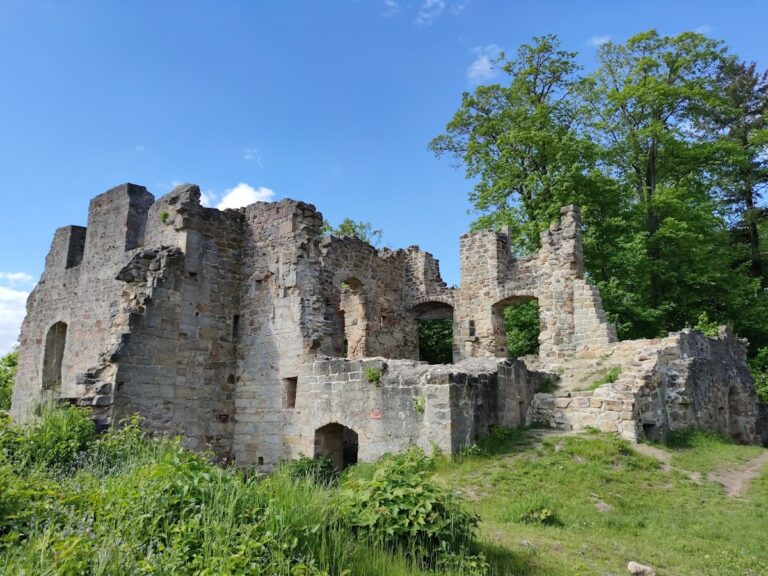
Burg Königsberg is the ruin of a high-medieval imperial castle in Germany, above the historic town of Königsberg in Bavaria, built around 1200 or during the thirteenth century. An imperial castle was held directly by the medieval Holy Roman Emperor rather than by a local feudal lord. Its position on the Schlossberg placed it above the town and within the medieval defensive landscape of the Haßberge.
After the castle was abandoned, some of its stone was reused to repair the walls of the former princely vineyard on the southern slope of the Schlossberg. The small observation tower and castle inn are later additions from the nineteenth or twentieth century. Since the twentieth century, the castle has undergone extensive renovation and partial reconstruction. The work carried out by the castle association has been viewed critically within academic castle studies, particularly in contrast with nearby ruins conserved during the development of the Haßberge castle educational trail with little reconstructive or historicizing addition.
Remains
Defensive works
Ring wall and ditches
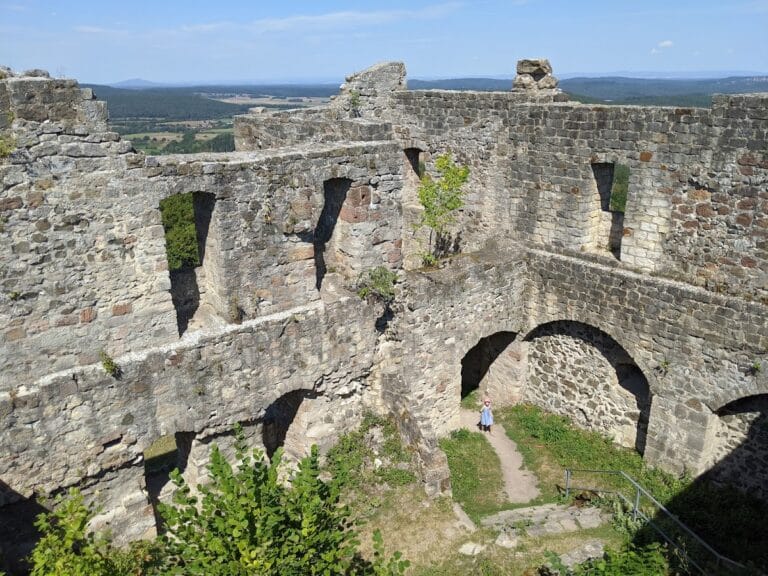
The restored ruin occupies a hilltop spur castle on the 355-metre Schlossberg, east of and high above Königsberg. A spur castle is built on a projecting ridge or high ground. On the eastern landward side, an approximately eight-metre-deep, masonry-lined neck ditch protects the approach. Beyond it, a ditch reaching two metres in depth continues around the oval ring wall. The wall has been extensively refaced and rebuilt, while the stumps of the two southern gun rondels retain more original fabric. Gun rondels are rounded artillery positions incorporated into fortifications for defensive fire along the walls.
Towers and bridge
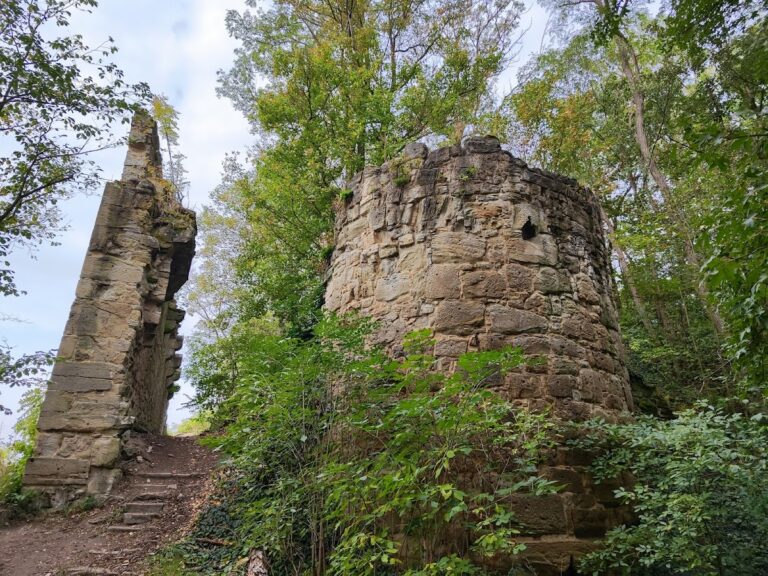
A bridge crosses the neck ditch. Projecting wall sections once connected the castle to the town fortifications, and the southern wall line descending towards the Catholic Church of St. Josef remains clearly recognizable. The tall western tower retains the base of its earlier structure, while its upper section, including the half-timbered part, is almost entirely a new construction from the final decades of the twentieth century. The southern ditch includes a powder tower, a structure used to store gunpowder or other military supplies.
Interior and southern slope
Castle well
Several wall remains and the castle well represent the internal buildings on the castle plateau. The well has a relatively large diameter and carefully constructed masonry. It was cleaned during the 1920s and 1930s and then measured at 80 metres deep. Water now collects in it only after exceptionally heavy rainfall, while accumulated debris probably makes its present depth shallower than the earlier measurement.
Gräfenberg vineyard
The former princely vineyard known as Gräfenberg occupies the southern slope of the Schlossberg. Its terrace walls and overgrown grapevines survive, and parts of the vineyard walls were repaired with stone taken from the abandoned castle. The vineyard remains physically linked to the castle’s later history through this reuse of masonry.
Nearby sites