Burg Streichenberg: A Medieval Spur Castle in Germany

Site at a Glance
- Rating
- 4.3
- Popularity
- Very Low
- Country
- Germany
- Primary era
- Medieval
- Eras represented
- Medieval, Early Modern, Modern
- Civilizations
- Electoral Palatinate, Holy Roman Empire
- Site type
- Military
- Remains
- Castle
On this page13 sections
History
Burg Streichenberg is a medieval spur castle in Germany, near Stebbach, now part of Gemmingen in Baden-Württemberg. Built in the second half of the thirteenth century on the territory of the village of Zimmern, it belonged to a landscape shaped by regional noble families and later became an administrative estate of the Electoral Palatinate, a major principality of the Holy Roman Empire.
Foundation and early lords
No surviving record explains the castle’s origin. The Counts of Oettingen inherited the Streichenberg lands in the late twelfth century and may have begun the project around 1255 to 1270. A more likely founder was Swicker, also called Schweicker, von Gemmingen, who built the castle between 1282 and 1287. He served as a royal governor in Wimpfen under Rudolf of Habsburg, the first Habsburg king of the Romans. At that time, Streichenberg was the fourth castle associated with the Gemmingen family.
The construction of Streichenberg may have helped bring about the abandonment of Zimmern, which had become deserted by the late Middle Ages. After Swicker von Gemmingen died, the castle passed to his sons-in-law, Raban Göler von Ravensburg and Albert von Enzberg. Their descendants retained it until the late fourteenth century. The castle first appears by name in 1331, while members of the Göler family are identified as its lords repeatedly between 1310 and 1379. Albrecht the Elder and Albrecht the Younger von Enzberg are associated with Streichenberg between 1351 and 1367.
A Göler family chronicle relates that Raban II Göler von Streichenberg murdered Zeisolf von Magenheim in 1320. Zeisolf was the second husband of Raban’s aunt Gertrud. In 1360, Albrecht the Elder von Enzberg and the younger Raven Göler placed their respective shares of the castle at the disposal of Count Palatine Ruprecht I. The mill below Streichenberg appears in the historical record in 1376.
Transfers among noble families
Eberhard the Elder von Mentzingen received three quarters of Streichenberg as a fief in 1385. A fief was land or a related right held from a superior lord in return for obligations. The transfer may have followed the Enzberg family’s conflict with Maulbronn Abbey. Count Palatine Ruprecht had destroyed the Enzbergs’ ancestral castle in 1384, and the confiscation of their Streichenberg holding is considered plausible, although the identity of a captured Albrecht Enzberg remains uncertain.
In 1387, Eberhard the Younger von Mentzingen allied Streichenberg and Ravensburg castles with the city of Wimpfen. Four years later, the brothers Eberhard Rafe and Wiprecht von Mentzingen pawned Streichenberg for 3,400 guilders to Hans von Gemmingen and his nephew Jörg. This briefly returned the castle to the family linked with its construction. By 1399, Raban VI von Mentzingen held it alone.
Wilhelm IV von Angelach-Angelach acquired Streichenberg in 1448 and spent another 500 guilders on building work. His brother Dieter VI inherited it in 1458. A heraldic stone records further construction by the Angelach family in 1536. Subsequent sales and transfers point to financial strain, and a poem of 1574 described Wilhelm VIII von Angelach-Streichenberg, the last Angelach owner, as a spendthrift.
From Neipperg ownership to the Electoral Palatinate
Wilhelm von Angelach and his sons sold the castle to Philipp von Neipperg for 33,000 guilders in 1560. The Neipperg family acquired the dependent mill in 1578. In 1596, however, Philipp and Engelhart von Neipperg sold their claim to the male fief to Elector Frederick IV for 39,000 guilders. A male fief was restricted to succession through the male line. Streichenberg consequently became part of the Electoral Palatinate.
The Electoral Palatinate established an administrative revenue office at the castle for the Hilsbach revenue district. Such an office managed territorial revenues and estates. Count Palatine Johann temporarily pledged Streichenberg to the Imperial Knights in 1621. The Imperial Knights were members of the lower nobility who held their territories directly from the Holy Roman Emperor rather than from a territorial prince.
Fighting during the Thirty Years’ War, the European conflict of 1618 to 1648, probably affected the castle. The mill burned in 1634, and a dwelling was built within the castle in 1643. Mennonite tenants were living there in 1661. Mennonites belong to a Christian Anabaptist tradition that developed during the Reformation and emphasized believer’s baptism and congregational organization.
Degenfeld ownership and decline as a residence
In 1670, Elector Carl Ludwig enfeoffed his minor son Karl Ludwig, Raugraf of the Palatinate, with Streichenberg and the village of Stebbach. Karl Ludwig died childless in 1688, as did his brothers. Through the marriage of his sister Caroline’s daughter to her uncle, Count Christoph Martin II von Degenfeld, part of the Schomberg inheritance, including Streichenberg, passed to the Degenfeld family. The family later used the names Degenfeld-Schomberg and Degenfeld-Schonburg.
The Palatine War of Succession, fought from 1688 to 1697, brought major troop movements and destruction to the Palatinate and neighboring regions. The area around Eppingen saw heavy military activity in the summer of 1693, and Streichenberg was described as ruined that year. A painting from 1610 still shows the keep, a strongly fortified central tower, but it no longer appears on a plan made around 1700.
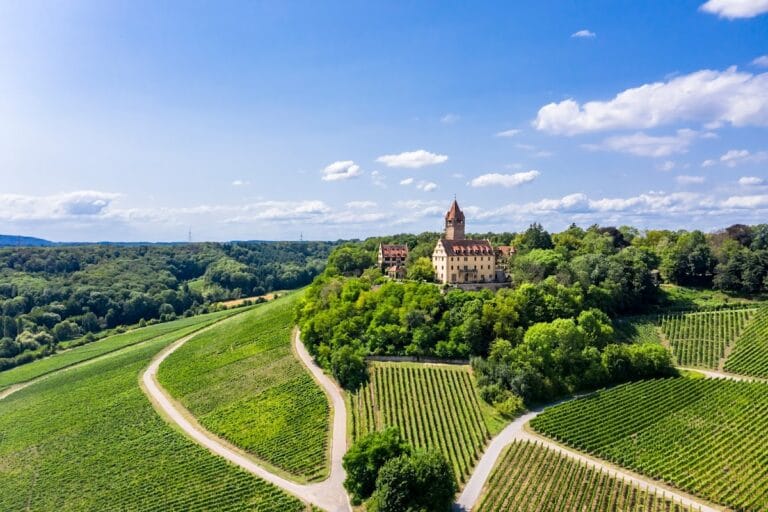
Between 1818 and 1822, the Counts of Degenfeld-Schonburg built Schloss Schomberg on a neighboring hill as their new seat of authority. The outer ward, the part of a castle complex outside the principal stronghold, was subsequently covered by farm buildings. By the middle of the nineteenth century, Streichenberg had become an agricultural estate. It remained a farm until about 1940 and continued to be inhabited until 1963.
Modern changes and conservation
After standing empty for approximately ten years, the castle was occupied in the mid-1970s by a group of younger residents. They could not prevent further deterioration, and two derelict, roofless residential buildings that had been used as stables were demolished during this period. In 1993 and 1994, the Degenfeld-Schonburg family secured and partly rebuilt a section of the fourteenth- or fifteenth-century defensive wall. Around 2000, the castle was offered for sale and almost returned to the Gemmingen family.
Remains
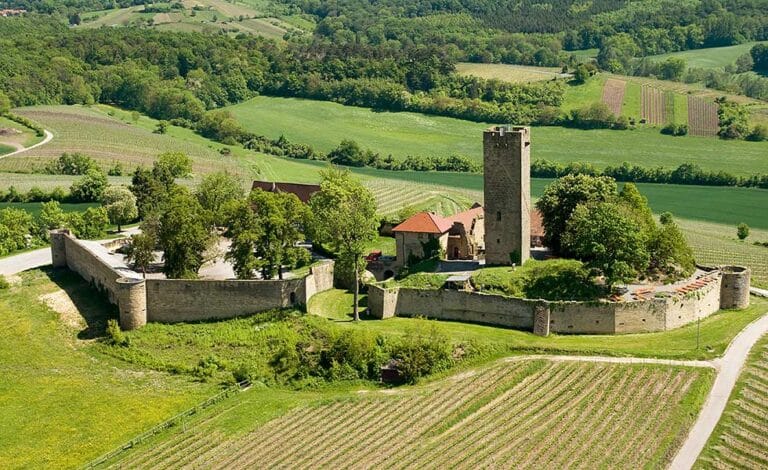
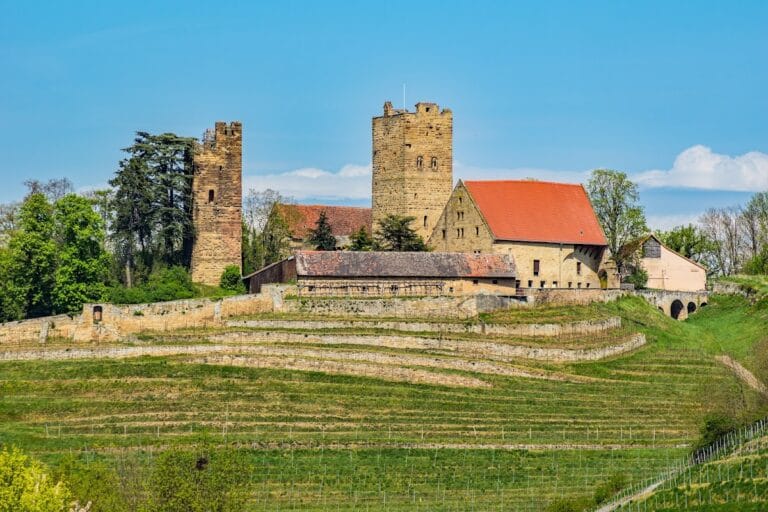
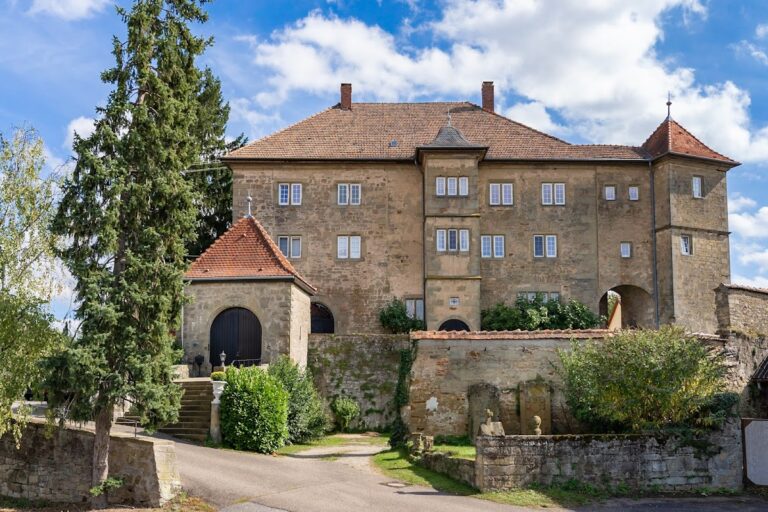
Burg Streichenberg occupies the projecting ridge of a small hill at the meeting point of a former trade route that remained in use until the fifteenth century. Its elevated position provided views toward Ravensburg Castle, Steinsberg Castle, and nearby Schloss Schomberg. The complex formerly contained three towers. The final tower was demolished in 1876 to make room for additional agricultural buildings. Trees now cover much of the hill, while the railway embankment of the nearby Kraichgau railway line and the Gemmingen quarry contribute to the site’s secluded present appearance.
Castle buildings and defenses
Main gate
The main gate survives as part of the castle entrance. The former palas, the principal residential and representative building of a medieval castle, has an ornate Renaissance portal. In May 2007, this portal was being secured with support from the state monuments office.
Defensive wall
A section of the defensive wall dates from the fourteenth or fifteenth century. It was secured and partly rebuilt in 1993 and 1994, preserving part of the castle’s earlier defensive enclosure within the later agricultural complex.
Agricultural transformation
Outer ward
The outer ward was built over with agricultural structures after Schloss Schomberg was erected. A large stable was added in 1856, followed by a large barn inside the castle in 1885. These buildings express the change from a noble residence and administrative center to a working farm.
Residential and farm buildings
Some residential buildings have been renovated and remain inhabited. Other residential buildings are unrestored, and a remnant of a former farm building survives only partly. A newer utility building has been provisionally adapted for events. Large parts of the complex require extensive repair or survive as ruins, and only sections have been secured and renovated. Access to the complex is restricted.
Nearby sites