Burg Steinbrück: A Medieval Water Castle and Border Fortress in Germany


Site at a Glance
- Rating
- 4.5
- Popularity
- Very Low
- Country
- Germany
- Primary era
- Medieval
- External website
- Open
- Eras represented
- Medieval, Early Modern
- Civilizations
- Holy Roman Empire
- Site type
- Military
- Remains
- Castle
On this page11 sections
History
Burg Steinbrück is a former water castle in Germany, located in Steinbrück within the municipality of Söhlde in Lower Saxony. Built after 1370 and before 1383, it guarded the eastern boundary of the Hildesheim ecclesiastical territory, where the Fuhse marked the frontier with the Duchy of Brunswick. The castle occupied a crossing used by the road between Hildesheim and Brunswick, giving it both military and administrative importance.
Foundation and Hildesheim rule
After the Battle of Dinklar, Bishop Gerhard of Berg sought to strengthen this exposed frontier against hostile incursions. The crossing of the Fuhse and the nearby road were selected for a fortified residence. The presumed builder was the knight Hans von Schwicheldt. The castle was probably first known as “the castle by the stone bridge,” a name apparently referring to the stone road bridge close to the site.
From 1394, Burg Steinbrück was repeatedly pledged. By 1421 it required repairs and was renovated that year. In 1425 the bishop transferred the castle and its jurisdiction to the Hildesheim cathedral chapter, the corporate body of clergy attached to Hildesheim Cathedral. In the medieval period, such a chapter could hold land, administer territory, exercise jurisdiction, and maintain fortifications. The chapter enlarged Steinbrück as a defensive position against the dukes of Brunswick.
The transfer of 1425 established the basis for the Steinbrück administrative district. This territory continued into the nineteenth century and possessed market and town rights. During the fifteenth century, the castle was pledged several times, including to members of the von Salder, von Veltheim, von Wenden, and von Reden families.
Sieges, imprisonment, and religious conflict
In 1521, troops of Duke Henry the Younger and Duke Eric of Calenberg besieged Burg Steinbrück. Their action enforced the imperial ban imposed on Bishop John of Hildesheim, a formal exclusion from the protection of the Holy Roman Empire that could also involve the confiscation of rights or property. The attackers captured the castle after a short siege and killed its approximately fifty-man garrison. Henry the Younger then expanded the fortifications, and the territory was awarded to him in the Quedlinburg Recess of 1523, a political settlement that redistributed territories involved in the conflict around Hildesheim.
Between 1535 and 1537, the castle dungeon held Jürgen Wullenwever, the former mayor of Lübeck. In 1553, troops commanded by Vollrad von Mansfeld plundered the castle and nearby villages. Duke Henry the Younger expelled them the following year and used Steinbrück as a base in his effort to suppress the Protestant faith introduced in 1542 and restore Catholicism.
Duke Julius of Brunswick-Wolfenbüttel expanded the castle in 1573 and commissioned the Kehrwieder Tower as a battery tower, a fortified structure designed to mount firearms. From this period, the buildings and enclosing wall formed a four-wing complex.
Thirty Years’ War and later administration
Shortly after the Battle of Lutter in 1626, Johann T’Serclaes, Count of Tilly, besieged Burg Steinbrück. Tilly was a leading commander of the Catholic forces during the Thirty Years’ War, the European conflict that lasted from 1618 to 1648. The castle surrendered after about two weeks. At the end of 1626, a decision by the Imperial Chamber Court, the Holy Roman Empire’s supreme judicial institution, transferred Steinbrück to the Hildesheim cathedral chapter.
Swedish troops captured and plundered the castle in 1632. After Hildesheim was conquered in 1634, Steinbrück became part of the Principality of Brunswick-Wolfenbüttel. The Hildesheim Main Recess of 1643 returned it to the Hildesheim cathedral chapter.
War damage reduced the castle’s military importance. From 1660, it served as an agricultural estate. Secularization, the transfer of church property into secular ownership or administration, followed the suppression of the Hildesheim cathedral chapter under Jerome of Westphalia. The former castle became a state domain in 1810, entered private ownership in 1812, and passed to the Hanover Monastery Chamber in 1862. The main castle complex was vacant from 1818, while the Kehrwieder Tower later continued in ecclesiastical use.
Church use and preservation
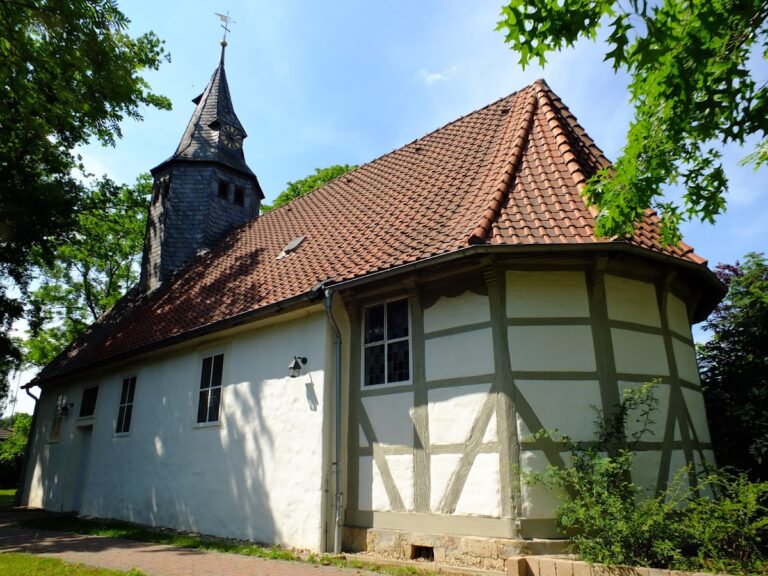
After the Second World War, Protestant refugees and displaced settlers from the Salzgitter area were resettled in Steinbrück. The castle lands were divided into farms for this purpose. The Evangelical Lutheran Church of Hanover acquired the castle in 1955. In 1956, the Kehrwieder Tower was converted into an Evangelical Lutheran church. Bishop Johannes Lilje consecrated it on the third Sunday of Advent that year, and it became known as the Kehrwieder Church.
Church use included reroofing the tower and temporarily slowed its deterioration. Most of the castle was sold into private ownership in 2013 and has since awaited restoration. The battery tower with the Kehrwieder Church and Protestant cemetery remained church property, while the gateway arch became communal property. The Burg Steinbrück association, which has more than 150 members, works for the preservation of the complex. Together with Marienburg and Steuerwald castles, Burg Steinbrück is regarded as one of the best-preserved episcopal castles in Lower Saxony and as one of the region’s few authentically preserved medieval structures.
Remains
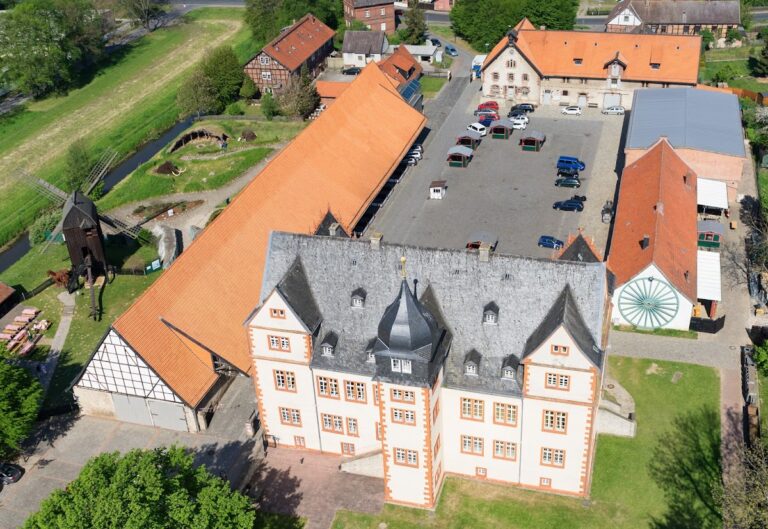
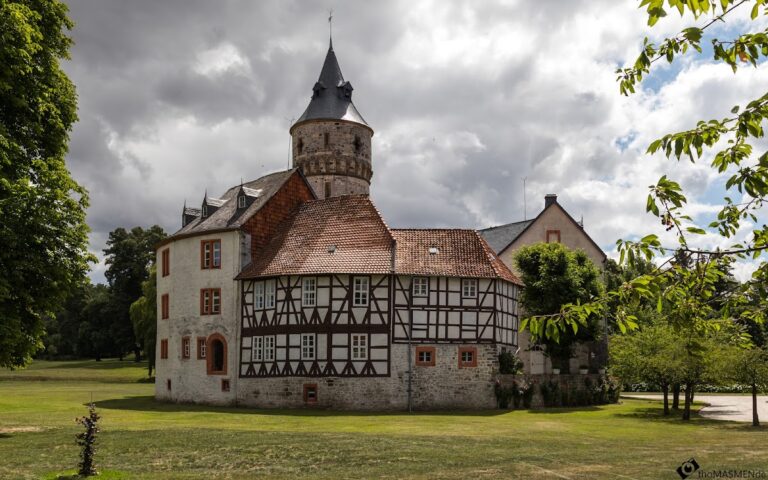
Burg Steinbrück survives as a lowland water castle in a village setting. A moat surrounds the complex, which stands at the former crossing of the Fuhse. Its buildings and enclosing wall form a four-wing arrangement established from 1573. The principal castle buildings are ruins or deteriorated historic fabric awaiting restoration, while the Kehrwieder Tower remains in use as a church.
Entrance and residential buildings
Gatehouse
Entry was provided by a two-storey gatehouse with a vaulted passage. Its massive construction reflects the defensive purpose of the entrance, whose walls are 1.7 metres thick. The gateway arch is now communal property and remains part of the surviving approach to the castle complex.
Keep and distillery building
A square keep stands behind the gatehouse and forms the southern end of a larger building. Its basement contains a dungeon. The building originally served as a distillery, combining the keep with a structure that had an economic function within the castle estate.
Palas
A four-storey palas, the castle’s principal residential and administrative wing, adjoins the keep. It served as the manor house. The date 1589 above its exterior door may indicate when the building was erected. On the courtyard side, the palas originally had a stair tower, which was demolished in 1845.
Kehrwieder Tower
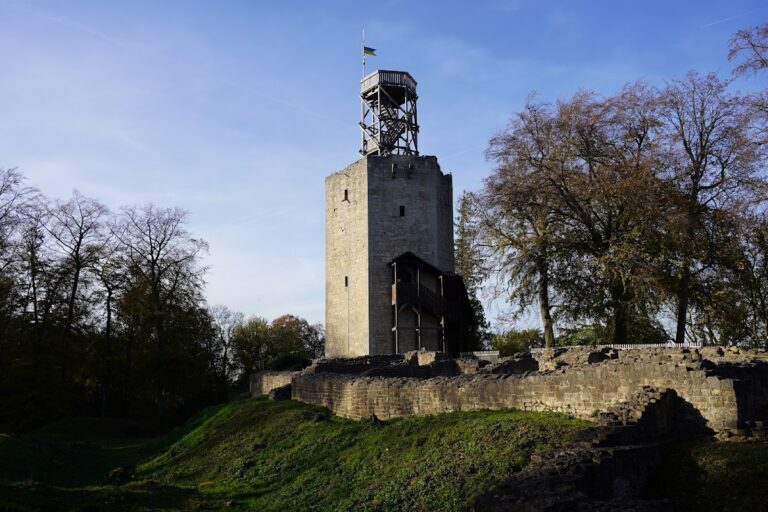
The circular Kehrwieder Tower stands in front of the castle and connects to it through a casemated passage, a protected route containing fortified vaulted spaces. Probably built as a battery tower in 1573, it has walls up to five metres thick and contains five gun embrasures. Its position and construction reflect the castle’s later adaptation to firearms.
In 1956, the tower was converted into the Kehrwieder Church. This change gave the structure a new religious function, and the associated reroofing helped delay further deterioration. The tower continues as an Evangelical Lutheran church and remains associated with a Protestant cemetery, while the surrounding castle buildings retain their ruinous and awaiting-restoration condition.