Derneburg Castle: A Monastery Transformed into an English Tudor-Style Castle


Site at a Glance
- Rating
- 4.4
- Popularity
- Very Low
- Country
- Germany
- Primary era
- Modern
- External website
- Open
- Eras represented
- Early Modern, Modern
- Civilizations
- German, Holy Roman Empire
- Site type
- Domestic
- Remains
- Castle
On this page18 sections
History
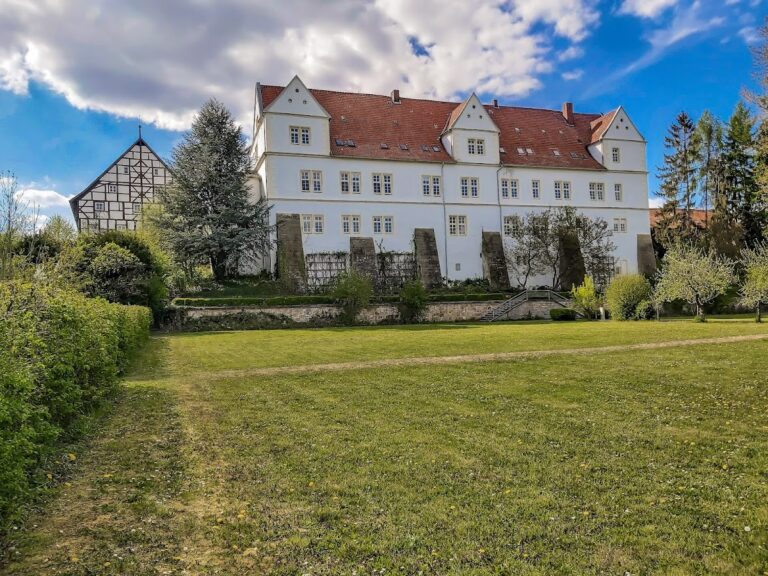
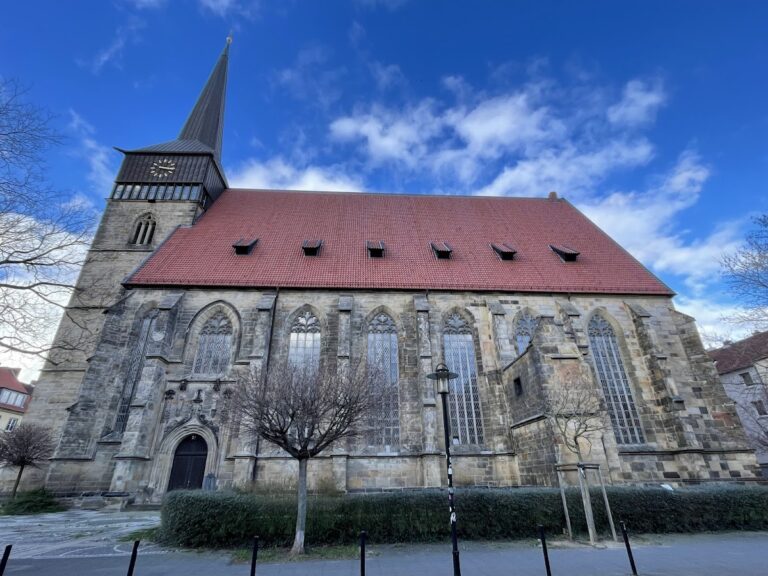
Derneburg Castle is a former monastery complex in Holle, Germany, remodelled in 1846–1848 in the English Gothic Tudor style. Its history began with a medieval manor, which became an Augustinian canonesses’ convent, a Cistercian institution, a state domain, and eventually a private castle and museum.
From Manor to Augustinian Foundation
Hermann I and his brother Heinrich of Winzenburg granted the manor of Derneburg as a fief to Burchard I of Loccum. After Hermann had Burchard murdered in 1130, Burchard’s son, Hermann II, transferred the manor to Bishop Bernhard I of Hildesheim as penance. The transfer required a nunnery to be founded on the site.
Lack of funds delayed the foundation until 1213, when an Augustinian canonesses’ convent was moved from Holle to Derneburg. The new institution was established in a fortified settlement called the castrum Sanctae virginis Derneburgense, meaning the fortified house of the Holy Virgin of Derneburg. During its first decade, the convent expanded its economic base by acquiring land and income from tithes in nearby villages.
In 1223 Bishop Konrad II transferred the principal and baptismal church of St. Martin in Sottrum to Derneburg’s provost. The arrangement was examined at the Council of Basel in 1436, but the convent could not produce its documents, saying that they had been destroyed by fire. By the sixteenth century, however, the convent held the entire property of the Sottrum church.
Reform, Dissolution, and Cistercian Restoration
The convent fell into poverty during the early fourteenth century, while discipline among the sisters weakened. It was excommunicated in 1370. In 1443 Abbot Heinrich Barnten of Marienrode expelled the disobedient nuns and transferred the foundation to the Cistercians, a monastic order that emphasized communal discipline, worship, and agricultural management. Cistercian nuns from Wöltingerode then settled at Derneburg.
During the Hildesheim Diocesan Feud, a conflict over territorial and political authority, the parish of St. Andrew sought the protection of Erich I of Calenberg in 1523. Troops of Duke Heinrich II had repeatedly plundered the area. Derneburg belonged to a Calenberg territory separated from the main part of the principality, and it did not undergo the Reformation until the church visitation conducted in 1543 by Elisabeth of Brandenburg, the ruling princess of Calenberg-Göttingen.
The Reformation turned the monastery into a Lutheran women’s foundation, held by the dukes of Brunswick into the seventeenth century. After the Hildesheim bishopric was restored in 1643, Catholic observance returned. In 1651, Cistercian monks from Altenberg arrived under Abbot Jodokus Rebroik. Plundering and requisitions during the Thirty Years’ War had left the buildings in poor condition, and three elderly former canonesses were still living at Derneburg when the monks arrived. The Cistercians then carried out extensive building and landscape work that formed the basis of the estate’s later prosperity.
Baroque Monastery and Secularization
Between 1735 and 1749, the Cistercians constructed a Baroque monastery church and domain buildings. The church was designed by Johann Daniel Köppel. They also regulated the waterways, created the Derneburg fishponds, and opened a sandstone quarry to supply building material for the estate and for the renewal of convent buildings in the eighteenth century.
Prussia dissolved the abbey in 1803 during secularization, the dissolution of a religious institution and transfer of its property to secular authority. Fourteen monks were affected, and the former monastery became a state domain. French troops occupied and plundered the estate in 1807. After the Congress of Vienna in 1815, Derneburg became part of the Guelph Kingdom of Hanover.
The Münster Family and the Castle Conversion
King George III gave the neglected former monastery and its land to Ernst, Count zu Münster, in recognition of his diplomatic work at the Congress of Vienna. Because the former monastery church had also served as the Catholic parish church, Ernst arranged for St. Andrew’s Church to be built in Sottrum through the Hanover Monastic Chamber. Some furnishings from Derneburg’s church were transferred there.
Ernst’s son, Georg Herbert, Count zu Münster, converted the monastery buildings into a castle between 1846 and 1848. The Hanoverian architect and civil engineer Georg Ludwig Friedrich Laves remodelled and partly rebuilt the complex in an English Gothic Tudor style. The choice was unusual in Lower Saxony and reflected Georg Herbert’s upbringing in London.
Ernst also commissioned Laves to design an English landscape garden. This type of garden arranged lawns, trees, water, buildings, and views in an apparently natural composition. At Derneburg, the design incorporated meadows, fields, mills, ponds, and agricultural buildings, combining productive estate functions with a Romantic landscape.
Twentieth-Century Uses and the Museum
During the Second World War, Derneburg Castle served as a military hospital for the Wehrmacht. After the war it became a hospital for the British Army of the Rhine and later housed displaced persons in a refugee camp. A section for elderly residents accommodated about 250 people for five years. This institution developed into the Caritas St. Josef Home, which moved to Hildesheim in 1952 after Count zu Münster reclaimed the castle rooms.
The state of Lower Saxony acquired the castle land in 1955 to operate the adjacent domain, while the castle remained with the Münster family. In 1975 Peter, Count zu Münster, sold the property to the artist Georg Baselitz for 300,000 Deutsche Mark, ending five generations of family ownership. Andrew J. Hall acquired Derneburg in 2006. Through Schloss Derneburg Museum GmbH, the castle and adjacent domain were reunited and comprehensively renovated for the Hall Art Foundation. The complex is now owned by Andrew Hall and Christine Hall.
The former greenhouse became the Glashaus cultural venue in 1988. Since the pandemic of 2020, the gardens have been maintained as a “biopark,” with wildflowers sown and lawns cut only every few months. Derneburg lies within the 11-square-kilometre historical cultural landscape of Ornamental Farm Söder and Derneburg, classified by the Lower Saxony State Agency for Water Management, Coastal Defence and Nature Conservation in 2018 as a landscape of statewide importance. After extensive renovation, Kunstmuseum Schloss Derneburg opened in 2025 as a venue for contemporary art.
Remains
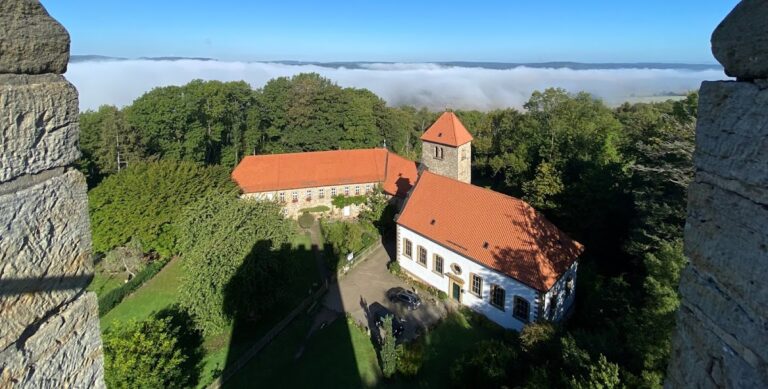
The surviving complex occupies the former Augustinian and Cistercian monastery site. Its principal buildings combine the older religious foundation with the 1846–1848 Tudor-style remodelling and rebuilding. Around them, the landscape retains waterworks, ponds, estate buildings, agricultural land, and structures created or adapted through successive monastic and aristocratic phases.
Monastery and Castle Buildings
Baroque Monastery Church
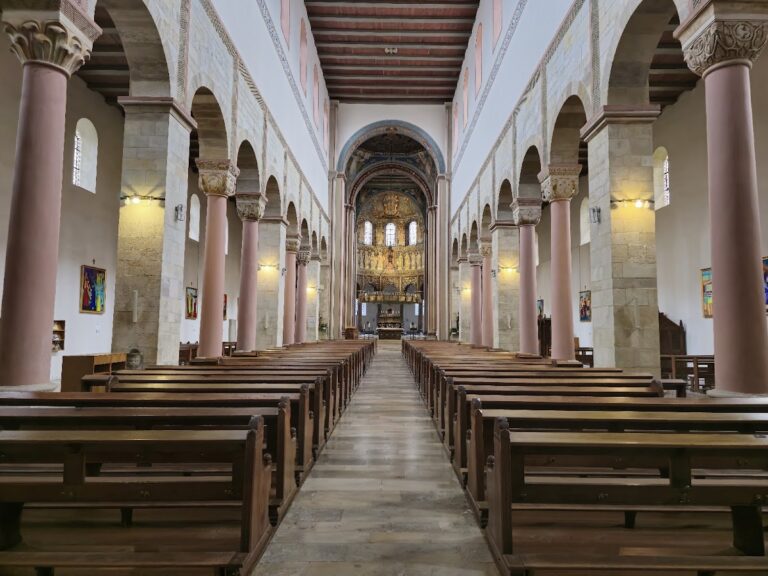
The former monastery church was built between 1735 and 1749 in the Baroque style under the direction of Johann Daniel Köppel. It was abolished when the abbey was dissolved in 1803. Because the church had also served as the Catholic parish church, part of its furnishings was later moved to St. Andrew’s Church in Sottrum.
Tudor-Style Castle
The monastery buildings were converted into a castle between 1846 and 1848 by Georg Ludwig Friedrich Laves. The rebuilding gave the complex its English Gothic Tudor appearance, combining the surviving monastery site with new nineteenth-century work. The former cloister now contains exhibition spaces, including fourteen white crosses by Robert Longo, the nearby Priests photographic series by Sante D’Orazio, and works by Hermann Nitsch.
Glashaus and Exhibition Spaces
The former castle greenhouse was converted into the Glashaus in 1988 and now serves as a cultural and dining venue. The park also contains the former studio of Georg Baselitz, which opened as an exhibition space on 7 April 2023 with Baselitz im Atelier. Kunstmuseum Schloss Derneburg presents contemporary art, including paintings, sculptures, videos, photographs, and works on paper by more than thirty artists. Its exhibited artists have included Christine Ay Tjoe, Jorge Galindo, Anselm Kiefer, Antony Gormley, Julian Schnabel, Kati Heck, Leon Golub, Robert Nava, Francesco Clemente, Katherine Bradford, Markus Lüpertz, Peter Dreher, Per Kirkeby, Nicole Eisenman, Joel Sternfeld, Gladys Nilsson, and David Wojnarowicz.
Landscape and Garden Structures
Waterworks and Estate Landscape
The Cistercians regulated the waterways around the monastery and created the Derneburg fishponds. The English landscape park later incorporated ponds, meadows, fields, mills, agricultural buildings, and other structures belonging to the estate. Its design placed useful and productive features within a deliberately composed landscape.
Teetempel Derneburg
The Teetempel Derneburg was built in 1827 on the Donnerberg as a viewing point for Ernst, Count zu Münster. The temple-like structure follows an ancient Greek style and has Doric columns. It contains a fireplace room.
Laves Bridge
The Laves Bridge was built across the Nette in 1838 and reconstructed as a pedestrian bridge in 1992. Its distinctive Laves beam is a lens-shaped truss placed beneath the deck, allowing the slender bridge to span a relatively long distance.
Mausoleum
The mausoleum of Ernst, Count zu Münster, was built in 1839 as an Egyptian-style steep pyramid. It rises 10.51 metres and contains the von Münster family tomb for Ernst and other members of the family.
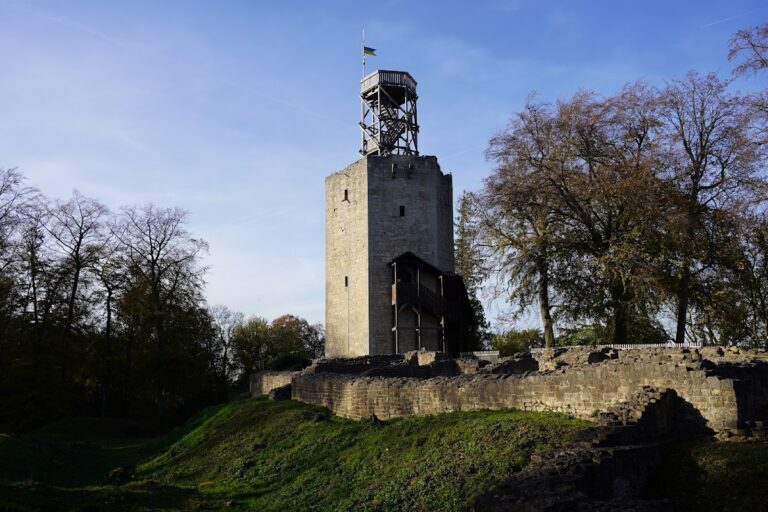
Tower Ruin
A tower ruin near Astenbeck once formed part of the visual axis leading to the Teetempel. Later tree growth obscured that axis, while the tower remains visible from Federal Highway 6.
Art in the Park
The sculpture park contains works by Tracey Emin, Antony Gormley, Jeppe Hein, Jörg Immendorff, Jonathan Meese, and Julian Schnabel. These outdoor works extend the museum’s contemporary art program beyond the former monastery and castle buildings into the surrounding park.
Nearby sites