Schaumberg Castle: An Ancestral Noble Residence and Fortress in Germany


Site at a Glance
- Rating
- 4.7
- Popularity
- Very Low
- Country
- Germany
- Primary era
- Medieval
- External website
- Open
- Eras represented
- Medieval, Early Modern
- Civilizations
- Holy Roman Empire
- Site type
- Military
- Remains
- Castle
On this page6 sections
History
Schaumberg Castle, also known as Burg Schaumberg, is a medieval hilltop castle in Germany near Schalkau. Its history can be traced to 1147, and it served as the ancestral residence of the Schaumberger noble family, which controlled the surrounding lands from the twelfth to the fourteenth century.
Medieval origins
The castle was probably established by the Burgraves of Meissen, high-ranking officials responsible for administering and defending the Meissen territory, from the Sterker von Wohlsbach family. The Schaumbergers acquired it in the late twelfth or early thirteenth century and are recorded there by 1216.
Many of the castle’s servants and military retainers lived at the foot of the Schaumberg. The settlement name Schalkau may derive from Schalken, a term used for horsemen and military retainers, although this proposed origin remains uncertain.
Displacement and return
In the mid-fourteenth century, the Schaumbergers were displaced by the Hennebergers, a noble dynasty whose territories included parts of central Germany. The Schaumbergers then withdrew to Rauenstein. On 6 December 1362, Margrave Friedrich III of Meissen granted Schalkau town and market rights after receiving the Coburg district as a marriage portion.
Wilwolt von Schaumberg brought the castle back into the family’s possession around 1500. Between 1501 and 1503, he enlarged it into a modern fortress.
Destruction and conservation
The fortress endured economic crises as well as political and religious wars before the Thirty Years’ War, the European conflict of 1618 to 1648 that involved dynastic, political, and religious struggles and caused widespread destruction in German territories. In the first days of July 1635, the castle was thoroughly plundered and burned. A further attack five years later reduced the remaining castle and outer bailey, an enclosed area outside the main fortified enclosure, completely to ruins.
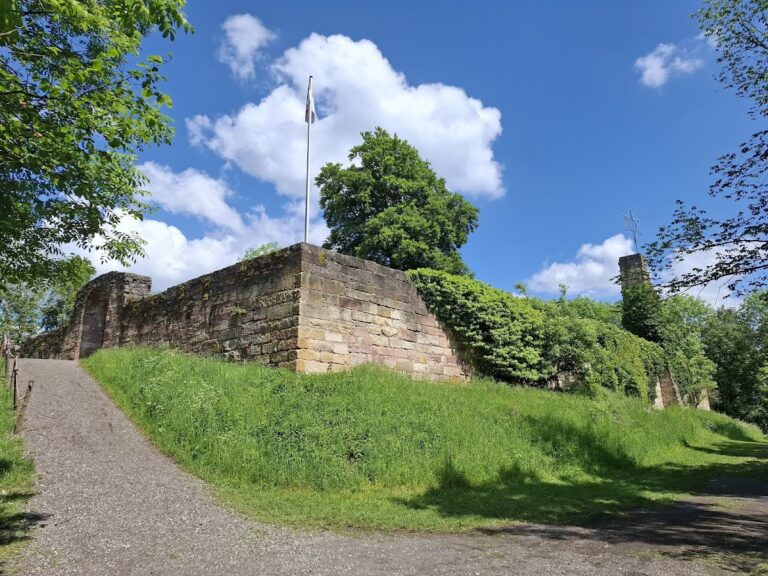
At the beginning of the 1990s, the city of Schalkau began extensive measures to secure and partially dismantle the ruin. These works conserved the remains and made the site accessible for tourism. Schaumberg Castle is the largest archaeological monument in the Sonneberg district.
Remains
Hilltop castle ruins
Schaumberg Castle occupies elevated ground west of Schalkau in Thuringia, at 492 metres above sea level. As a hilltop castle, or Höhenburg, it was built on high terrain suited to defense and control of the surrounding area. The former complex comprised a principal castle and an outer bailey. The surviving physical remains are wall remnants from this fortified complex, preserved as an archaeological monument after the destruction of 1635 and 1640 and later conservation work.
Nearby sites