Scharfeneck Castle in Mannersdorf: A Border Fortress and Refuge
Site at a Glance
- Popularity
- Medium
- Country
- Austria
- Primary era
- Medieval
- Eras represented
- Medieval
- Civilizations
- Hungarian
- Site type
- Military
- Remains
- Castle
On this page5 sections
History
Scharfeneck Castle in Mannersdorf, Austria, is a hilltop ruin whose origins may reach back to the 11th century. In Hungarian, it is known as Sárfenék. The castle took its name from the Scharfeneckers, a Hungarian princely family whose influence peaked around 1400. It then stood near the Austrian border and became a focus of territorial disputes between the family and Austrian nobles.
Origins and border conflicts
The Scharfeneckers were highly regarded by Hungarian kings and used the castle as a base during conflicts with neighboring nobles. In 1396 they attacked Deutsch-Altenburg, and in 1404 they captured Trautmannsdorf. Stuchs von Trautmannsdorf retaliated in 1408 by attacking Scharfeneck. The family then raided Edelsthal and Deutsch Haslau in 1412. The Scharfeneckers probably died out soon afterward, possibly amid these feuds. By 1417, the castle, then called Neuscharfeneck, belonged to the Hungarian king Sigismund.
Royal ownership and Habsburg control
After 1400, the castle was remodeled, probably drawing on French and English castle designs. The Hungarian crown later leased or sold it to several owners. Matthias Corvinus, king of Hungary and Bohemia, sold Scharfeneck to Ulrich von Grafeneck for 6,000 Hungarian gold florins.
In 1485, Corvinus captured Vienna after a four-month siege, leaving Scharfeneck no longer a frontier fortress. Following his death in 1490, Austria returned to Habsburg rule. Maximilian I took possession of the castle in 1493, possibly by force. The seizure reflected growing Habsburg interest in the east, a development that contributed to the dynasty’s later dominance in Central and Eastern Europe.
Damage, decline, and refuge
Lightning destroyed the keep in 1555, during the reign of Ferdinand I, Maximilian’s grandson. The strike probably damaged the wider complex. Rebuilding efforts did not stop its decline, and the castle eventually ceased to be inhabited. The keep was never rebuilt. The shifting frontier also reduced the site’s strategic value.
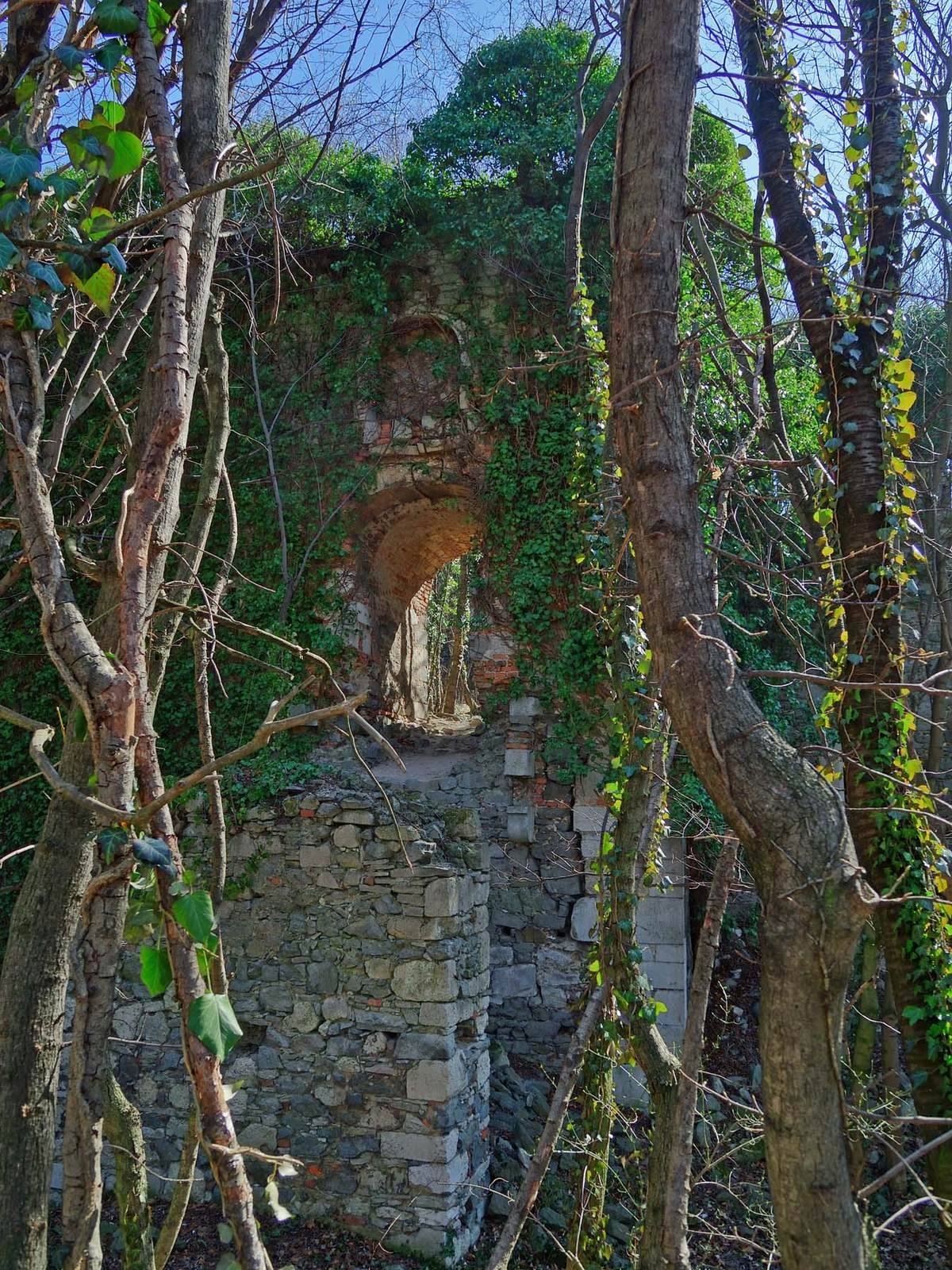
In 1683, farmers from nearby Mannersdorf took refuge in the castle during the Second Ottoman siege. Its walls withstood the attack, while the 3,000 people sheltering inside endured hunger and poor hygiene. The defenders refused to surrender. Hungarian insurgents known as the Kuruc, who fought Habsburg rule, devastated the locality between 1704 and 1708, and the castle again sheltered residents. From the 18th century onward, it deteriorated into a ruin and was gradually reclaimed by nature.
Remains
The hilltop ruin stands in Nature Park Wüste, within Mannersdorf am Leithagebirge in Lower Austria. Its stone walls form a rectangle, with a deep defensive ditch, or moat, along the northern and eastern sides. Four projecting defensive structures, called bastions, occupy the corners, and the walls reach up to 4.5 metres in thickness. The keep, the castle’s principal fortified tower and the core of the complex, originally rose to 24 metres.