Burg Peppenhoven: A Former Water Castle in Rheinbach, Germany


Site at a Glance
- Rating
- 3.6
- Popularity
- Very Low
- Country
- Germany
- Primary era
- Early Modern
- External website
- Open
- Eras represented
- Early Modern, Modern
- Civilizations
- Holy Roman Empire
- Site type
- Domestic
- Remains
- Manor House
On this page7 sections
History
Burg Peppenhoven is a former water castle in Germany, in the Peppenhoven locality of Rheinbach, with a surviving manor house built in 1697. Also known as Pippins Hof, the complex is regarded as one of the oldest structures in the Voreifel and lies between Swisttal and Morenhoven in the Rhein-Sieg district.
Frankish and feudal ownership
Peppenhoven was formerly among the estates of Pippin, generally identified as Pippin the Short, the eighth-century king of the Franks and father of Charlemagne. He transferred the estate to Prüm Abbey, a major Benedictine abbey whose landed property extended through the Rhineland.
In the fourteenth century, Count Wilhelm von Neuenahr was the feudal lord of Peppenhoven. A fief was land or property held from a superior in return for recognized duties or allegiance. In 1569, Johann Kessel von Nürburg received the estate as a fief from Duke Wilhelm of Jülich.
The Kessel, Schall von Bell, and Randerath families
In 1627, the Schall von Bell zu Schwadorf family acquired Peppenhoven through the marriage of Johann Heinrich Schall von Bell to Agnes Kessel von Nürburg. On 16 July 1655, Johann Wilhelm, Baron von Randerath zu Pesch and Schaven, received Haus Peppenhoven as a fief. He was married to Catharina Schall von Bell, the heiress of Peppenhoven.
Peppenhoven passed in 1672 as a marriage portion to Nicolaus von Werll, who was married to Anna Catharina, the daughter of Johann Wilhelm von Randerath. On 9 July 1696, Nicolaus von Werll’s son Johann Franz received the fief. The Counts von Werll then had the main house newly built in 1697.
Eighteenth- and nineteenth-century succession
On 18 May 1701, Franz Theodor Adolph von Werll, the son of Johann Franz, received Peppenhoven as a fief. After his death, the holding returned to the Duchy of Jülich in 1703 because he left no heirs. His widow, Anna Sophia von Bünninghausen, contested the reversion, maintaining that her marriage portion had been used to improve the fief.
Peter Ludwig, Baron von Albada, held the fief by 1717, and an associated enfeoffment was dated 2 March 1725. Johann Anton, Baron von Martial, held it in 1744. The von Vorst zu Lombeck family was recorded as owner in 1811. By 1826, ancestors of the present owner and resident, Baron Maximilian von Boeselager, were associated with the property.
Max von Boeselager, who lived from 1830 to 1896, was born at Peppenhoven. He was an estate owner and politician. The buildings were placed under monument protection in 1984.
Remains
The manor and castle complex
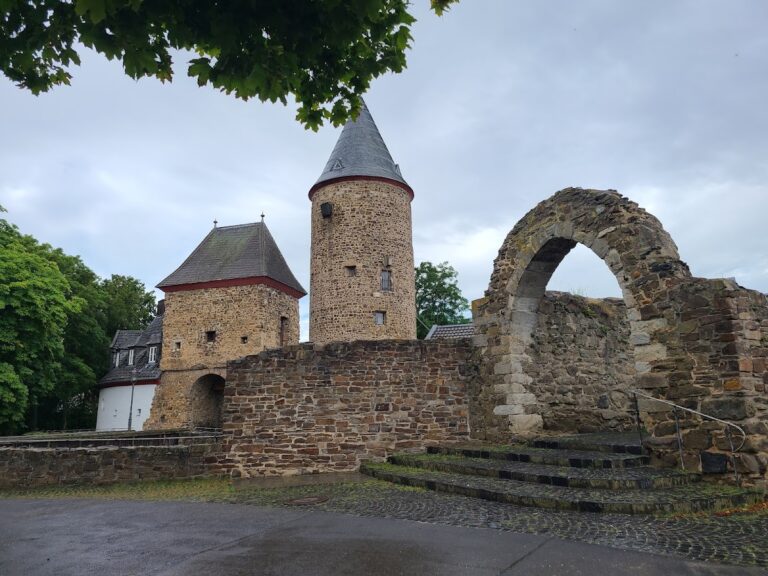
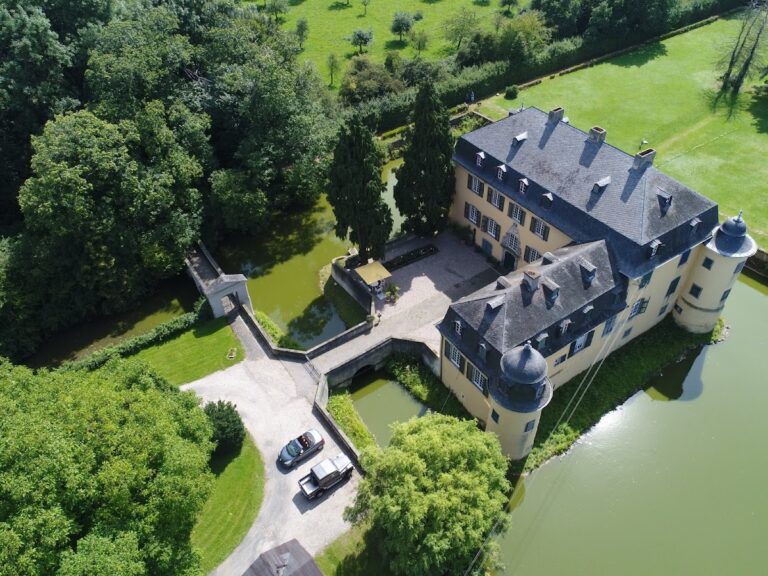
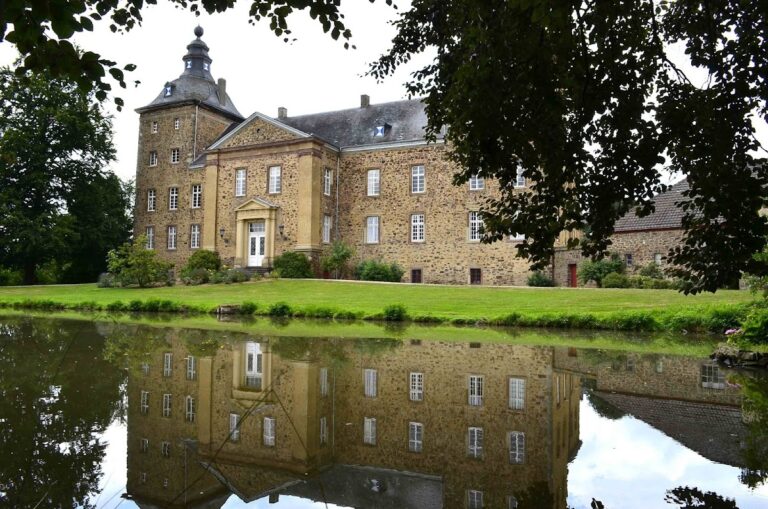
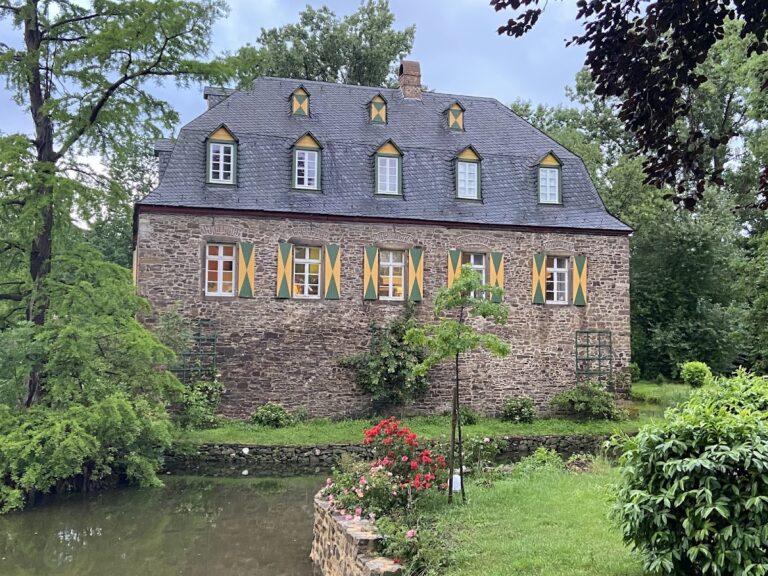
Burg Peppenhoven survives as a former water castle whose principal building is a two-story brick manor house. Constructed in 1697, it stands on an island in a pond and has five vertical bays across its principal facade. A five-axis building is one arranged with five window or structural divisions across that facade. A gate dating from around 1700 stands on the western side of the complex.
Chapel and service buildings
A small, freestanding brick court chapel was built in 1880. The service buildings that belonged to the eighteenth-century complex have been replaced by modern residential buildings. The site lies at approximately 153 metres above sea level.