Burg Hattstein: A Medieval Spur Castle in Germany


Site at a Glance
- Rating
- 4.2
- Popularity
- Very Low
- Country
- Germany
- Primary era
- Medieval
- External website
- Open
- Eras represented
- Medieval
- Civilizations
- Holy Roman Empire
- Site type
- Military
- Remains
- Castle
On this page7 sections
History
Burg Hattstein is the remnant of a medieval spur castle in Germany, located near Schmitten in the Taunus. It was probably established around 1150, although its precise construction date is unknown, and it may be older than nearby Burg Reifenberg. The castle became the seat of the Hattstein knights, a noble family whose activities shaped the history of the surrounding region for centuries.
Origins and the Hattstein knights
The castle’s early lord may have been Guntramus de Hazechenstein, who appears in a foundation charter for the monastery at Walsdorf in 1156. The names Hazechenstein and Hatzechinstein are also associated with Burg Hattstein. These forms reflect the changing use of the castle’s name in the medieval period.
During the fourteenth century, members of the Hattstein family were frequently described as robber knights. This term referred to lower-ranking nobles accused of using raids, force, or unlawful tolls for private gain. In 1379, troops from the Free Imperial City of Frankfurt and its allies attacked the castle during a land-peace campaign, a military effort intended to suppress violence and restore public order. The Hattsteins promised to end their raids and regained control of the castle, but the violence continued. In 1387, they attacked Thron Monastery.
Further punitive expeditions in 1393 and 1428 failed to capture Burg Hattstein. The Hattsteins were related to the Reifenbergs, who held nearby Burg Reifenberg, but the two families became involved in feuds. During the Hattstein Feud of 1428 to 1435, the Reifenbergs joined Frankfurt and the Electorate of Mainz, the ecclesiastical principality ruled by the archbishop-electors of Mainz. This alliance captured Burg Hattstein in 1432.
Shared lordship and rebuilding
Until 1468, Burg Hattstein was held as a Ganerbschaft, a form of joint possession or administration by several heirs or lords. Frankfurt and Mainz participated in this arrangement. In 1467, Walter von Reifenberg captured and demolished the castle. The Hattsteins recovered possession in 1468, after which reconstruction took approximately thirty years.
Once rebuilt, Burg Hattstein was increasingly neglected and gradually fell into decay. The Hattstein knights retained the lordship, while during the early modern period they increasingly directed their geographical interests toward the Wetterau. The castle’s legal position also differed from that of Burg Reifenberg. Whereas Reifenberg was free of feudal obligations, half of Hattstein was held as a fief from the Electorate of Trier, the ecclesiastical principality governed by the archbishop-electors of Trier.
In 1614, Philipp Georg von Hattstein sold the allodial half of the castle to Johann Heinrich von Reifenberg. An allodial holding was property owned outright rather than held as a feudal fief. The purchase price was never paid in full, and the resulting legal dispute remained unresolved until the Hattstein family died out in 1767. The surviving ruins are designated as a cultural monument.
Remains
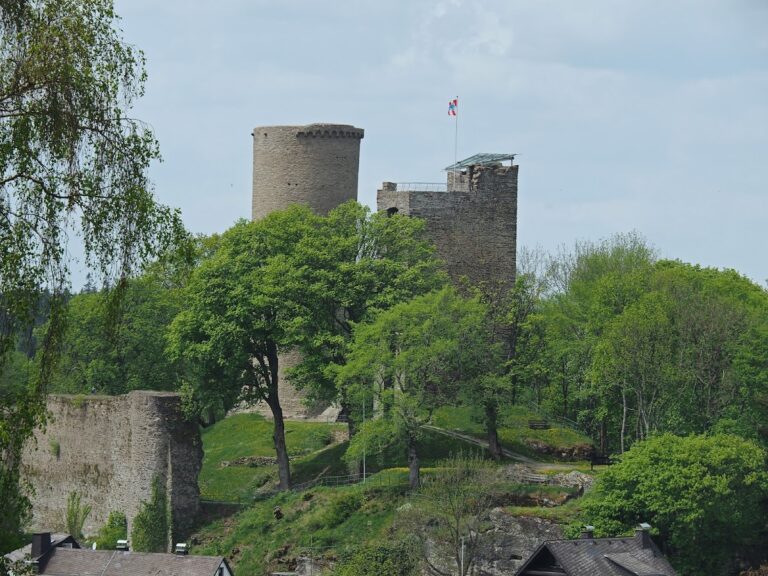
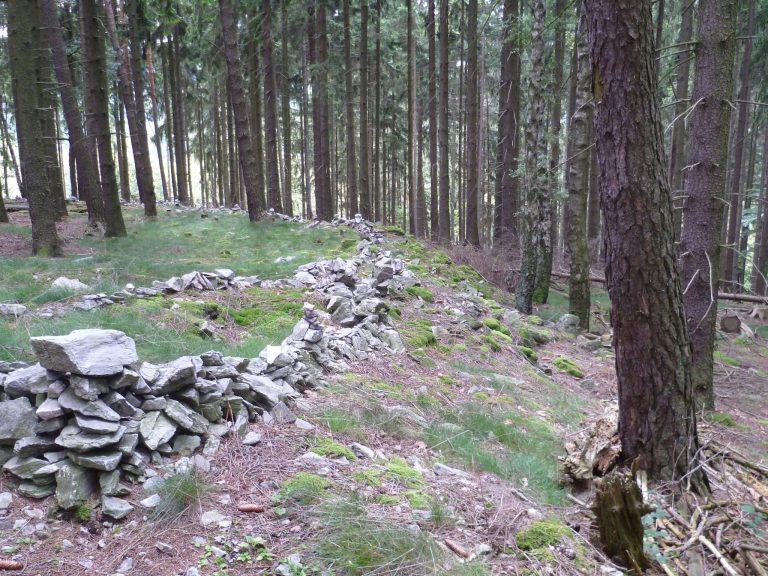
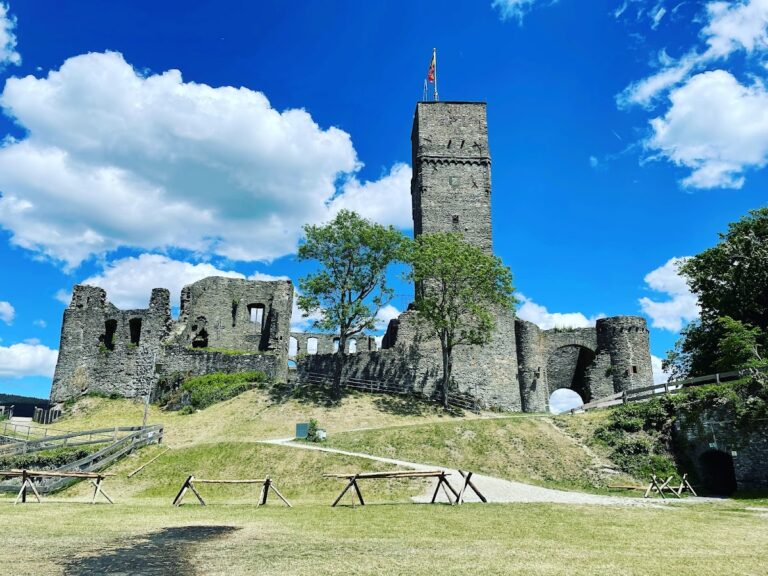
Burg Hattstein occupies a wooded mountain spur north of the Sängelberg, between Schmitten in the Taunus and its district of Oberreifenberg. At an elevation of 533 metres above sea level, the site follows the defensive form of a spur castle, a fortified settlement built on a projecting ridge and protected partly by the surrounding slopes. A raised area marks the former castle site, with a pronounced ditch encircling it. The principal surviving masonry is part of the castle’s shield wall, a heavily strengthened wall designed to defend its most vulnerable side.
Defensive remains
Castle ditch
The ditch forms a conspicuous boundary around the raised castle area. Its position helped separate the fortified site from the adjoining mountain spur and worked with the natural slopes to strengthen the castle’s defensive position. Together, the ditch and elevated interior preserve the basic shape of the hilltop stronghold.
Shield wall
Only fragmentary masonry survives above ground, with the shield wall representing the most notable remnant. This wall was built as the castle’s strongest defensive barrier. A narrow path follows the surviving wall toward a small terrace, linking the remaining masonry with the raised area enclosed by the ditch. The ruins stand within woodland, where seasonal vegetation affects their visibility.