Burg Ehrenfels: A Medieval Noble Castle in Bavaria


Site at a Glance
- Rating
- 4.4
- Popularity
- Very Low
- Country
- Germany
- Primary era
- Medieval
- Eras represented
- Medieval
- Civilizations
- Holy Roman Empire
- Site type
- Military
- Remains
- Castle
On this page11 sections
History
Burg Ehrenfels is the ruin of a high-medieval noble castle in Beratzhausen, Germany, at Haderlsdorf in Bavaria’s Upper Palatinate. Construction probably began shortly before 1256, when the Ehrenfels family established the castle as the center of its lordship on the boundary of the Regensburg prince-bishopric, a territory ruled by the bishops of Regensburg in both ecclesiastical and secular affairs.
The Ehrenfels Lordship
The Ehrenfels family originated from the Hohenfels family and first appears in documentary evidence in a donation charter of 1256. In that year, Chunrad of Ernfels gave his estate at Dettenhofen and his mother Hatwig’s estate at Anzenhofen to Pielenhofen Abbey in compensation for the annual tithe. The family served the bishops of Regensburg and remained associated with the Cistercian nunnery founded at Pielenhofen in 1237. A Cistercian nunnery was a women’s religious community belonging to the Cistercian order.
Transfer to the Stauffer Family
On 23 August 1335, Emperor Louis the Bavarian enfeoffed Dietrich of Stauf with Burg Ehrenfels. Dietrich retained the male fiefs connected with Burg Stauf, so the family kept its possessions around Stauf while transferring its principal seat to Ehrenfels. The castle therefore became associated with the Stauffer family, whose lordship centered on the site.
Siege, Sale, and Decline
On 23 January 1492, Duke Albert IV captured the castle after an eight-day siege and left it badly damaged. The Stauffer family of Ehrenfels had taken a leading part in the Löwlerbund, a late-medieval association involved in a knights’ uprising in Bavaria. In 1567, the lordship of Ehrenfels, including the castle, was sold to Palatinate-Neuburg, a territory ruled by a branch of the Wittelsbach dynasty. Burg Ehrenfels then lost its role as the lordship’s center and progressively decayed. Some of its stones were also taken for use as a quarry near Beratzhausen.
Memory and Protection
Argula von Grumbach, born Argula von Stauff, was probably born in 1492 and grew up at Burg Ehrenfels. From 1523, this German noblewoman and early supporter of the Reformation used printed pamphlets to defend Martin Luther’s position. Her forthrightness has been associated with the pride and self-confidence of the Stauffer family.
The ruin drew literary and historical attention in the nineteenth century. In 1827, the historian and archivist Max Prokop von Freyberg wrote The Stauffer Family of Ehrenfels, Part History, Part Novel. Julie von Zerzog later contributed Beratzhausen and the Ruin of Ehrenfels in the Nordgau to the Historical Association of Regensburg and the Upper Palatinate. By the beginning of the twentieth century, the remains were continuing to disappear, prompting Beratzhausen’s former mayor Alois Koller to call for their protection in 1914. In 1982, the local heritage officer began repairing and securing the severely endangered masonry, but financial constraints prevented the work from being completed.
Burg Ehrenfels is listed as a monument of Haderlsdorf under file number D-3-75-118-24. Archaeological findings associated with the medieval ruin are separately listed as an archaeological monument under file number D-3-6836-0043.
Remains
Hilltop Setting and Defences
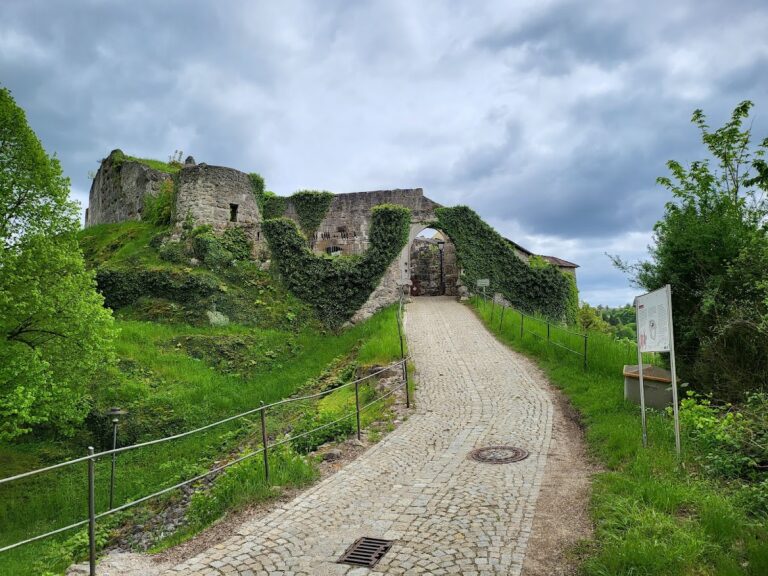
The castle occupies the 554.8-metre Schlossberg, a conical hill rising about 150 metres above the valley of the Black Laber. It lies in the western Upper Palatinate, approximately 1.6 kilometres west-northwest of the parish church of St Peter and Paul in Beratzhausen and about 25 kilometres northwest of Regensburg. Ramparts and a ditch surround parts of an irregular polygonal enclosing wall. The distinctive ditch system remains visible and indicates that an extensive outer bailey probably occupied the southern side of the castle.
Core Castle
The core castle was divided into two sections, a division that remains recognizable despite the ruin’s decay. This arrangement is attributed to an enlargement of the original complex during the late Middle Ages. The surviving walls were built with bossed ashlar masonry, made from dressed stone blocks whose outer faces project or remain roughly finished, creating a rugged surface.
Gates and Towers
Surviving defensive features include gate remains, two round towers, and a half-round tower. A shallow arched gateway was still visible at the beginning of the twentieth century. Together with the ramparts, ditch, and enclosing wall, these remains define the principal defensive elements of the hilltop complex.
Residential and Chapel Remains
Wall and foundation remains mark the former residential tract. At the beginning of the twentieth century, traces of a horse-watering facility and the beginnings of the vaults belonging to the sacristy of the castle chapel of St Michael could still be seen. Increasing numbers of stones later disappeared from the ruin.
Memorial of Hans von Stauff
A valuable tomb slab for Hans von Stauff, who died in 1478, was made by the cathedral master builder Roritzer. It shows Hans in Gothic plate armour. The slab is now mounted on the west wall of the present Rococo parish church of St Peter and Paul in Beratzhausen, after previously being kept in the church’s Late Gothic predecessor.
Nearby sites