St Nicholas and St Andrew Church in Biegen: History and Remains
Site at a Glance
- Rating
- 4.3
- Popularity
- Very Low
- Country
- Germany
- Primary era
- Medieval
- External website
- Open
- Eras represented
- Medieval, Early Modern, Modern
- Civilizations
- Holy Roman Empire, Kingdom of Prussia, Margraviate of Brandenburg
- Site type
- Religious
- Remains
- Fortified Church
On this page12 sections
History
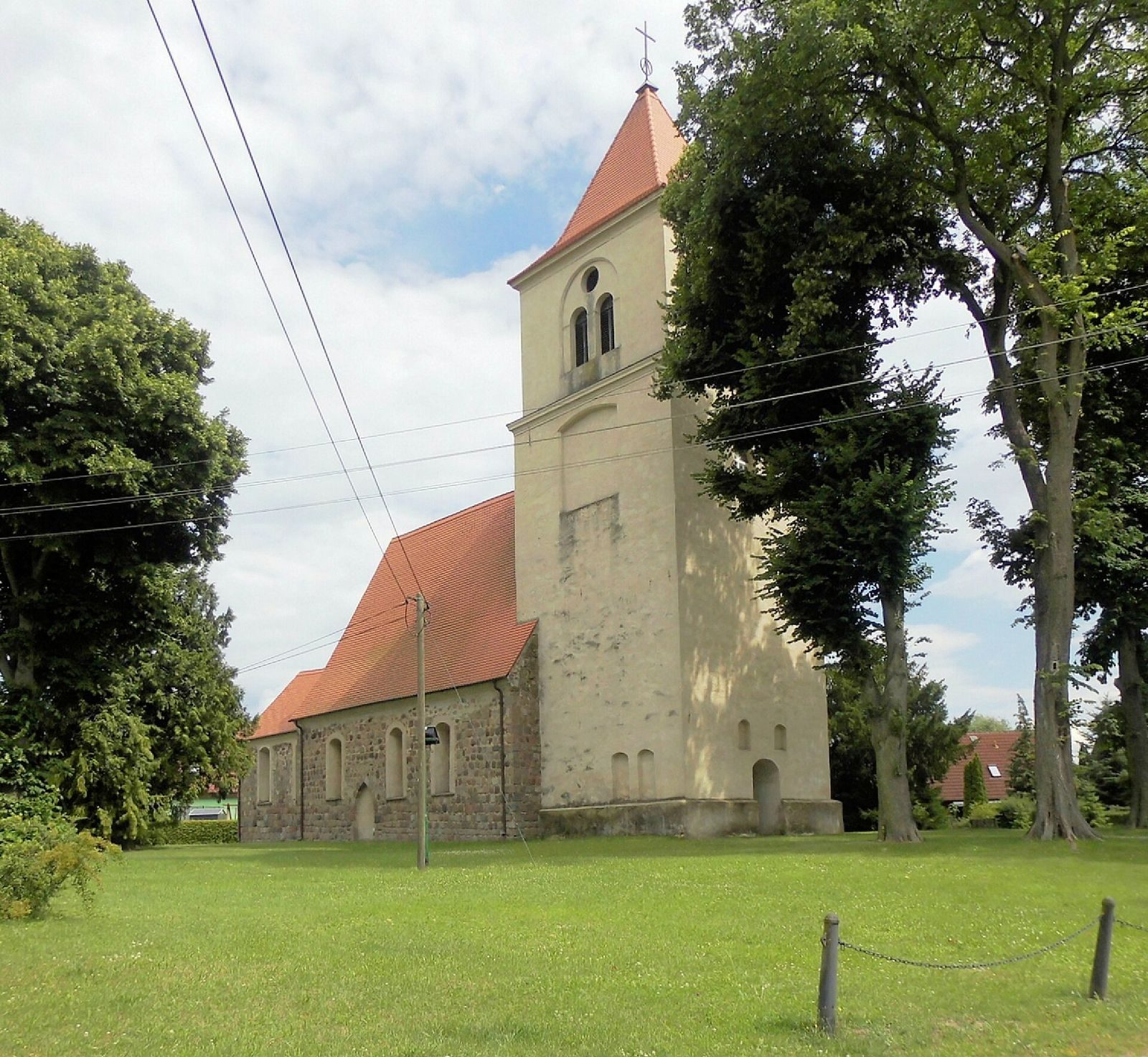
St Nicholas and St Andrew Church in Biegen, Germany, is a medieval village church probably built around 1270, roughly two decades after the settlement of Bigyn was founded in 1253. Today it belongs to the Oderland-Spree church district of the Protestant Church of Berlin-Brandenburg-Silesian Upper Lusatia. Its tall form and heavy fieldstone walls also allowed it to serve as a refuge for villagers during unsettled periods.
Medieval foundation and defensive use
The church was built with substantial two-shell walls, meaning two layers of fieldstone construction, which contributed to its defensive usefulness when combined with the building’s height. At about 90 centimetres, the walls are thinner than those of purpose-built fortified churches in southern Germany, but they nevertheless gave the villagers a place of shelter in times of danger.
Reformation and eighteenth-century changes
The sixteenth-century Reformation, the religious movement that created Protestant churches and changed worship and church organization, brought alterations to the interior. The priest’s portal was blocked, a wooden horseshoe-shaped gallery was installed, and the pulpit was moved closer to the chancel arch, the opening between the nave and choir. The earlier pulpit had been destroyed during the Seven Years’ War, so a replacement was required.
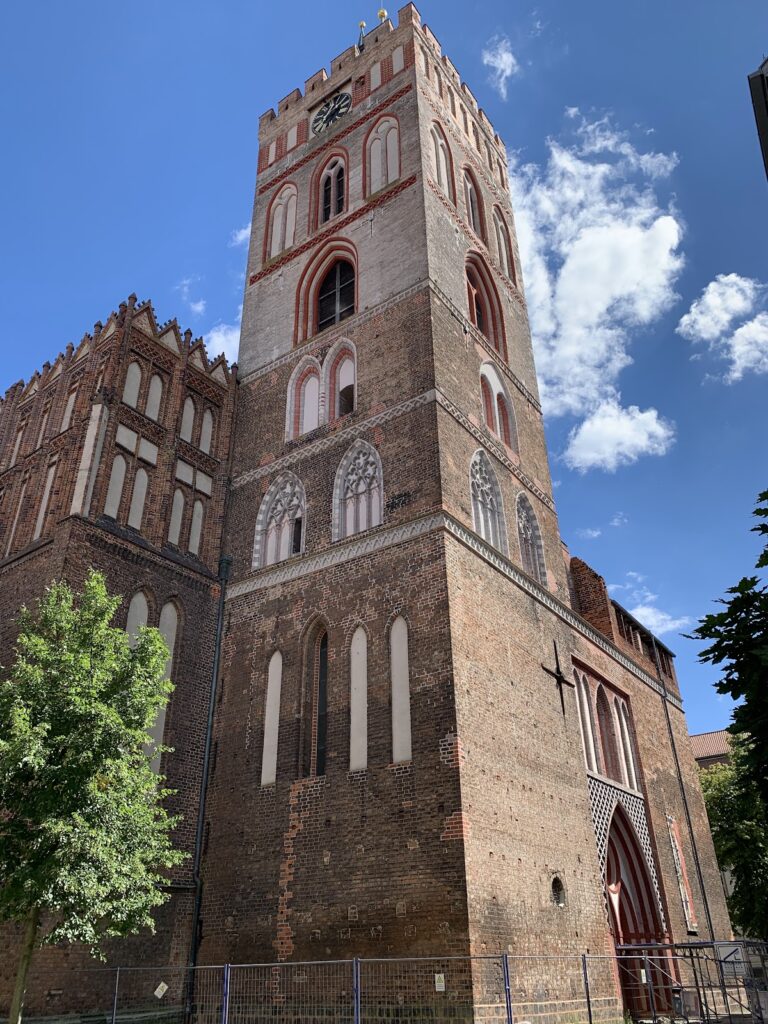
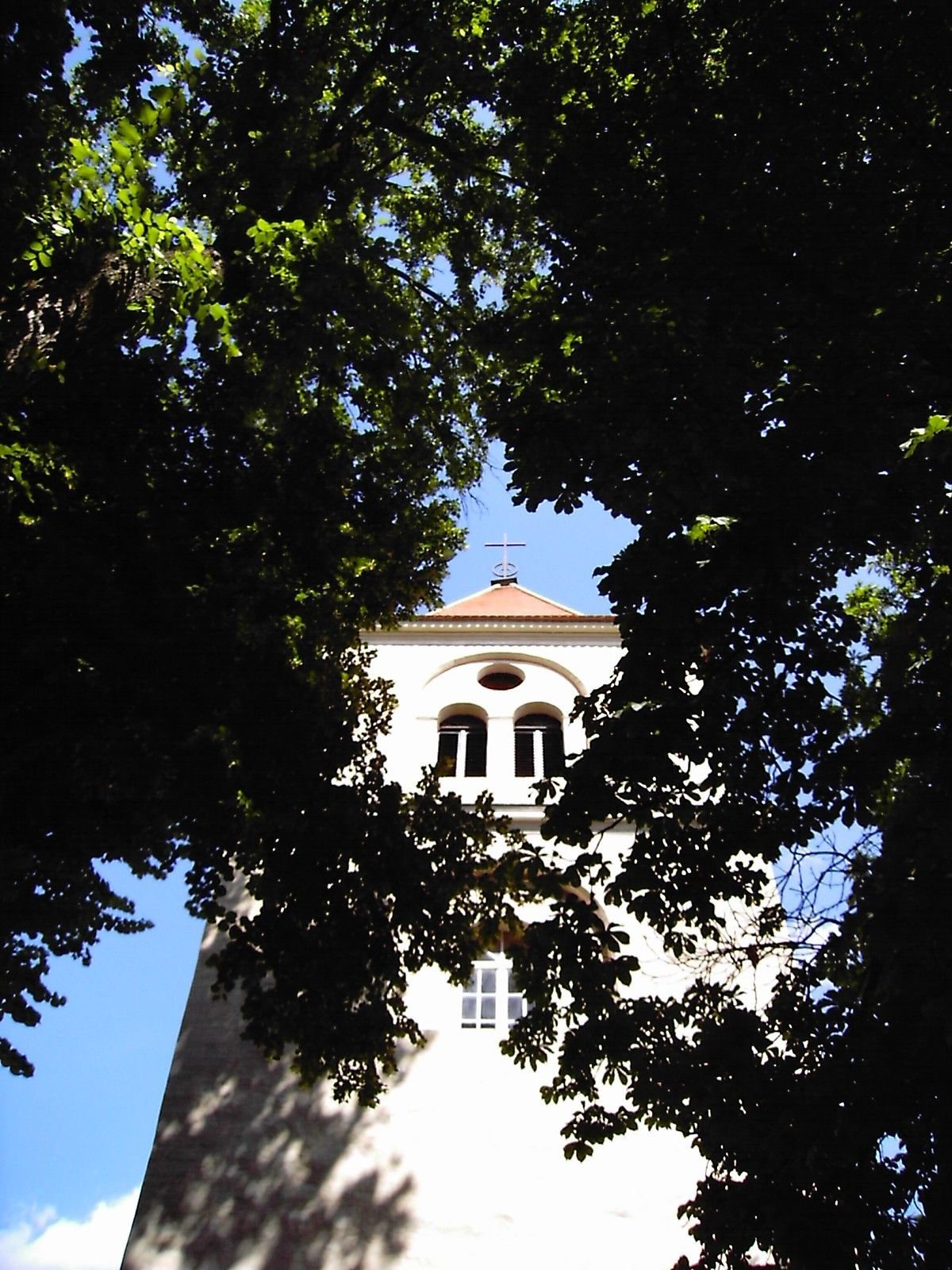
A fire in 1794 led to further rebuilding. The upper part of the tower was added in brick, the windows were altered, and the choir was enlarged with an attached extension. The tower received a hipped tent roof and a weather vane, while a tower clock was present around 1900.
War damage and reconstruction
The church once possessed bells from the fourteenth and fifteenth centuries. The younger bell was requisitioned in 1917, later replaced, and taken for melting in 1944. Shelling in 1945 destroyed about 80 percent of the building and shattered the older fourteenth-century bell.
After the Second World War, the church was rebuilt. The bell taken for melting returned from a bell cemetery, while a bell from Hasselbusch, formerly in Soldin district and now in Poland, replaced the shattered medieval bell. Cast in 1670 by Lorenz Kökeritz of Stettin, it remains part of the church’s postwar history. Extensive repairs and conservation work carried out afterward and continuing into the present have preserved the building as a regional monument.
Remains
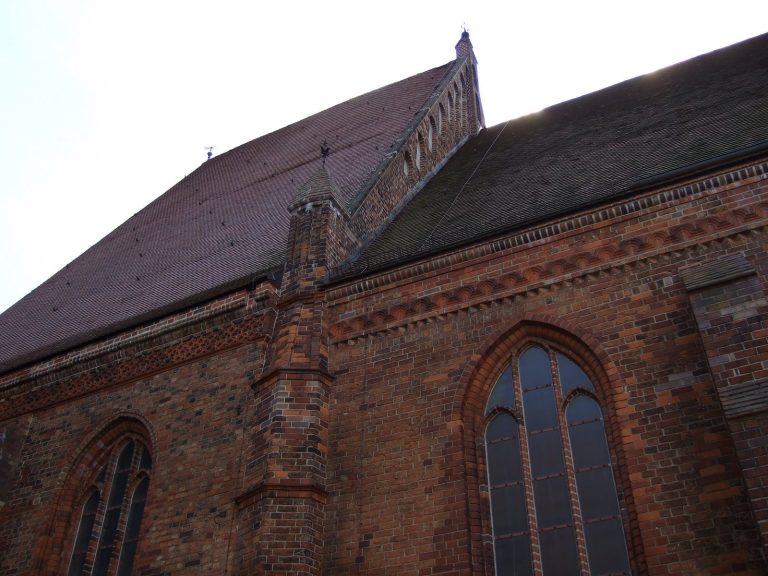
The church has an east-west alignment and is built from dressed granite erratic boulders. Its narrow windows and small door openings reflect a period when glass was costly. The surviving structure combines the medieval fieldstone body with later brickwork and alterations made after the fire of 1794.
Fabric and tower
The walls are approximately 90 centimetres thick and use two-shell fieldstone construction. This substantial fabric forms the main body of the church and preserves the defensive character associated with its height and robust construction.
The brick upper section of the tower contains sound openings and fittings for two bells. Above it is a hipped tent roof with a weather vane. The choir extension belongs to the rebuilding after the 1794 fire, and its remodeled windows have basket arches.
Interior furnishings and decoration
Late Renaissance altar
The late Renaissance altar has the structure of a winged altarpiece and is protected as a historic monument. Its particularly sculptural sandstone treatment of the Passion, the Christian account of Jesus’s suffering and death, is regarded as unique in the region. The predella, the lower section of an altarpiece, presents the Last Supper on Maundy Thursday, followed by Jesus praying in the Garden of Gethsemane before his arrest, being mocked and scourged, receiving the Crown of Thorns from Roman soldiers, falling beneath the cross, and undergoing the Crucifixion.
Mary and the beloved disciple appear beside the Crucifixion. The disciple is probably John, although some interpretations identify the figure as Peter. The cross stands on a skull, referring to Golgotha, the site traditionally associated with the Crucifixion. The altar also carries the coats of arms of the patron families von Röbel, von Krummensee, von Biesenbrow, and von Mörner. Since 1351, the von Mörner family had held the privilege of minting Brandenburg Kelpfennige and Stettin Vinkenaugen.
Medieval wall paintings
Wall paintings from around 1400 include Passion scenes showing the Last Supper, the Kiss of Judas, and the arrest in Gethsemane. Other images represent Andrew, Catherine, and Hedwig, together with coats of arms, consecration crosses, and Christ of the Last Judgment within a mandorla, an almond-shaped aureole surrounding a sacred figure. A trumpet-blowing angel and paintings on the chancel arch complete the surviving painted decoration.
Epitaph and baptismal font
A 1601 epitaph portrays Hans von Gelnitz, one of the church’s owners, at life size. The baptismal font dates from the first half of the eighteenth century.
Sauer organ
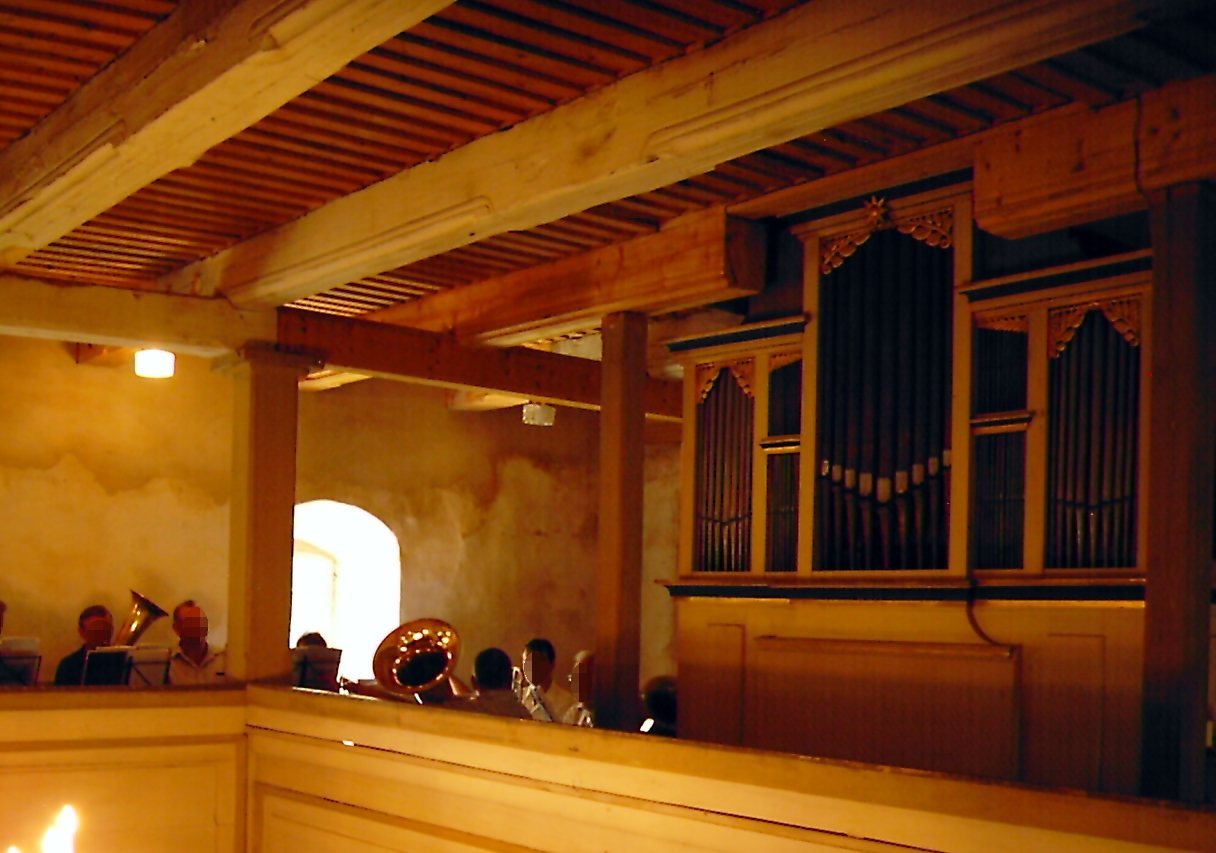
The Sauer organ, Opus 1503, was installed around 1936, probably using the case of an older organ. Looting in 1945 damaged the instrument, and the Sauer firm repaired it in 1950 while changing its disposition, meaning the arrangement of its stops. A new tin pipe facade was added in 1960, and Christian Scheffler of the organ-building workshop in Sieversdorf cleaned the organ in 1999.
The instrument has pneumatic pouch chests, in which compressed air transmits the movement of the keys to the pipes. Its couplers are II/I, I/P, and II/P, and its playing aids include Tutti and two unlabeled stop rocker switches that may be octave couplers.
Relics and altar restoration
During restoration of the altar in 1958, two pouches containing relics of Saint Eucharius were found. Their discovery forms part of the church’s surviving evidence for earlier religious practice.