Burg Amöneburg: A Ruined Hilltop Castle in Germany



Site at a Glance
- Rating
- 4.5
- Popularity
- Low
- Country
- Germany
- Primary era
- Medieval
- Eras represented
- Medieval
- Civilizations
- Carolingian, Holy Roman Empire, Merovingian
- Site type
- Military
- Remains
- Castle
On this page9 sections
History
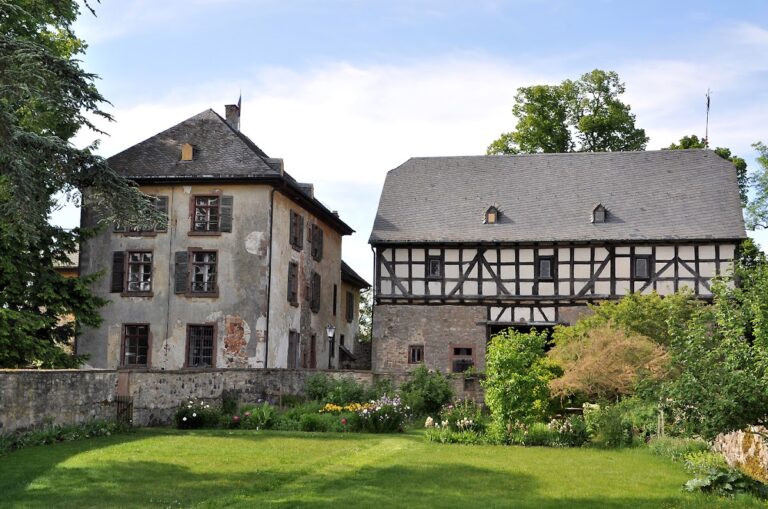
Burg Amöneburg is a ruined medieval hilltop castle in Germany, developed through Frankish and Mainz rule on the basalt cone of Amöneberg. The site overlooks the Amöneburg Basin and preserves evidence of settlement from the Neolithic period through the medieval era and into the age of early modern warfare. It is also known as Mainzische Burg Amöneburg and was formerly called Schloss Amöneburg. The name Amöneburg derives from Amana, the medieval name of the Ohm River.
Neolithic and Celtic settlement
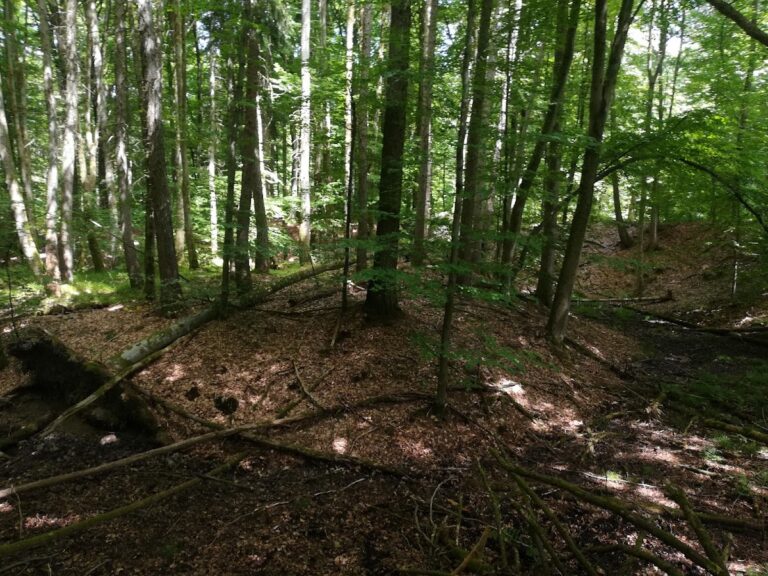
The Amöneberg shows traces of occupation dating from approximately 5500 to 2200 BC. Many centuries later, the mountain supported a fortified late Celtic oppidum, a substantial settlement of the later Iron Age associated especially with Celtic communities. Covering about 12 hectares, it was among the northernmost settlements of this type. Its area apparently extended onto the southern spur where the medieval ruins of Wenigenburg later stood, while much of the ancient settlement is now covered by Amöneburg and Burg Amöneburg.
Investigations carried out between 1982 and 1985 identified twenty houses on habitation terraces. The work also uncovered pottery concentrations and evidence that the settlement had been destroyed by fire. Earlier excavations on the southern saddle and slope had revealed house plans, charred floorboards on the slope side, postholes, late La Tène pottery, and small finds including brooches. The La Tène period was the later European Iron Age, conventionally extending from about the fifth century BC until the Roman conquest or the adoption of Roman culture in different regions.
Frankish and Carolingian strongholds
Nearly 700 years after the late Celtic settlement, a smaller fortified installation was established on the mountain during the Merovingian period. The Merovingians were the Frankish ruling dynasty before the Carolingians. In 721, the Anglo-Saxon missionary and church organizer Boniface used the Frankish fortress as his residence while working among the pagan and Christian population in and around Amöneburg. Within the fortified area he established a small monastery and a church dedicated to the Archangel Michael.
An extensive hilltop castle was built during the Carolingian period, when the dynasty associated with Charlemagne and his successors ruled the Frankish realms. The position benefited from its proximity to the Lange Hessen and the Weinstraße, important long-distance routes. From the ninth century onward, however, the castle became less important.
Mainz rule and medieval rebuilding
In 1145, the Archbishopric of Mainz and its newly appointed burgrave, Poppo of Reichenbach and Hollende, built a new castle on the summit. Landgrave Ludwig of Thuringia destroyed it in 1165 on behalf of Emperor Frederick I because the Archbishop of Mainz supported Pope Alexander III. The castle was rebuilt immediately after its destruction.
A pledge of the castle to Kuno of Münzenberg is recorded in 1183. By 1222, retainers of Mainz were again stationed there. From 1273, Amöneburg served as the seat of the Mainz territorial bailiff and as the administrative center for the archbishopric’s possessions in Upper Hesse.
War, destruction, and demolition
The castle changed hands repeatedly during the Thirty Years’ War, the European conflict that lasted from 1618 to 1648. General Christian of Brunswick-Wolfenbüttel captured it in 1621, but Imperial troops recaptured it on 6 November 1640. Hessian and Swedish troops under General Carl Gustav Wrangel seized it on 19 June 1646 and subsequently destroyed it. Parts of the castle were renewed between 1650 and 1675.
The castle was destroyed again in 1762 during the Seven Years’ War, a conflict involving major European powers between 1756 and 1763. The castle hill was occupied in 1797 during the War of the First Coalition, fought against revolutionary France. Because the buildings had become unsafe, they were finally demolished in 1839. The surviving ruins now represent the former complex rather than an intact castle ensemble.
Remains
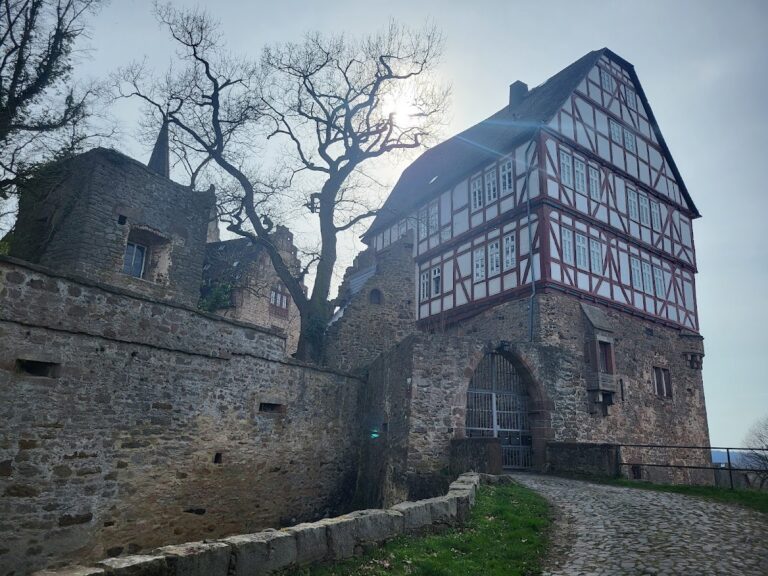
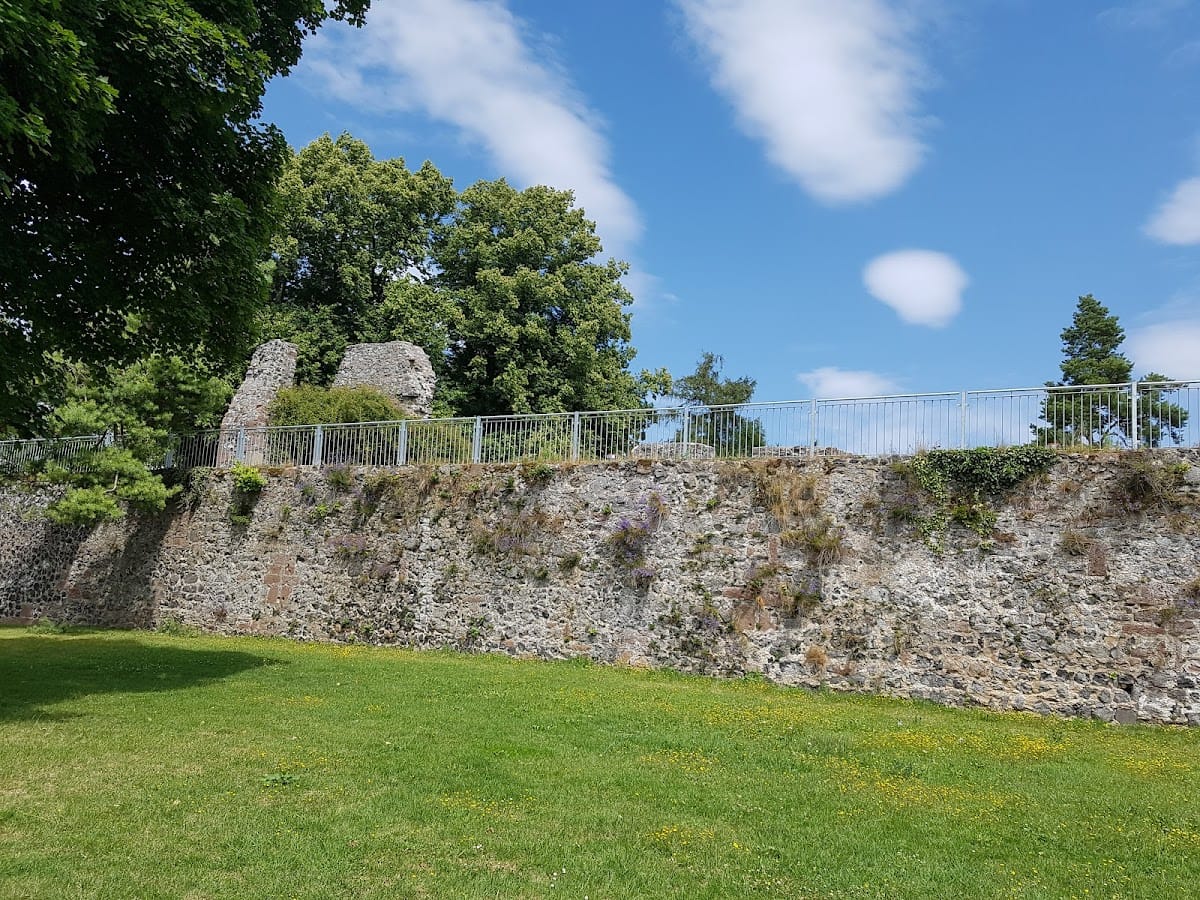
Burg Amöneburg occupies the summit of the 365-meter-high Amöneberg, a basalt cone rising about 150 meters above the Amöneburg Basin. The hilltop fortress was linked to the town fortifications of Amöneburg. Its original plan consisted of three wings, including a long building, a stable, and a kitchen, all enclosed by a continuous ring wall.
Castle buildings and defenses
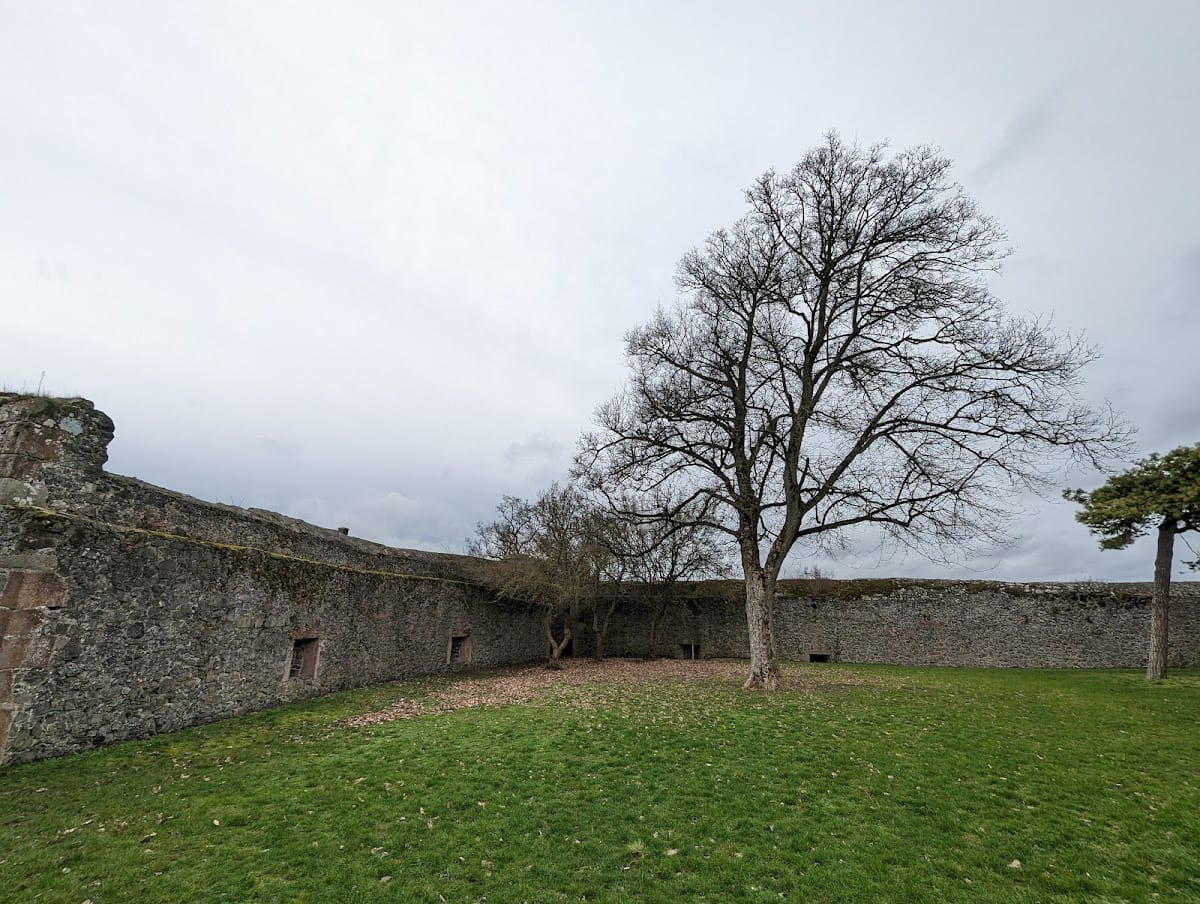
Locally available basalt formed the principal building material, while sandstone was used for window and door frames. Surviving remains include parts of the residential buildings, several cellars, sections of the ring wall, the bergfried, and an extensive zwinger. A bergfried was the principal defensive tower of a medieval German castle. The zwinger was an outer defensive enclosure between fortifications. Its outer towers contain loopholes designed for firearms, reflecting the later military use of the defenses.
Volcanic setting
The Amöneberg is a volcanic cone formed approximately eight million years ago. It belongs to a group of smaller volcanic vents probably representing outlying formations of the Vogelsberg. Limited basalt lava was produced there. Volcanic activity commonly began with gas explosions and pyroclastic material before basaltic lava flowed. Meter-long basalt columns are exposed on the mountain’s steep eastern wall. Below the castle, the Ohm River is fed by the Rulfbach before continuing through the Amöneburg Basin.
Archaeological finds
Objects connected with the late Celtic settlement include a gold coin, silver coins of Forrer types 352 and 350, and a potin coin. Potin coins were cast from a copper-rich alloy and are commonly associated with Iron Age Celtic communities. These finds are displayed in the Museum Amöneburg, whose Iron Age section was newly redesigned in 2022.