Bufalini Chapel: A Renaissance Funerary Chapel in Rome
Site at a Glance
- Popularity
- Medium
- Country
- Italy
- Primary era
- Medieval
- Eras represented
- Medieval
- Civilizations
- Papal States
- Site type
- Religious
- Remains
- Chapel
On this page17 sections
History
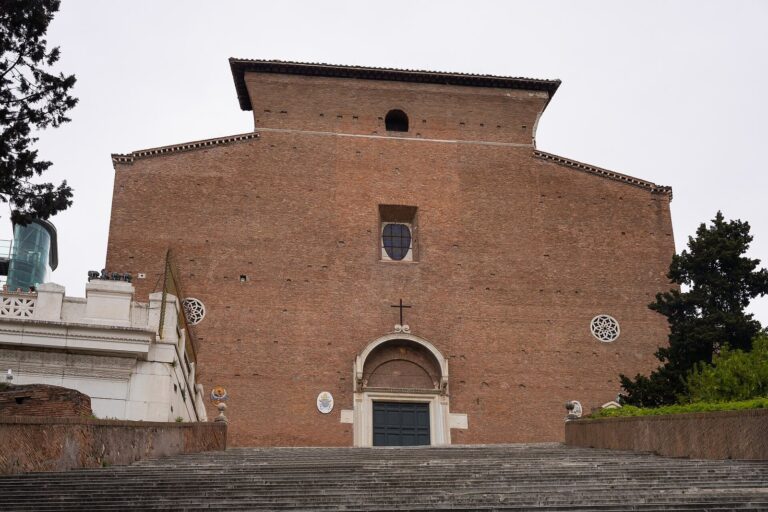
The Bufalini Chapel is a Catholic funerary chapel in the right transept of the Basilica of Santa Maria in Aracoeli, Rome, Italy. Niccolò di Manno Bufalini established it in 1484 for burial, devotion, and the promotion of his family. Its frescoes, painted by Pinturicchio and his workshop around 1484–1486, center on the Franciscan preacher Bernardino of Siena, with whom the Bufalinis had a close association.
Foundation and commission
Niccolò di Manno Bufalini, who lived from about 1450 to 1506, was a church prelate and a lawyer who pleaded cases before the papal consistory, an assembly of cardinals advising the pope. He came from Città di Castello and also served as an abbreviator of the greater park, a papal chancery official who helped prepare formal documents. The family was linked to Bernardino, who was credited with settling disputes between the Bufalinis and the rival Baglioni and Del Monte families. That connection helped determine the chapel’s subject.
Pinturicchio received the commission after working on the Sistine Chapel in 1482. While other painters from that project left Rome, he stayed and formed a workshop with collaborators from the Sistine work. The Bufalini commission became his first major assignment. Their shared Umbrian origins may have helped foster a relationship already established by a Madonna he painted for the family around 1480; that work is now in the municipal gallery at Città di Castello. The Basilica of Santa Maria in Aracoeli was then in the care of the Franciscan Minorites, members of the Order of Friars Minor.
Bernardino and the chapel’s later history
Bernardino was a Franciscan friar, preacher, and vicar general, an official exercising delegated authority for the head of a religious order. His devotion to the name of Jesus led to an accusation of heresy in 1423, but he was acquitted in 1427. He was canonized in 1450. The chapel’s imagery also includes Francis of Assisi, founder of the Franciscan order, and the Franciscan saints Louis of Toulouse and Anthony of Padua.
In 1646 Cardinal Mazarin assumed patronage of the chapel. His mother, Ortensia, belonged to the Bufalini family, and the patronage subsequently passed to the Mancini-Mazzarino family. The frescoes suffered damage and repainting over time, particularly in the vault. Conservation campaigns in 1955–1956 and 1981–1982 addressed their deterioration.
Remains
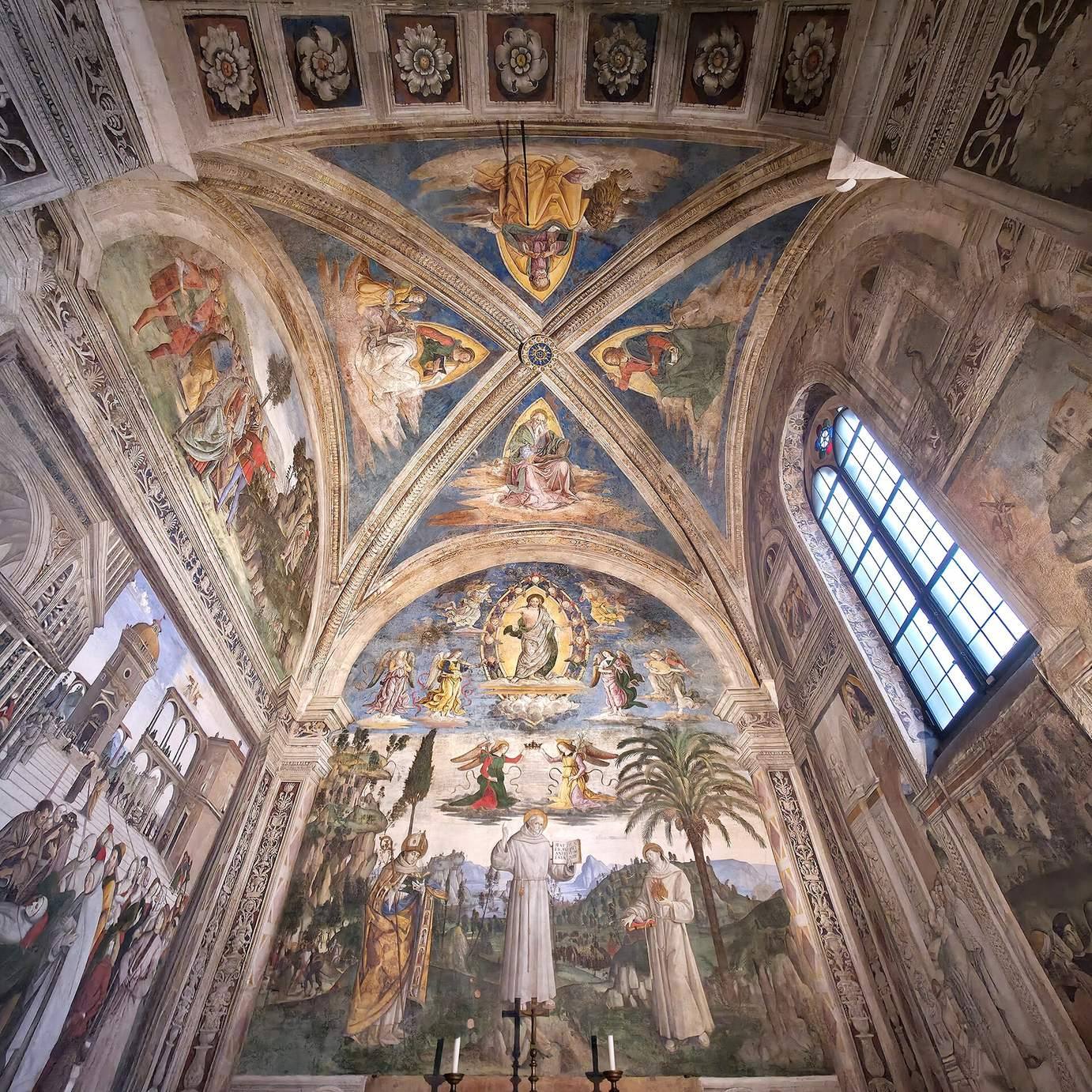
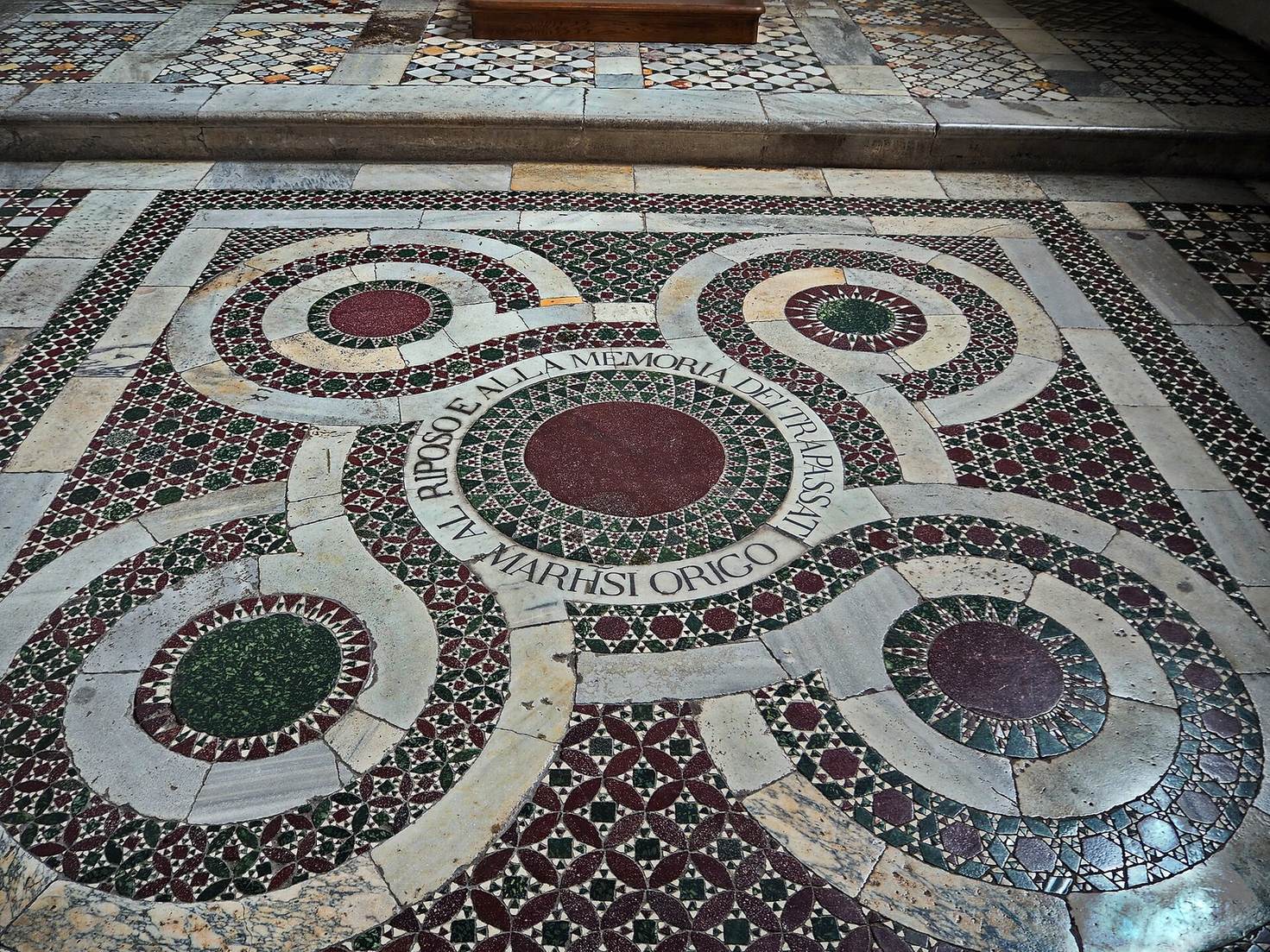
The chapel has a roughly square plan, about five metres on each side, and stands just over five metres high beneath its rib vault, a ceiling framework formed by intersecting ribs. It is the first chapel on the right after the basilica entrance. A triumphal arch frames the entrance, and its forms continue inside as painted architecture that imitates built surfaces. Frescoes cover the three walls and vault, while the floor retains well-preserved Cosmatesque mosaics, a medieval Italian style using patterned pieces of coloured stone and mosaic.
Vault
The vault is divided into four sections, each containing one of the Evangelists seated on a cloud against a dark-blue, star-studded ground. Pointed, luminous almond-shaped frames enclose the figures. Their arrangement follows a scheme associated with Perugino, though their poses are more animated. At the point where the ribs meet, a medallion bears IHS, a monogram associated with the name of Jesus.
Central wall
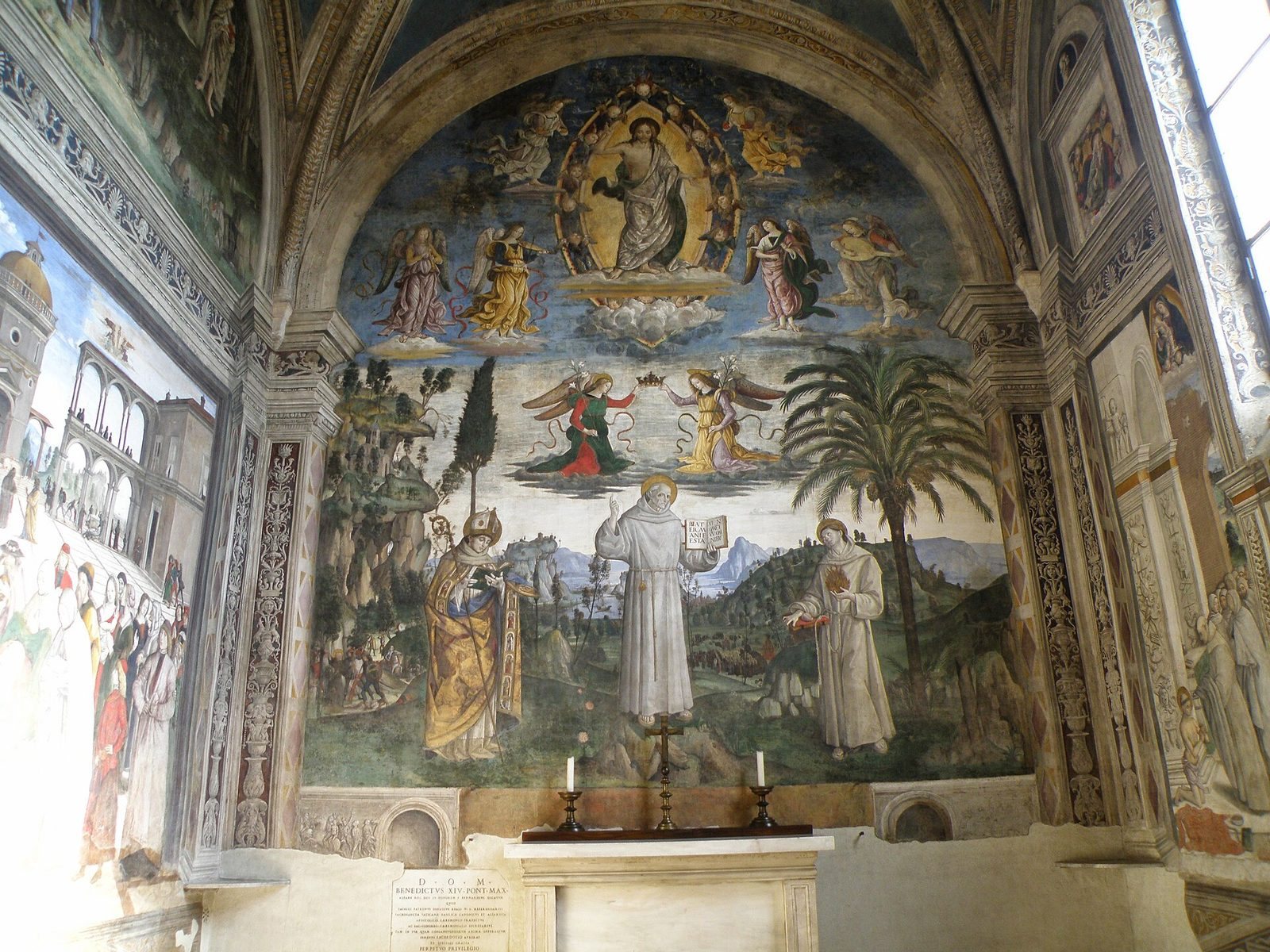
Glory of Saint Bernardino
The central wall’s Glory of Saint Bernardino is arranged in two levels, drawing on the general composition of Perugino’s lost Assumption in the Sistine Chapel. In the lower scene, Bernardino stands on a rock with his arms extended as two angels prepare to crown him. Saints Louis of Toulouse and Anthony of Padua flank him. Cypresses and palms, together with a landscape of rocks, lakes, and mountains, frame the group. Above, Christ gives a blessing within an almond-shaped frame, accompanied by praying angels and musicians.
Bernardino holds an open book bearing the Latin words “PATER MANIFESTAVI NOMEN TVVM OMNIBVS.” These are the words the friars chanted as he died on the eve of Ascension in 1444. His representation connects the chapel’s devotional imagery with the family’s association with him.
Painted relief band
A partly legible band beneath the main scene was painted to resemble niches and relief sculpture. One surviving relief shows a military procession with prisoners and satyrs. The decoration is an early Roman example of the period’s interest in ancient forms, a taste soon echoed in Filippino Lippi’s Carafa Chapel.
Right wall
Windows and painted scenes
The wall combines a real window with two openings and two painted false windows arranged symmetrically. One false window shows the Eternal Father giving a blessing; the other contains a peacock, an early Christian symbol associated with immortality. Painted scenes show Bernardino renouncing worldly possessions and receiving the religious habit from a superior of the order. Another depicts Francis of Assisi receiving the stigmata, wounds believed to resemble those of Christ, in a rocky landscape with an aqueduct.
Figures beneath the window
Beneath the real window, a painted opening contains five figures. An elderly friar may represent the convent prior, while a similar-looking layman may be an administrator or artisan connected with the basilica. A Franciscan in the foreground appears to point toward the scene of Francis and discuss it with nearby figures. A group of cavalry appears behind them. The background may represent Siena’s Porta Camollia, where Bernardino reportedly prayed each day before an image of the Virgin.
East-facing left wall
A painted horizontal band divides the east-facing wall into an upper and lower scene.
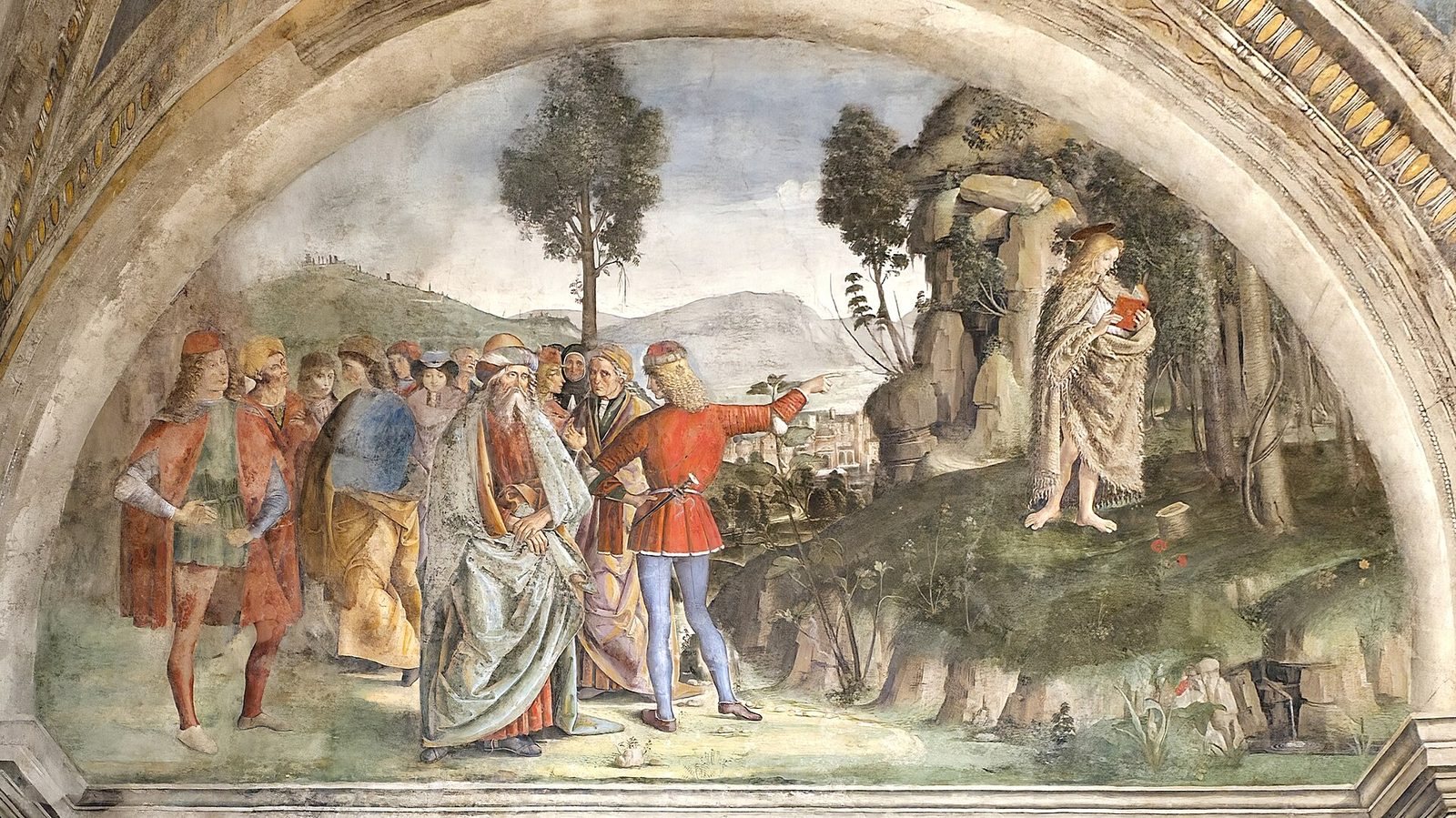
Bernardino as a hermit
In the upper arched panel, Bernardino reads scripture on a hill at the right. At the left, a young man points him out; a younger man in a red cloak raises a hand as if to restrain him, while an elderly man appears to accept Bernardino’s choice of an ascetic life. The scene reflects a tradition that Bernardino withdrew into solitude for ten years after surviving a plague epidemic.
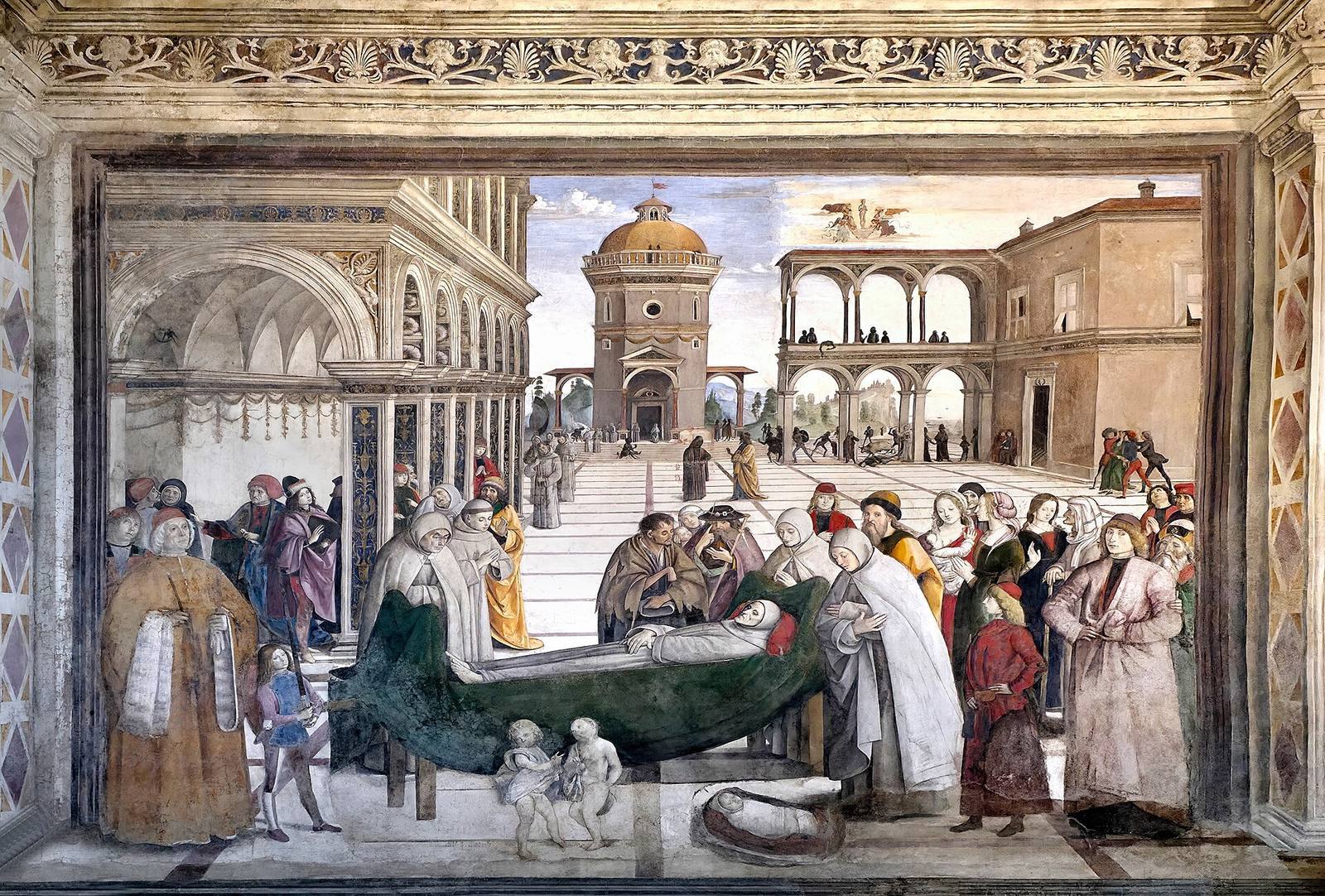
Bernardino’s funeral
The large lower painting places the funeral in an urban square with a checkered pavement laid out in geometric perspective. The lines of the square converge on an octagonal religious building designed around a central space, recalling Perugino’s Delivery of the Keys. Pinturicchio varied that model’s symmetry: a left-hand roofed gallery has piers and arches decorated with gilded candelabra, while a more distant cube-shaped building at the right connects to an open, double gallery facing landscape and sky.
Procession and miracles
Bernardino’s body lies on a catafalque, a raised platform for displaying a body during funeral rites, set at an angle to deepen the painted space. Friars, pilgrims, and other mourners approach it. A richly dressed figure at the left represents the patron, with another member of the Bufalini family nearby. Other figures illustrate miracles attributed to Bernardino: the healing of a blind man and of a man with a disabled hand, the revival of a possessed person and of the stillborn child of Giovanni and Margherita da Basilea, the healing of Lorenzo di Niccolò da Prato after a bull wounded him, and the pacification of Umbrian families.
Painted ornament and artistic features
Painted surfaces include motifs of books, weapons, helmets, and musical instruments. The fantastical candelabra ornament combines monsters, animals, plants, and furnishings, drawing on ancient reliefs and the rediscovered decoration of the Domus Aurea, an ancient Roman palace complex. A drawing securely attributed to Pinturicchio in Berlin’s Kupferstichkabinett relates to this ornament. Across the frescoes, spatial perspective associated with Umbrian and Perugian painting is joined by varied figures and poses linked to Florentine painters, as well as vivid depictions of poor pilgrims and beggars associated with Flemish painting.
Bufalini family burial
The family burial lies to the right of the chapel. A stele marks it with the inscription “Nicolai de Castello et suorum.”