Bip Fortress: Paul I’s Pleasure Fortress in Pavlovsk, Russia


Site at a Glance
- Rating
- 4.9
- Popularity
- Very Low
- Country
- Russia
- Primary era
- Early Modern
- Eras represented
- Early Modern
- Civilizations
- Russian
- Site type
- Military
- Remains
- Castle
On this page9 sections
History
Bip Fortress is a late-eighteenth-century pleasure fortress in Pavlovsk, Russia, built in the classical fortification tradition for Emperor Paul I. Construction began in 1795 and continued for two years on the site of the former Mariental hunting lodge, one of two wooden Dutch-style lodges created after Catherine II gave the Pavlovsk estate to her son Paul.
From hunting lodge to fortress
The two lodges were named Paullyust and Mariental after Paul and his wife, Maria Feodorovna, the empress consort and an early owner of the estate. Pavlovsk Palace later replaced Paullyust, while Paul chose Mariental for a pleasure, or “toy,” fortress. D. Quadri directed the construction, although the project has traditionally been attributed to Vincenzo Brenna, an Italian architect and decorator working at the Russian imperial court.
A park called Mariental was laid out around the new building during the 1790s. A dam on the Slavyanka River also formed Mariental Pond. Because the fortress followed established principles of military fortification, Paul assigned it to the military department and equipped it with 28 artillery pieces. Mariental remained listed among the military fortresses of the Russian Empire until 1811.
Institutional uses in the nineteenth and early twentieth centuries
Military customs continued at the fortress until the October Revolution. The drawbridge was raised at sunset, and a cannon was fired at noon. After Paul’s death, the building acquired civilian and institutional uses. It housed the country’s first school for deaf-mutes from 1807 to 1810, a military hospital from 1833 to 1834, and the Alexander Educational Institution from 1835 to 1851. Parish and municipal schools occupied it in the early twentieth century, while regiments stationed in Pavlovsk used the basement as a shared officers’ guardhouse.
Revolution, war, and repair
After the October Revolution, Bip Fortress was excluded from the Pavlovsk Museum-Reserve and left without state protection. From 20 to 23 October 1919, during the White Army’s autumn advance toward Petrograd in the Russian Civil War, it served as the headquarters of General Nikolai Yudenich, commander of the anti-Bolshevik Northwestern Army.
Before the Second World War, the building housed an orphanage and a military commissariat. It burned completely during the war and remained an empty stone shell until repairs in the mid-2000s adapted the surviving structure for use as a private hotel and restaurant. The fortress is a protected cultural-heritage monument of federal significance in Russia and forms part of the UNESCO World Heritage property “Historic Centre of Saint Petersburg and Related Groups of Monuments,” inscribed in 1990 under cultural criteria i, ii, iv, and vi.
The name Bip
Pre-revolutionary documents and maps generally called the building Mariental or Fort Mariental, while Bip became its familiar informal name. The name probably developed from “Bibs,” a comic baron in a French-language performance staged in Pavlovsk shortly before construction began. Maria Feodorovna used “Bip” in a 1813 letter to the historian Nikolai Karamzin, showing that the name was already used by the fortress’s early owners. In the Soviet period, popular explanations incorrectly presented Bip as an abbreviation for “Bastion of Emperor Paul” or “Paul’s Big Toy,” and some guidebooks called it Pavlovsk Fortress.
Earlier fortification at the site
A plaque from the Pavlovsk period preserves a reference to an earlier earthwork. Its inscription says that the rampart was the remnant of a fortification made by the Swedish general Kroniort in 1702. According to the text, Kroniort retreated through this post toward Duderhof Hill after his defeat by Okolnichy Apraksin.
Remains
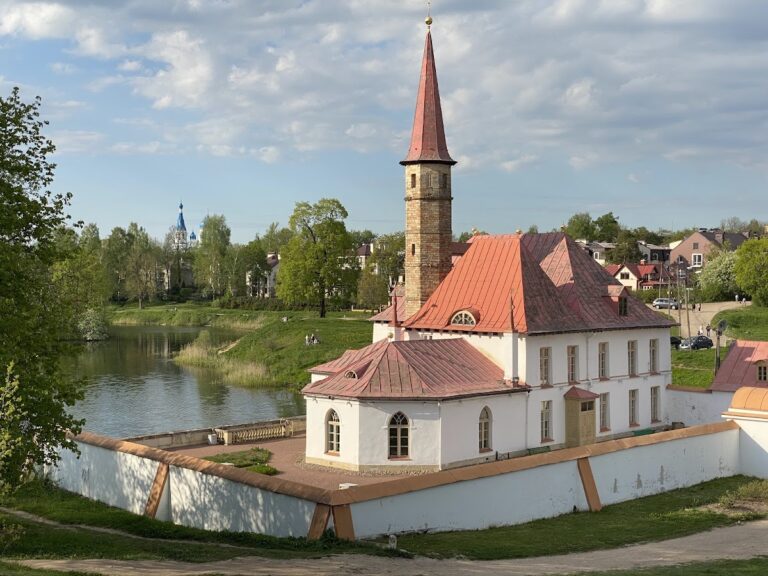
Bip Fortress is a two-story castle with a pentagonal plan, two oval-plan towers, and an inner courtyard. It stands at the confluence of the Slavyanka and Tyzva Rivers in southern Pavlovsk. Earthwork defenses arranged in the bastion system surround the building, combining projecting bastions with ravelins, lunettes, and flèches. A drawbridge formed part of this defensive arrangement, while Mariental Pond was created by the dam across the Slavyanka.
The castle and defensive works
The central castle preserves the form of a pentagonal, two-story building organized around an inner courtyard. Its two oval-plan towers are integrated into the structure. The surrounding earthworks express the building’s military purpose, with projecting artillery positions and associated works designed to protect the walls and cover approaches. The fortress was armed with 28 artillery pieces, and its basement contained the shared officers’ guardhouse used by Pavlovsk’s stationed regiments.
Waterworks and surviving evidence
Mariental Pond remains physically connected with the fortress’s defensive setting through the dam built on the Slavyanka River. The building itself survived the Second World War as a stone shell after burning completely. Mid-2000s repairs adapted the surviving structure for private hotel and restaurant use. The Pavlovsk-period plaque remains at the site, preserving the account of the 1702 Swedish fortification and Kroniort’s retreat toward Duderhof Hill.
Nearby sites