Berkhamsted Castle: A Norman Motte-and-Bailey Fortress in England


Site at a Glance
- Rating
- 4.5
- Popularity
- Low
- Country
- United Kingdom
- Primary era
- Medieval
- External website
- Open
- Eras represented
- Medieval
- Civilizations
- English, Norman
- Site type
- Military
- Remains
- Castle
On this page20 sections
History
Berkhamsted Castle is a Norman motte-and-bailey castle in the United Kingdom, built after the Norman Conquest began in 1066 to control the route from London through the Chiltern Hills toward the Midlands. Tradition holds that the Archbishop of York surrendered to William the Conqueror at Berkhamsted, after which William ordered a castle to be built before continuing toward London. Radiocarbon dating of organic material from the motte supports construction after 1066.
Foundation under Norman rule
Construction was probably overseen by William’s half-brother, Robert, Count of Mortain, who owned the castle by the time of the Domesday Book in 1086. This survey of landholding and resources was commissioned by William the Conqueror for administrative and fiscal purposes. The former Anglo-Saxon manorial centre moved to the castle, and the settlement may consequently have shifted from the area now known as Northchurch toward the new stronghold. Several flour mills were included among the manor’s recorded resources.
A Crown-owned deer park and a vineyard were established beside the castle. The park served as hunting ground and was arranged so that it could be watched from the motte. After Robert’s son William rebelled against Henry I, the Crown confiscated Berkhamsted and granted it to Henry’s chancellor, Ranulf. Ranulf died in 1123 after falling from his horse while travelling to the castle with the king.
Royal authority and expansion
In 1155 Henry II granted Berkhamsted to his chancellor, Thomas Becket, who later became Archbishop of Canterbury. Becket enlarged the castle to accommodate his household. After his fall from royal favour in 1164, he lost the property, which returned to the Crown. Henry II then used Berkhamsted extensively and formally recognised the surrounding settlement as a town in 1156.
Under King John, the castle formed part of the lands assigned to his second wife, Isabella. In 1206 John entrusted it to Geoffrey FitzPeter, who rebuilt much of the town. Following Geoffrey’s death in 1213, the castle passed to his son, John FitzGeoffrey. Early in 1215, John placed the castle under the command of the German mercenary Ranulph and reviewed its defences.
The First Barons’ War
The First Barons’ War was an English civil conflict fought from 1215 to 1217 between King John and rebellious barons, with French support for the rebels. Prince Louis of France joined the baronial cause and brought heavy siege equipment to England. After John’s death in October 1216, Louis besieged Berkhamsted for twenty days, probably using trebuchets, counterweight-powered engines for hurling projectiles. The garrison eventually surrendered and was allowed to leave with its weapons and armour. Royal forces recovered the castle in the following year after defeating the rebels.
The Earldom of Cornwall
After its recovery, Berkhamsted was granted to Richard, Earl of Cornwall, the brother of Henry III. This began the castle’s long association with the Earldom of Cornwall and, later, the Duchy of Cornwall. The earldom was a major medieval territorial lordship. Richard transformed Berkhamsted into a palatial residence and made it the administrative centre of his lands, where nine stewards submitted their annual financial reports. The town also prospered through the wool trade. Richard died at the castle in 1272, and his son Edmund inherited it.
The castle later passed through Edward I and his second wife, Margaret, to Edward II. Edward II granted it to his favourite, Piers Gaveston, after making him Earl of Cornwall. Gaveston married at Berkhamsted in 1307 in the king’s presence. After Edward II and Gaveston lost power in 1327, the castle passed to Edward’s second son, John, who became Earl of Cornwall.
Edward III and the Black Prince
Edward III reclaimed Berkhamsted after John’s death. A survey found the castle in need of substantial repairs, and Edward used it as his principal residence while Windsor Castle remained unimproved. He invested heavily in renovation before granting Berkhamsted to his son Edward, the Black Prince, when it became part of the Duchy of Cornwall. The duchy had been created in 1337 for the heir to the English throne and inherited the castle’s established Cornish association.
The Black Prince enlarged the hunting grounds by 65 acres, eventually creating a park of about 991 acres that included woodland pasture on the Chilterns. Berkhamsted also served as a place of confinement for royal prisoners, including John II of France, captured by the English after the Battle of Poitiers, and other rival claimants to the English throne. The Black Prince retired to the castle when illness followed his campaigns in France and died there in 1376.
Later medieval decline
Richard II inherited Berkhamsted in 1377 and first assigned its use to his favourite, Robert de Vere. After de Vere’s exile in 1388, John Holland received the castle. When Henry IV deposed Richard in 1400, he lived at Berkhamsted and used it to detain rivals to the English throne. Geoffrey Chaucer supervised renovation work as a clerk.
Henry V and Henry VI also owned the castle, and Henry VI used it until his overthrow in 1461. Edward IV then confiscated Berkhamsted during the Wars of the Roses, the dynastic conflicts between the houses of Lancaster and York. In the late fifteenth century, Edward’s mother, Cecily Neville, Duchess of York, occupied the castle. After her death in 1495, it was abandoned as it had become unfashionable and was declining. By the middle of the sixteenth century, John Leland described Berkhamsted as greatly ruined and unsuitable for royal use.
Estate division and modern protection
In 1580 Elizabeth I leased the estate, including the castle ruins and park, to Sir Edward Carey for an annual rent of one red rose. Castle stone was later reused in Berkhamsted Place, a local school, and other buildings. The park measured about 1,252 acres in 1627, but it was divided during the following two decades, leaving about 376 acres. The English Civil War of the 1640s appears to have had little effect on Berkhamsted, which played no recorded role in the conflict.
In 1761 the wider estate was separated from the castle. The estate was leased to the Duke of Bridgewater, while the castle remained under the direct control of the Duchy of Cornwall. In 1863 the duchy sold the surrounding estates and park to Earl Brownlow, who agreed to rent the castle from the duchy for a nominal sum.
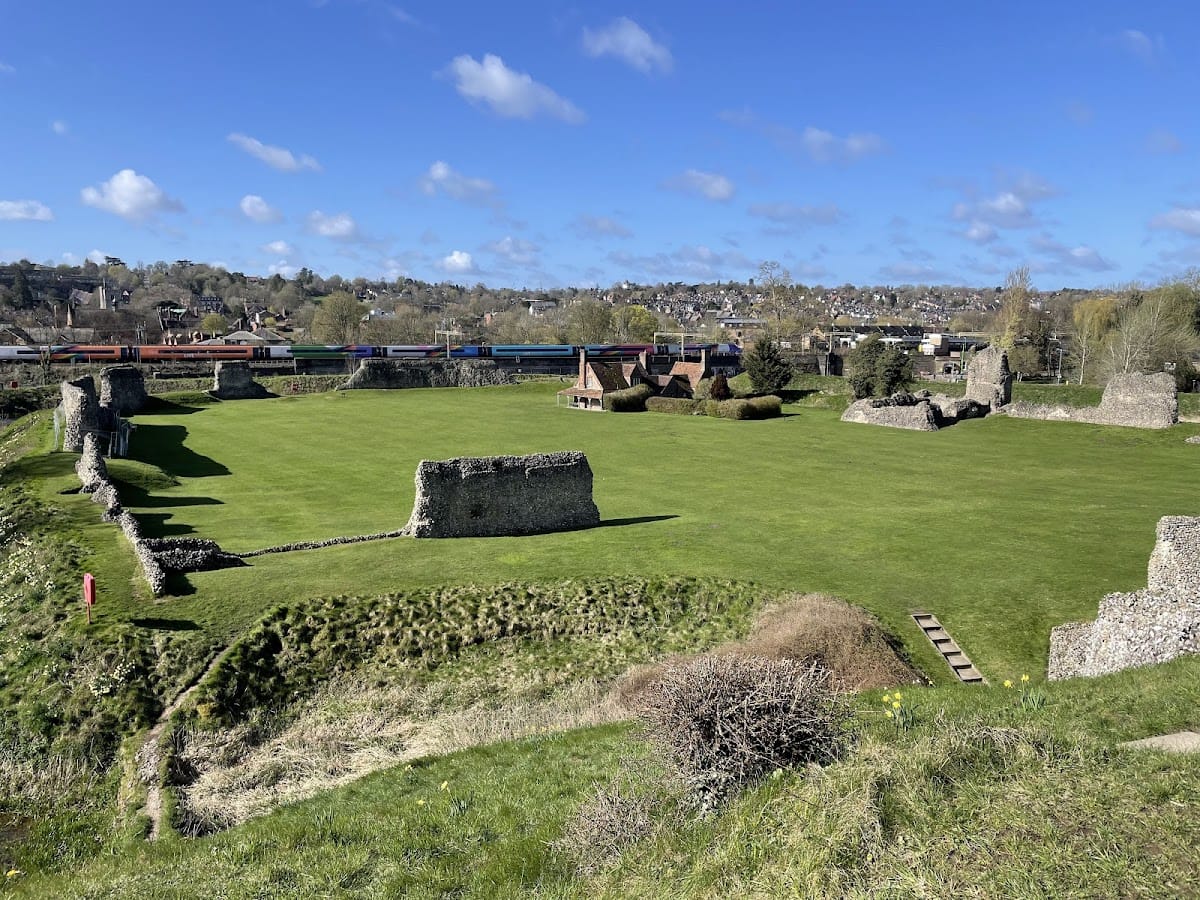
The planned London and Birmingham Railway threatened the site in the 1830s. An Act of 1833 required the railway to avoid the castle and cross the valley floor, making Berkhamsted the first building in Britain to receive statutory protection from development by Parliament. The railway nevertheless cut through the outer fortifications. The outer moat was partly infilled, and the gatehouse was demolished in 1834.
From about 1841 to 1897, a charitable soup kitchen operated within the ruins, distributing soup and bread during winter to hundreds of destitute agricultural workers. Charlotte Catherine Anne, Countess of Bridgewater, established it. The associated building is thought to have been the nineteenth-century keeper’s house in the outer ward, the outer enclosed area of a castle.
Conservation and present status
The Office of Works, the British government body responsible for public buildings and historic monuments, acquired control of Berkhamsted Castle from the Duchy of Cornwall on 24 December 1929. Conservation work in 1930 and 1931 cleared overgrown trees and the moats, employing unemployed workers during the Great Depression. The inner ditch was drained in the 1950s.
During the Second World War, the castle served as a secret storage location for public statues removed from central London to protect them from Blitz damage. The stored works included Auguste Rodin’s The Burghers of Calais and sculptures of King George III, King William III, and Viscount Wolseley. A pageant commemorating the 900th anniversary of the Norman Conquest took place in the grounds in 1966.
The ruins remain owned by the Duchy of Cornwall. Two peripheral sections formerly held by Coopers Works are divided between the Secretary of State for Digital, Culture, Media and Sport and the Berkhamsted Castle Trust, while English Heritage operates and maintains the site. Berkhamsted Castle is protected as a Scheduled Ancient Monument, a legally protected archaeological or historic site in England. Historian Isobel Thompson has described it as one of the best-surviving motte-and-bailey castles in England.
Remains
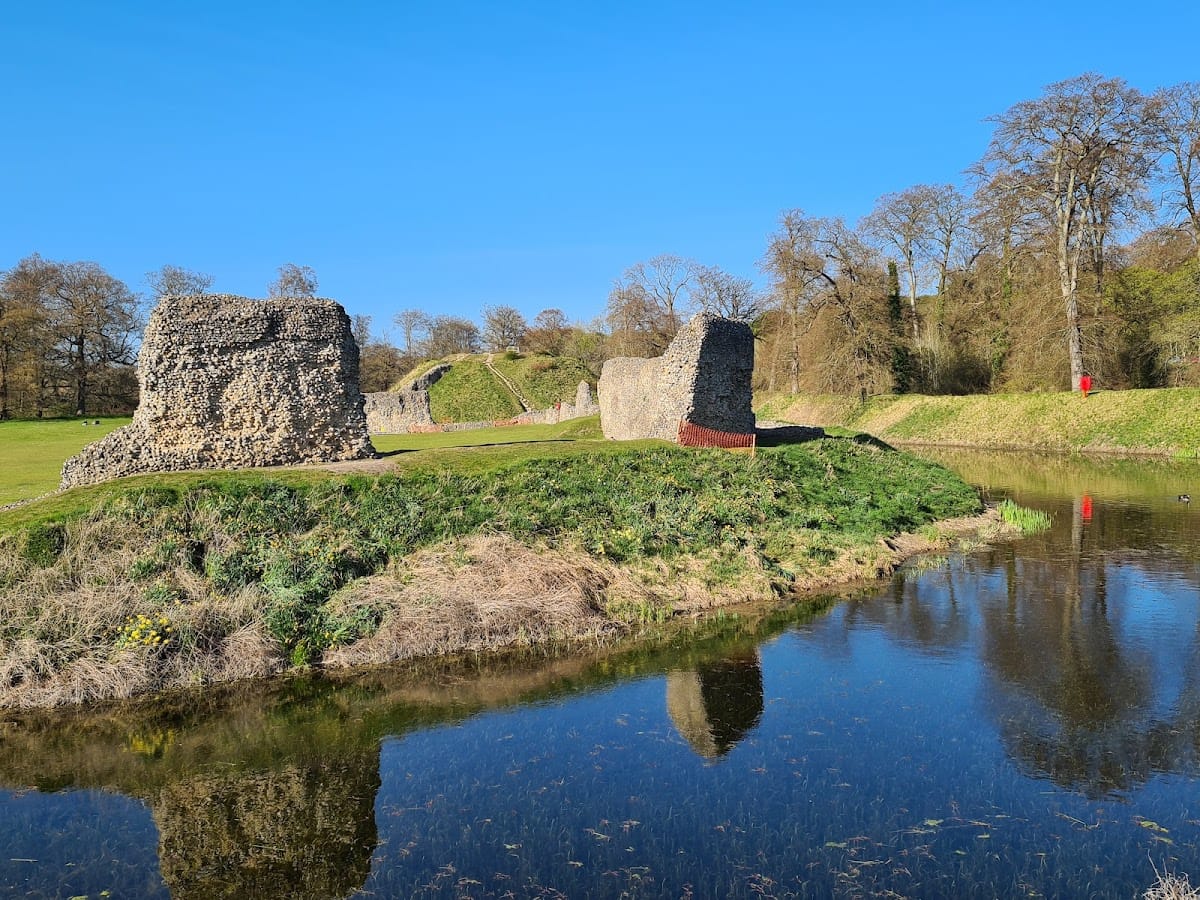
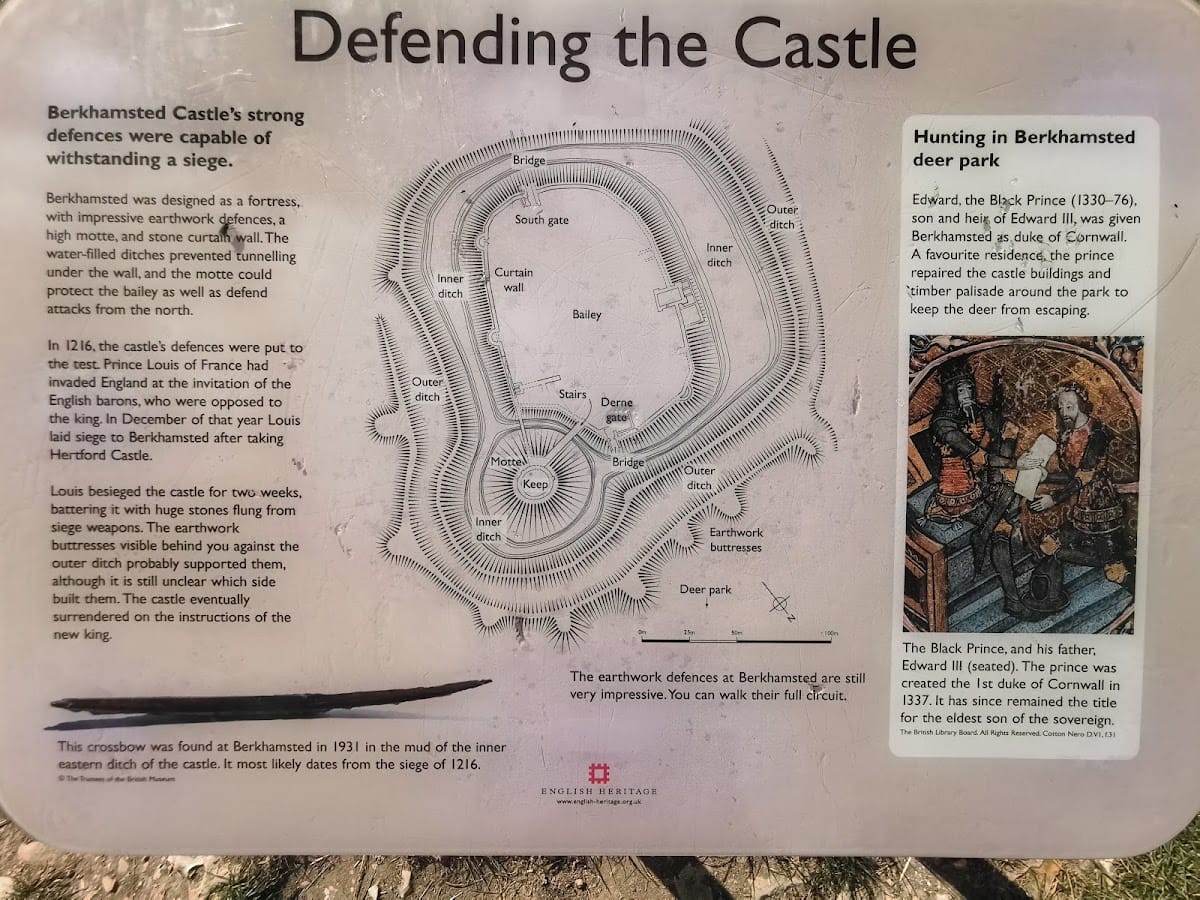
Berkhamsted is principally a stone-built Norman motte-and-bailey castle. Its oblong bailey encloses the site, with the motte occupying the northeast corner. Double banks and ditches surrounded the castle, and both ditches held water during its main period of use. The position was slightly set back from the principal road, allowing space for the earthworks and making use of natural springs descending beneath the hill.
Earthworks and defended enclosures
The motte and shell keep
The motte is a substantial raised earth mound, about 12 to 14 metres high and approximately 55 metres in diameter. It supported a shell keep, a stone-walled enclosure built on a motte rather than a solid tower, measuring about 18 metres across. By the middle of the twelfth century, the castle had been rebuilt in stone, probably during Thomas Becket’s tenure. The keep occupied the upper part of the motte, while an outer stone wall strengthened the wider enclosure. The surviving mound and fragmentary stonework preserve the central defensive focus of the castle.
The bailey and dividing wall
The bailey forms an enclosed courtyard measuring approximately 150 metres by 90 to 91 metres. Its enclosed area is given as about 0.6 acres in one measurement and about 1.3 hectares in another, while the wider earthworks occupy approximately 11 acres, or 4.5 hectares. A wall divided the bailey into inner and outer sections. The gatehouse led down toward the town and connected with Castle Street.
Outer siege earthworks
Earthworks outside the walls date to the thirteenth century and may have served as firing platforms for trebuchets during the siege of 1216. Their purpose remains uncertain, since they have also been interpreted as defensive works constructed by Richard, Earl of Cornwall. They form part of the wider earthwork landscape surrounding the principal enclosure.
Entrances and medieval buildings
Approach and gateways
The approach to the castle crossed the River Bulbourne on a low wooden bridge, followed by a second drawbridge leading to the central gateway. The gatehouse once connected the defended enclosure with Castle Street and the town. Railway construction damaged the outer fortifications and led to the gatehouse’s demolition in 1834. The outer moat was partly filled during the same period.
Richard of Cornwall’s tower
Richard, Earl of Cornwall, added an imposing three-storey tower in 1254 and restored much of the castle. Its construction formed part of the transformation of Berkhamsted into a palatial residence and administrative centre. Later renovation under Edward III altered the castle’s fabric, while subsequent stone removal for buildings elsewhere in Berkhamsted contributed to the ruinous condition of the remains.
Archaeological evidence and survival
The crossbow stave
During clearance work in 1930 and 1931, workers found the stave of a thirteenth-century crossbow in the eastern part of the inner moat. The object is thought to have been connected with the 1216 siege. It was displayed at the Royal Armouries in the Tower of London from 1976 until 1995 and is now held by the British Museum in London.
The surviving ruin
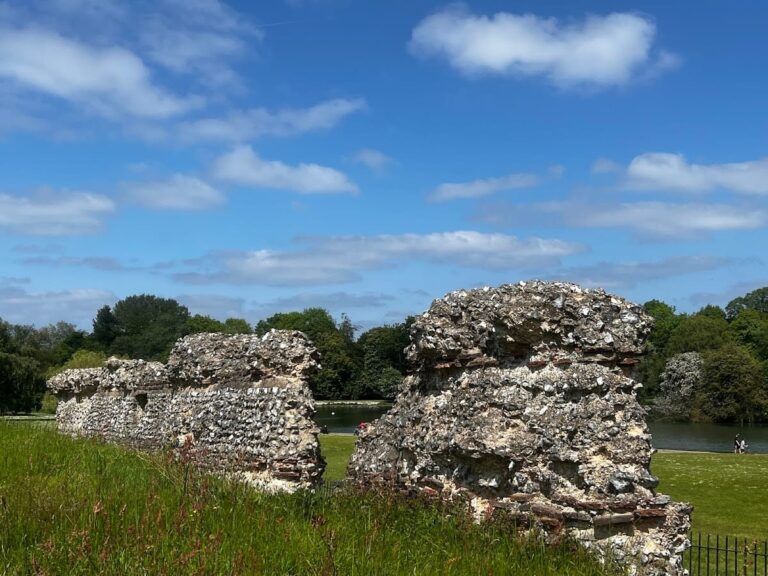
Berkhamsted Castle survives as a ruin of earthworks, walls, towers, ditches, and gateways. The inner moat was drained in the 1950s, while the outer defences retain the effects of railway construction and earlier stone removal. The surviving arrangement of the motte, baileys, dividing wall, moats, and peripheral earthworks preserves the principal organization of the medieval fortress.