Church of St Michael, Chenies: A Historic Anglican Parish Church and Russell Mausoleum


Site at a Glance
- Rating
- 4.8
- Popularity
- Very Low
- Country
- United Kingdom
- Primary era
- Medieval
- Eras represented
- Medieval, Early Modern, Modern
- Civilizations
- British, English
- Site type
- Religious
- Remains
- Church
On this page10 sections
History
Church of St Michael, Chenies, in the United Kingdom, is a Grade I listed Anglican parish church in the Diocese of Oxford. The present building mainly dates from the late fifteenth and early sixteenth centuries and stands near Chenies Manor House in the Chess Valley, Buckinghamshire. Its Bedford Chapel, added in 1556, remains the mausoleum of the Russell family, later the Dukes of Bedford.
Medieval origins and rebuilding
The first church on this site is believed to have been built in the latter part of the twelfth century by Alexander de Isenhampstead. It was mainly wooden and was dedicated, like the present church, to St Michael. Isenhampstead was the original name of the village, which later became Isenhampstead Chenies and, by the nineteenth century, was known simply as Chenies.
The medieval church was replaced in stages by the present structure. The chancel, nave, south aisle, and west tower date from the fifteenth century, while the north chapel was added in the following century. This rebuilding created the church that served the parish before later restoration and enlargement.
The Bedford Chapel
The Russell family established its connection with the church through the Bedford Chapel, commissioned in 1556 by Anne Sapcote, widow of John Russell, 1st Earl of Bedford. She acted in accordance with his will. The chapel became a family mausoleum and was subsequently rebuilt and enlarged.
The Russell family continued to use the ancient mausoleum at Chenies after a new parish church and crypt were completed near Woburn Abbey in Woburn in 1868 under the 8th Duke of Bedford. The Woburn crypt had originally been intended for burials of the Dukes of Bedford and their family. It is now used for events and meetings, although its coffin hatch remains visible.
The Bedford Chapel contains the burials or memorials of many members of the Russell family and people connected with it. The ashes of the 9th Duke of Bedford and his wife Elizabeth are buried there, as are those of Herbrand Russell, 11th Duke of Bedford. The 9th Duke and Elizabeth supported cremation and paid for the construction of Woking Crematorium. Herbrand Russell was president of the Cremation Society of Great Britain from 1921 until his death in 1940.
Lady Amberley, the wife of Viscount Amberley and daughter-in-law of the 1st Earl Russell, died of diphtheria in 1874, five days after her daughter Rachel died from the same disease. After Viscount Amberley died in 1876, the ashes of Lady Amberley, Rachel, and Viscount Amberley were moved to the Bedford Chapel from the grounds of their former home in the Wye Valley.
Restoration and later changes
The church fell into disrepair during the eighteenth century. Major repairs and alterations began in 1829 under Lord Wriothesley Russell, who served as rector of Chenies for 57 years. The church was closed for part of the 1830s, and his father, the 6th Duke of Bedford, allowed the Long Room at Chenies Manor House to be used for services. The restored church reopened for public worship on 23 June 1836.
A further major renovation between 1861 and 1887 substantially rebuilt the church. The Bedford Chapel was extended westwards towards the tower in 1885 and enlarged again in 1906. The roof was raised in 1886 and 1887, when the present hammer-beam roof was installed. A belfry chamber was added in 1933, replacing the earlier arrangement in which ringers stood at the base of the tower at nave level.
Electric lighting was installed in 1936. Storm damage destroyed the organ in 1959 and 1960, and the present organ replaced it in 1960. The churchyard extension contains the war grave of Aircraftman 2nd Class John Lionel Crook, who died on 12 December 1944 during the Second World War.
Remains
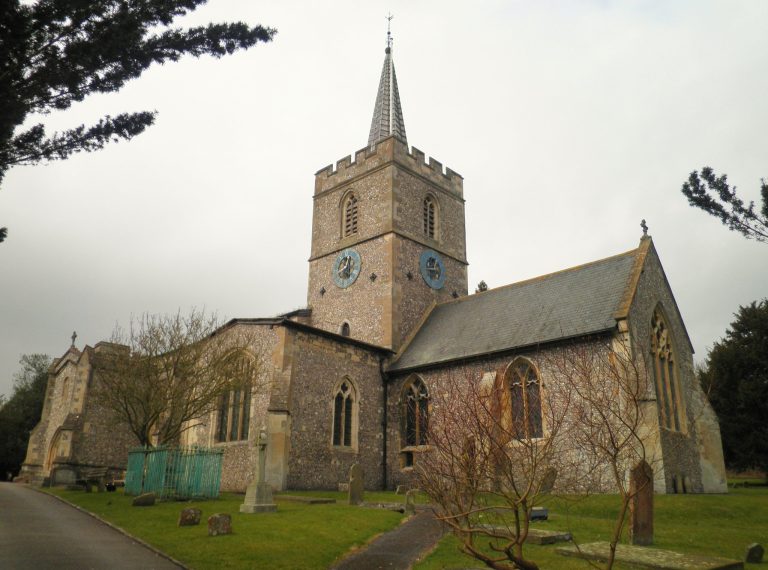
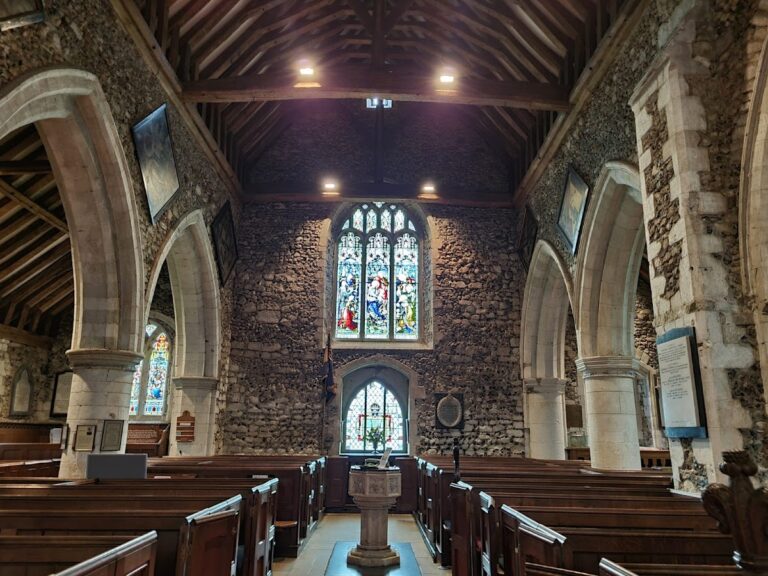
Church of St Michael consists of a chancel, nave, south aisle, west tower, and north chapel. The principal medieval elements are the fifteenth-century chancel, nave, south aisle, and tower, joined by the Bedford Chapel on the north side. Most of the masonry is flint rubble with stone dressings, while the exterior flint facing was reworked in the 1860s.
Parish church
The west tower has a stair turret on its south-east side and includes the belfry chamber added in 1933. An arch on the north side of the nave opens into the Bedford Chapel. Inside the church are a twelfth-century Norman font of the Aylesbury type, medieval brasses, and Victorian windows. The chancel floor preserves the helm and sword that hung above the stall of the 7th Duke of Bedford in St George’s Chapel, Windsor Castle, when he was a Knight of the Garter.
Bedford Chapel
Structure and decorative fittings
The Bedford Chapel is attached to the north side of the church and is a private mausoleum. A glazed screen allows it to be viewed from the church. An inscribed stone tablet set into the outer face of the east wall, below the window, states that Anne, Countess of Bedford, wife of John, Earl of Bedford, built the chapel in 1556 in accordance with his last will.
The chapel has a black-and-white marble floor and an open wooden hammer-beam roof. Half-figures of angels carrying coloured shields of the Russell and associated families decorate the ends of the corbels. Six stained-glass windows on the north side were made by C. E. Kempe around 1897. The large east window is dedicated to the 9th Duke of Bedford and his wife Elizabeth, while a carved stone heraldic achievement dedicated to them is set into the exterior face of the west gable wall.
The Russell standard and banners hang on the chapel walls, and ten funeral hatchments are fixed to the roof. Several coronets are set at cornice level on the south wall. The recumbent figures throughout the chapel have their feet turned away from the east.
Early and Stuart monuments
The chapel’s monuments range from a fifteenth-century example to elaborate seventeenth-century sculpture. A fourteenth-century table tomb with effigies commemorates a member of the Cheyne family, the medieval lords of the manor of Chenies, and his wife. The male effigy was never completed.
The tomb chest with effigies of John Russell, 1st Earl of Bedford, and Anne Sapcote is among the chapel’s principal memorials. Bridget Hussey, who died in 1600, is represented by a table tomb and effigy. She was the widow of Sir Richard Morison and the 2nd Earl of Bedford. The monument to Anne Russell, Countess of Warwick, who died in 1604, is a tomb chest and effigy by William Cure the Younger. Elizabeth Russell, Lady Russell of Thornhaugh, who died in 1611, has a tomb chest and effigy.
Lady Frances Bourchier died unmarried in 1612 at the age of 25. Her monument, erected by her cousin Anne Clifford, Countess of Dorset, stands in the centre of the chapel opposite the south entrance. A plain black-marble slab rests on four white-marble Doric columns, which form a canopy over a second black-marble slab. The lower slab carries two heraldic lozenges, each surmounted by an Earl’s coronet and carved in relief in white marble.
The monument to Francis Russell, 2nd Earl of Bedford, who died in 1619, is a tomb chest with effigies by William Cure the Younger. Lady Frances Clinton, who died in 1623, is represented by a semi-reclining figure on a base. The alabaster monument to Francis Russell, 4th Earl of Bedford, and Catherine Brydges has effigies, a back wall with two arches, and a large open pediment. William Cure the Younger made it.
The monument to William Russell, 1st Duke of Bedford, who died in 1700, combines pairs of marble Corinthian columns, oval portrait medallions, two life-size seated figures, and a baldacchino. Wriothesley Russell, 2nd Duke of Bedford, and Elizabeth Howland are commemorated by a white alabaster monument made in 1769 by Joseph Wilton to designs by Sir William Chambers. It shows a youth and maiden separated by clouds, with putti above them.
Later memorials and relocated monuments
The memorial to Lady Georgiana Russell, who died in 1858, was made by Richard Westmacott. It consists of a Gothic arch with knobbly foliage and a praying female figure in profile. The monument to Odo Russell, 1st Baron Ampthill, who died in 1884, was made by Sir Joseph Edgar Boehm. Francis Russell, 9th Duke of Bedford, who died in 1891, is commemorated by a monument made by G. E. Fox in the Jacobean style.
The memorial to Lord Arthur Russell, who died in 1892, was made by Alfred Gilbert in the Art Nouveau style. Lord Arthur is buried in Brompton Cemetery, London, while the Bedford Chapel contains his memorial. Other memorials in the chapel commemorate members of the Russell family including Lady Frances Bourchier, Francis Russell, 4th Earl of Bedford, and Odo Russell, 1st Baron Ampthill.
Bridget Hussey’s table tomb was moved from the church at Watford to the Bedford Chapel in 1907. Elizabeth Russell’s monument was also transferred from Watford that year. The chapel’s collection therefore includes monuments brought together from other churches as well as memorials created for the Russell mausoleum itself.