Beglik Tash: A Thracian Sanctuary in Bulgaria
Site at a Glance
- Popularity
- Very High
- Country
- Bulgaria
- Primary era
- Bronze Age
- Eras represented
- Bronze Age, Classical
- Civilizations
- Roman, Thracian
- Site type
- Religious
- Remains
- Sanctuary
On this page19 sections
History
Beglik Tash is an ancient Thracian sanctuary in Bulgaria, generally dated to the fourteenth century BCE and used into the fifth century CE. Its creation is attributed to a Thracian tribe associated with the Strandzha region, whose members may have arranged natural rocks as a sacred place.
Thracian sanctuary and ancient use
The sanctuary’s beginnings may reach further back, perhaps to the Neolithic or Chalcolithic, although this earlier origin remains a possibility rather than its usual dating. Finds indicate activity during the Late Bronze Age, the Early and Late Iron Ages, and Antiquity. Thracians, Greeks, and Romans visited the site, whose religious function has been compared with that of a monastery.
Interpretations of the sanctuary’s worship refer to a Mother Goddess and a Sun God, labels for proposed deities rather than certain identifications. The Sun God has been associated variously with Zagreus, Apollo, or Dionysus. Zagreus is a figure in Greek religious mythology; Apollo and Dionysus are distinct Greek gods, linked respectively with prophecy and music, and wine and ecstatic rites.
The name and local use
The name Beglik Tash is commonly explained through Turkish words for an in-kind tax, meaning a levy paid in goods, and for stone. The tax was associated with a feudal lord, or bey. Before Bulgaria’s liberation from Ottoman rule, local shepherds reportedly brought livestock to the site, where authorities collected the levy.
Quarrying, traditions, and restricted access
In the 1950s, a state-run quarry used about ten extraction points to obtain syenite for paving stones and kerbs. The quarry had closed by the middle of the 1960s. Residents recalled Nestinar, a Bulgarian firewalking tradition in which people dance on hot embers, on the meadow before the sanctuary until 1956. That year the land was nationalized and work began on the Perla government estate. During the 1970s and 1980s, access to the area was restricted because it lay within the estate, used by Bulgaria’s communist-era leader Todor Zhivkov and the UBO, the service responsible for protecting state leaders.
Recording and archaeological work
In the late nineteenth century, archaeologist Karel Škorpil made an early scientific record of the sanctuary, calling it Apostol Tash and describing a heart-shaped rock. An expedition led by Alexander Fol and Ivan Venedikov returned in 1972–73 and recorded hollows beneath a rock and a large dolmen formation.
Partial archaeological investigations began in 2001. Excavations in 2002–04, led by Tsonia Drazheva and Dimitar Nedev, cleared parts of the site and returned fallen megaliths to positions considered likely. Work stopped in 2005 for lack of funds, and only a limited area has been examined. The sanctuary’s exact boundaries remain uncertain.
In June 2006, vehicles were used in an attempt to restore the presumed arrangement of stones in the solar clock. The intervention drew criticism that moving megaliths could compromise their archaeological context and possible future dating. A geological assessment in 2013 classified Beglik Tash as a geological phenomenon of national significance, recognizing its aesthetic, scientific, educational, and research value.
Remains
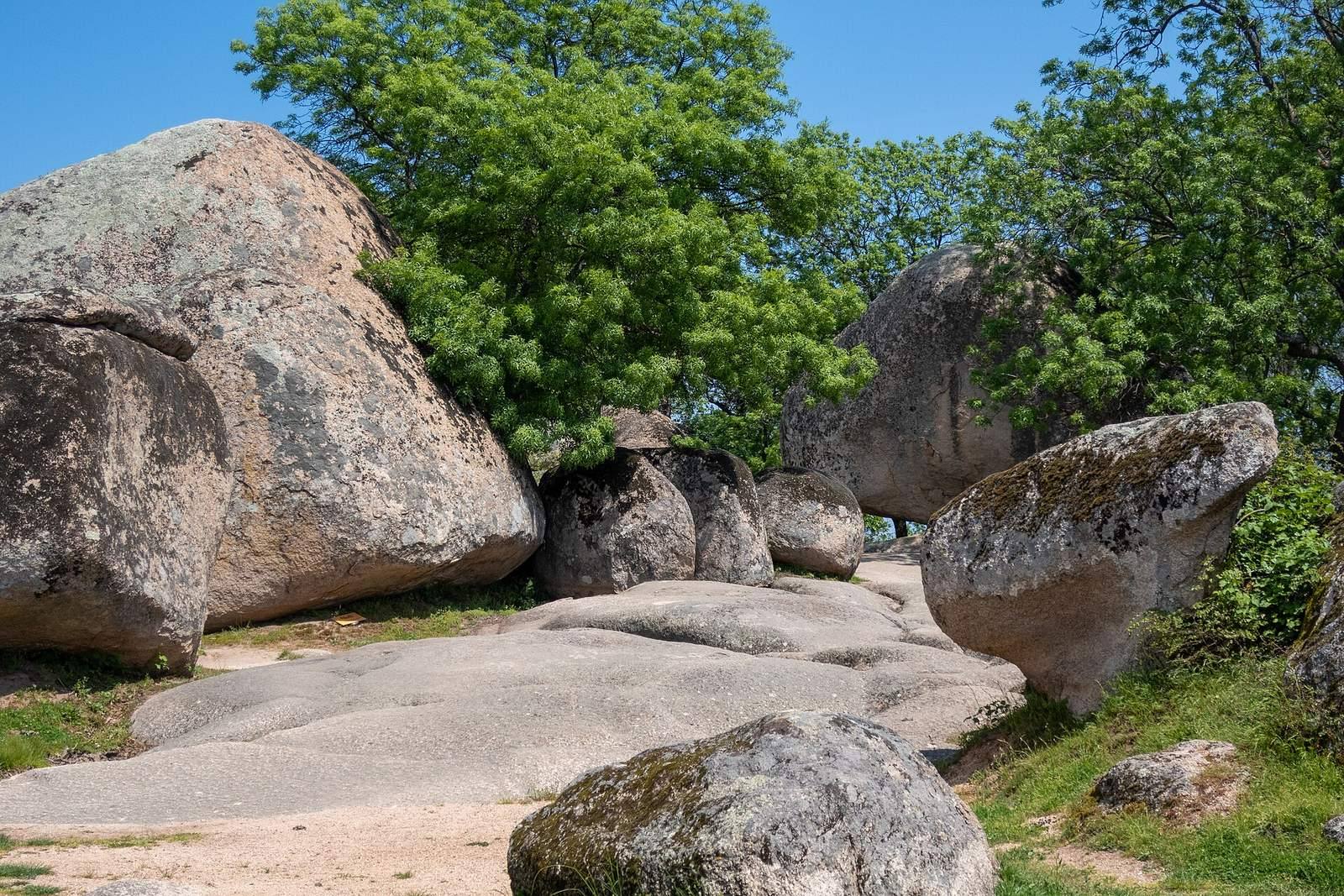
The sanctuary combines natural rock masses with stones that were partly shaped and arranged by people. Its broader complex is described as covering about six hectares, organized around a central ritual platform and surrounded by other megaliths and structures. Some of the largest blocks weigh up to about 100 tonnes.
Landscape and rock formations
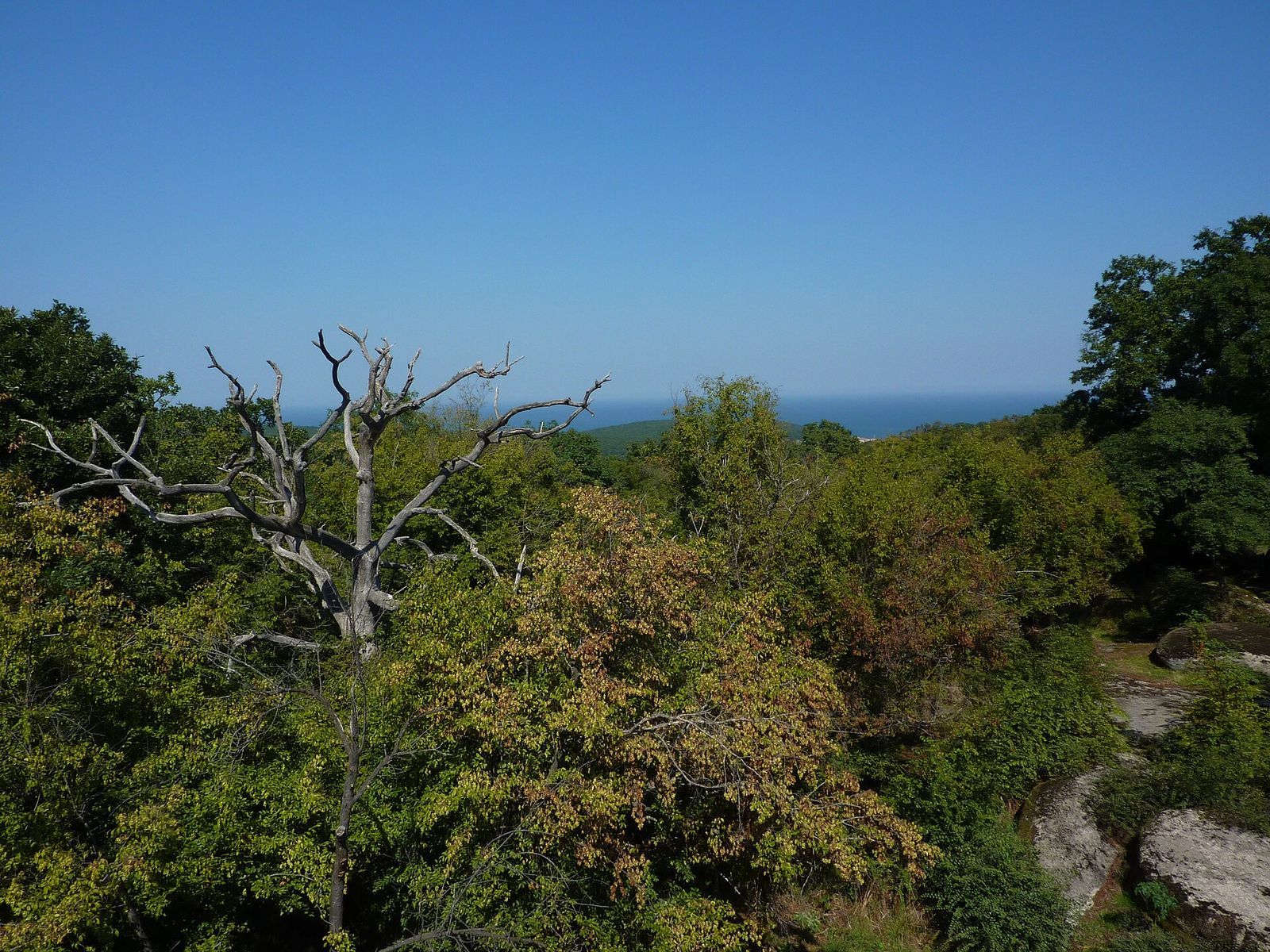
Beglik Tash occupies the highest part of Cape Beglik Tash, on the Maslen Nos ridge, at about 210 metres above sea level near the summit of Kitka. The site lies near the Zigra River valley between the bays of St. Paraskeva and Zigra. The sea lies to the north and east, while the Primorsko mountain range shelters the site to the west and south. About fifteen dolmens have been recorded among the megaliths between the cape and the Ropotamo River, including one north of the sanctuary’s platform.
The rocks are syenite, a coarse-grained igneous stone, formed in place as part of the Rosen pluton. Their rounded shapes result in part from weathering that wears away the outer layers of rock; their forms are also linked to ancient volcanic activity associated with Kitka’s extinct crater. Quarrying has left broken and blasted blocks below the sanctuary’s central area.
Approaches and central ritual area
Entrance and path
The excavated western entrance leads toward the ritual platform through a passage cut in steps into the bedrock. It is about eight metres long and 2.4 metres wide, with shallow channels along the sides to drain surface water. A separate entrance proposed by researchers is oriented southwest and may continue west through the unexcavated area, forming an east–west alignment for the principal features.
A rock-cut path about twelve metres long runs from the entrance toward a stone arrangement interpreted as a marriage bed, whose stone pillows face east. Nearby basins cut into the rock have been read as vessels for water, milk, vegetable oil, and wine. In this interpretation, the liquids correspond symbolically to water, air, fire, and earth.
Central platform
Flat surfaces on the platform bear carved circles, hollows, basins, channels, troughs, steps, solar signs, and diamond-shaped figures. Seats and two features called Mark’s Footprints lie at opposite ends and at different heights. Six postholes form a U between the small dolmen and the high Mark’s Stone.
Six hollows have been interpreted by Drazheva as an image of the Pleiades, a prominent star cluster, though this reading is unproven. Other interpretations connect carved signs with male and female principles and regard the differently shaped basins as collectors of rainwater for ritual use.
Hearths and carved stones
In the platform’s southern part, four ritual hearths, or altars, lie in front of two sacrificial stones. The stones face each other along a north–south line, and one arrangement has been described as a bed. A large rectangular basin gathers water from channels cut radially into the bedrock.
A kidney-shaped stone has a carved seat and armrests and is interpreted as a throne. It now lies on the ground. It may once have stood on a larger rock before falling in an earthquake or being displaced by treasure hunters. A proposed reconstruction of the ritual plan identifies it as a place from which a high priest could observe offerings and performances.
A menhir, or large standing stone, bears a carved footprint attributed in the sanctuary’s interpretation to the Sun God. It measures 0.80 by 0.40 metres and is aligned east–west. A separate footprint is interpreted as that of the Mother Goddess.
Megaliths and alignments
Dolmens
A dolmen is a prehistoric stone chamber often made from upright stones supporting a large capstone. The large dolmen at Beglik Tash is about twelve metres high and nine metres long. It has also been interpreted as a sacred womb cave and as a symbol of the feminine principle. Another dolmen has a nut-shaped roof block about twelve metres in diameter, resting on other stones to form a roof beneath which a person could pass.
Apostol Tash and the solar clock
The heart-shaped megalith recorded by Škorpil, known as Apostol Tash, rests on three points and leaves a niche beneath it large enough for a person to lie in. On 22 June, the summer solstice, sunlight passes through the niche. Archaeologists have suggested that people moved the rock into position and cut the space beneath it. North of the megalith, six flat stones form a solar clock: its shadow falls on different stones over the course of the day, marking six intervals.
A separate split stone was damaged by blasting during the quarrying period. The quarrying also left visible traces among the blocks below the sanctuary’s centre.
Labyrinth
A group of monoliths in the northeastern part of the sanctuary forms a labyrinth with two exits, interpreted as sacred and profane. One route passes through a cleft between the two halves of a split boulder. The cleft is about six metres high and around 0.30 metres wide. Suggested uses include Orphic rites, practices associated with the religious traditions of Orpheus, as well as divination and initiation; these remain interpretations.
Buildings and excavated finds
Rectangular building
A rectangular building lies about sixty metres east of the large dolmen. Measuring 11.3 by 9.2 metres, it uses a large rock as its western wall, while its other walls were built from rubble laid without mortar. Grooves for pitched-roof supports were cut into the rock. Square tiles covered the floor, and fragments of roof tiles lay beside the foundations. Two buried storage jars in front of the eastern wall were crushed by collapsed material. Finds date the building’s use from the second to the early fourth century CE; two Roman bronze coins were among them.
Other structures
Excavators recorded the remains of a building with earthen walls in 2002. Another feature, called the Temenos, or House of the Oracle, is tentatively dated to the fourth century CE and interpreted as accommodation for priests serving the sanctuary throughout the year. A proposal links the spread of Christianity in the fifth and sixth centuries with a shift of the area’s religious centre north to the Bay of St. Paraskeva, where a Christian monastery was established.
Ritual deposits and other finds
Finds from the site include pottery, clay idols, stone tools and weapons, stone axes, flint objects and cores, coins, and animal bones, some with traces of burning. Pottery fragments came from inside the large dolmen and from in front of its entrance. Four deposits from hearths contained pottery and amphora fragments, animal bones, stone tools, and flint cores. The objects had been deliberately broken and date to the eighth through fifth centuries BCE.