Begijnhof Chapel: A Catholic Chapel in Amsterdam
Site at a Glance
- Rating
- 4.5
- Popularity
- High
- Country
- Netherlands
- Primary era
- Early Modern
- Eras represented
- Early Modern, Modern
- Civilizations
- Dutch
- Site type
- Religious
- Remains
- Chapel
On this page11 sections
History
Begijnhof Chapel is a Roman Catholic chapel in the Beguinage in Amsterdam, Netherlands. Its present building dates to the 17th century and serves a community whose roots reach back several centuries. Beguines were lay religious women who lived in communities without becoming nuns; they could own property and leave, including to marry.
The Beguinage and its medieval chapel
A community of women formed around 1150 to care for the sick, though the foundation date of Amsterdam’s Beguinage is uncertain. The word Beguines appears in an official record from 1307. A document dated 31 July 1346 records a house ceded to the women by Cope van der Laene.
A chapel stood in the Beguinage by the early 14th century. By 1397, a small chapel there was dedicated to the Blessed Virgin Mary. After the Beguinage had grown, Matthias, who held the title of bishop of Biduane without governing that diocese, consecrated a new chapel on 17 October 1419. He served as deputy to Frederic III, Bishop of Utrecht. The chapel was dedicated to Mary, John the Evangelist, and the apostle Matthew, and had its own burial ground.
Fires on 23 April 1421 and 25 May 1452 badly damaged the chapel. The Beguines paid for rebuilding and repairs, and the restored church was rededicated.
The Alteration and the loss of the medieval church
Before the Alteration of 1578, Amsterdam was predominantly Roman Catholic, with two large parish churches, six chapels, and numerous monasteries and convents. The Miracle of Amsterdam, a Catholic tradition about an event regarded as a sign connected with the consecrated bread and wine of Communion, drew thousands of pilgrims each year. Many took part in the Stille Omgang, or Silent Procession, and a related fair contributed to the city’s economy.
In 1578, Protestant reformers took power in an unbloody revolution. Catholic magistrates were dismissed, public Catholic worship was forbidden, and churches and religious houses were confiscated. The Beguines had to surrender their church, which passed to the English community. English Protestants were using the medieval chapel by 1604. The Beguines worshipped first in its sacristy, then in one of the community’s small houses after the city council took over the sacristy.
Beguines who died were usually buried in the church. Cornelia Arens asked to be buried outside after it became a Protestant place of worship. When she died on 14 October 1654, she was buried in the church; on 2 May 1655, she was reburied against its outer wall. Later wall work led to another move.
The present chapel and its later role
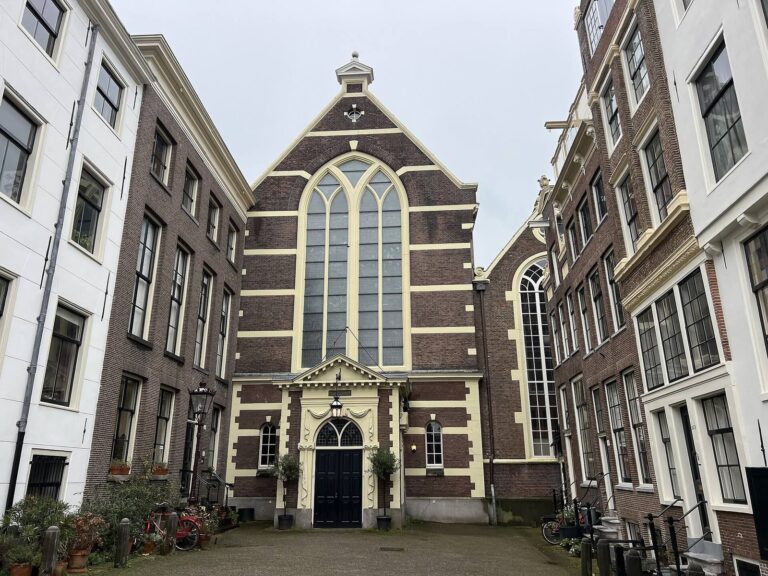
In 1665, two houses were joined to create the present chapel, at the initiative of parish priest Van der Mije. His nephew laid its foundation stone on 2 July 1671. The Protestant city council approved the plans only on condition that the building would not look like a church from outside. Designed by Philips Vingboons, the chapel was dedicated to John the Evangelist and Ursula and opened in 1682. At that time, 150 Beguines and 12 widows or unmarried women lived in the Beguinage.
In the late 19th century, renewed Catholic interest in the Miracle of Amsterdam prompted a search for a church to serve as a center of devotion. The Nieuwezijds Chapel, at the site associated with the Miracle, was considered first, but that plan fell through and Begijnhof Chapel was chosen instead. Near the end of the 20th century, priests of the Congregation of the Blessed Sacrament, a Catholic community devoted to the consecrated bread and wine of Communion, came to serve the chapel and encourage this devotion. An annual procession commemorating the Miracle begins there.
The chapel remains Roman Catholic and belongs to Amsterdam’s St Nicholas Parish in the Haarlem-Amsterdam diocese. It is one of four churches in the parish administered by a rector rather than a parish priest, and it is designated a Dutch national monument.
Remains
Chapel and associated remains
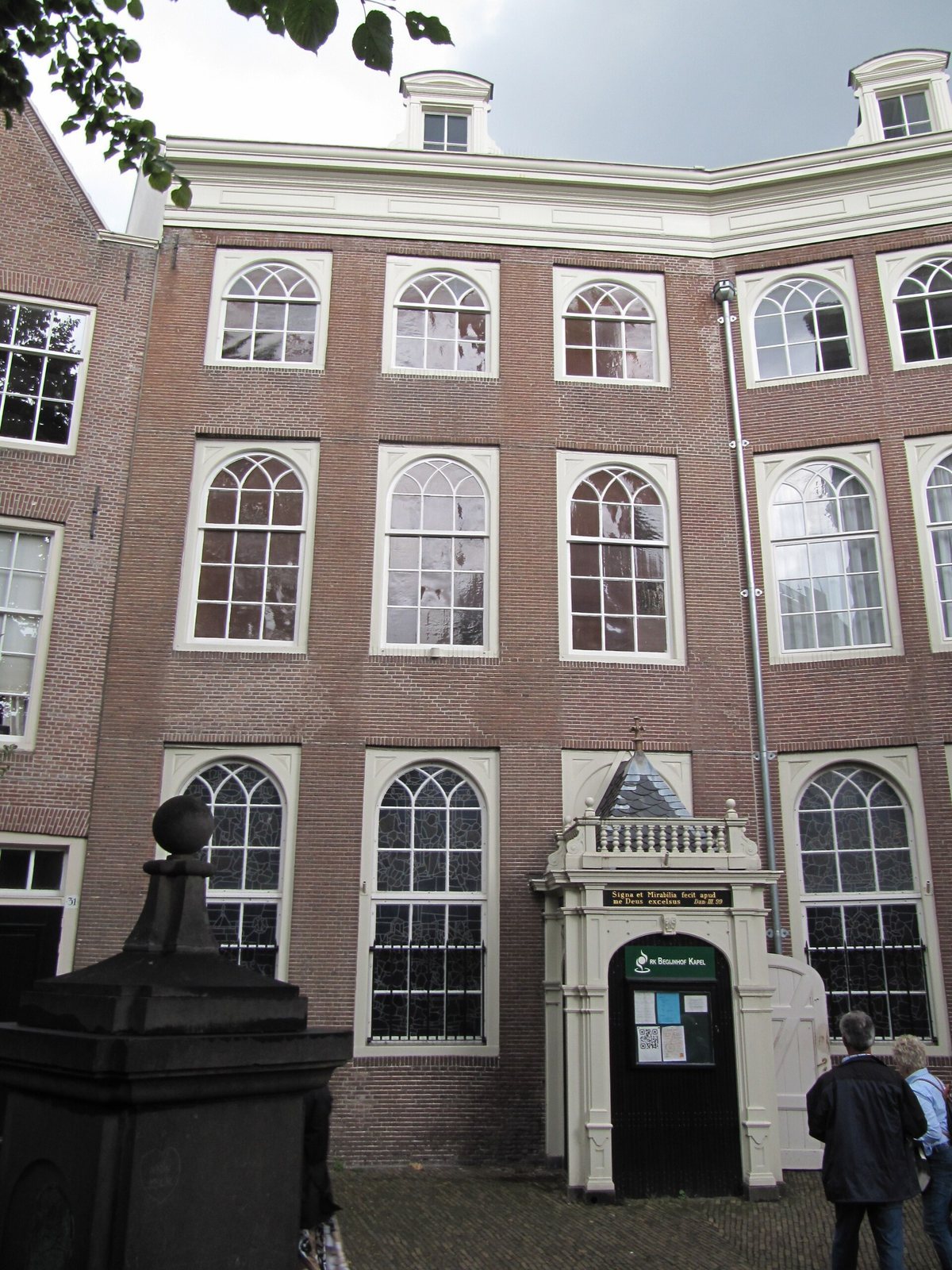
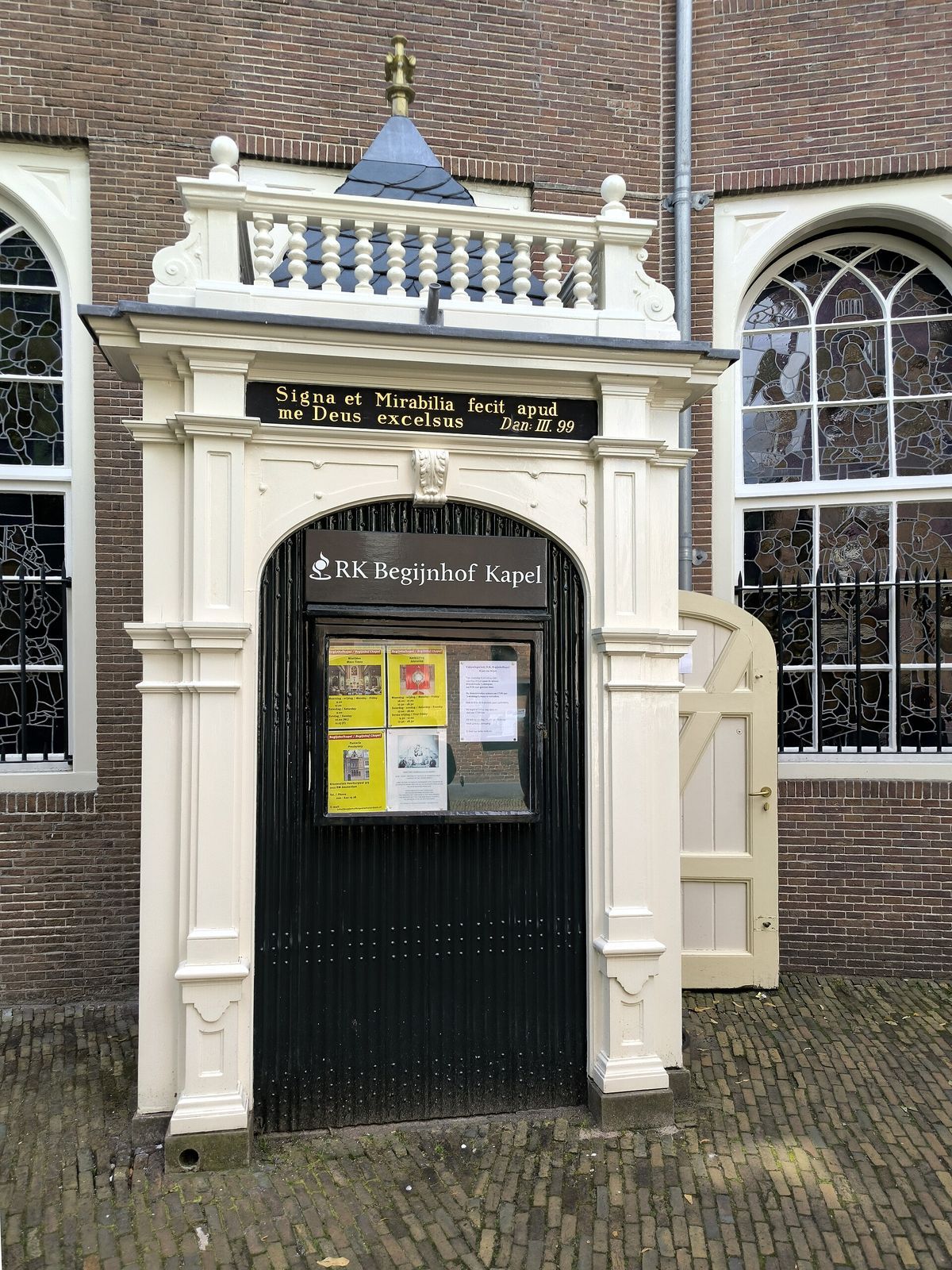
The chapel stands within the Beguinage, opposite the English Reformed Church, which occupies the site of the earlier chapel. Its exterior was designed to resemble an ordinary residence. The building extends substantially to the right, while the Beguines had a side chapel on the left, dedicated to the Miracle of Amsterdam.
Facade and layout
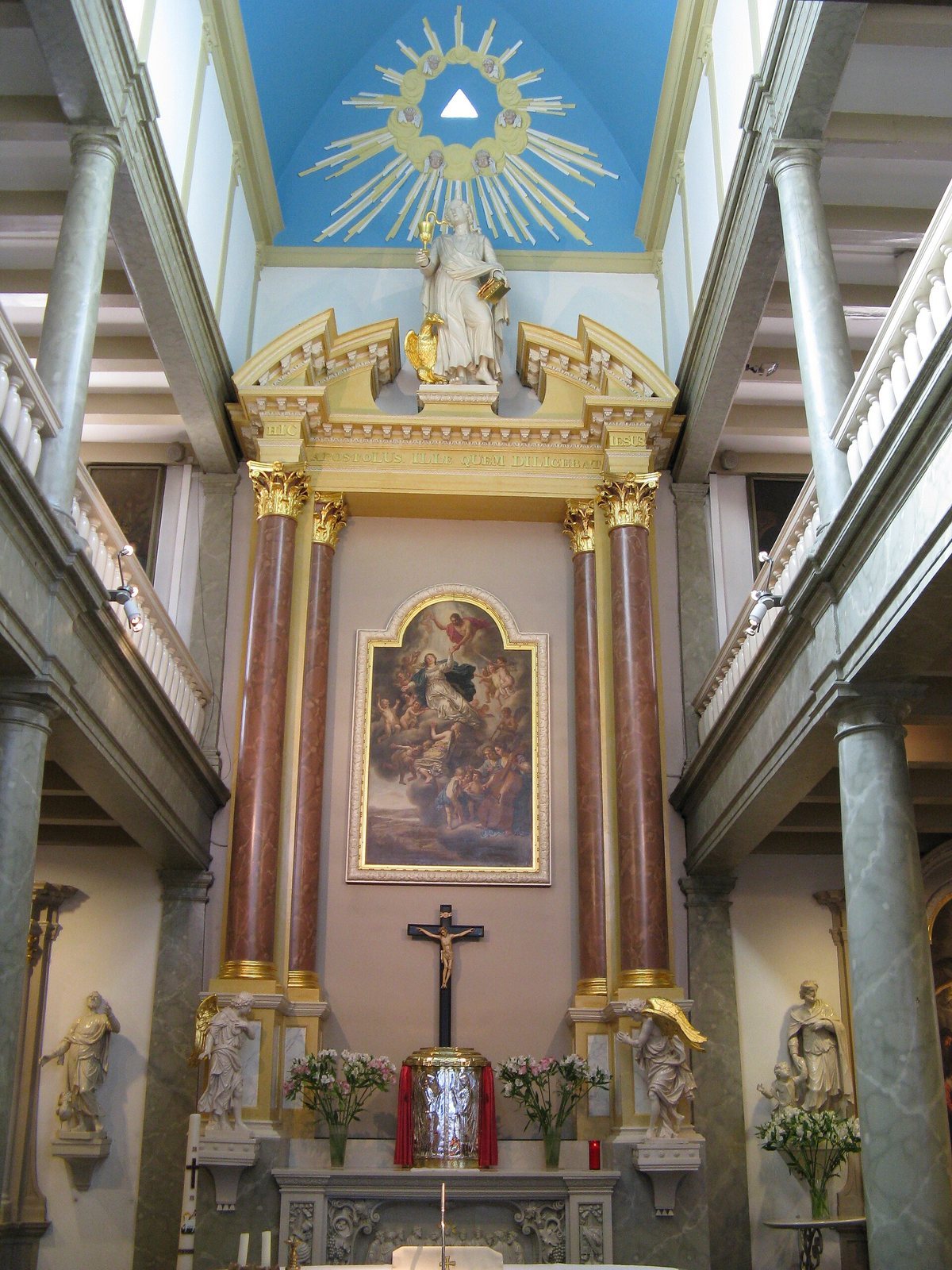
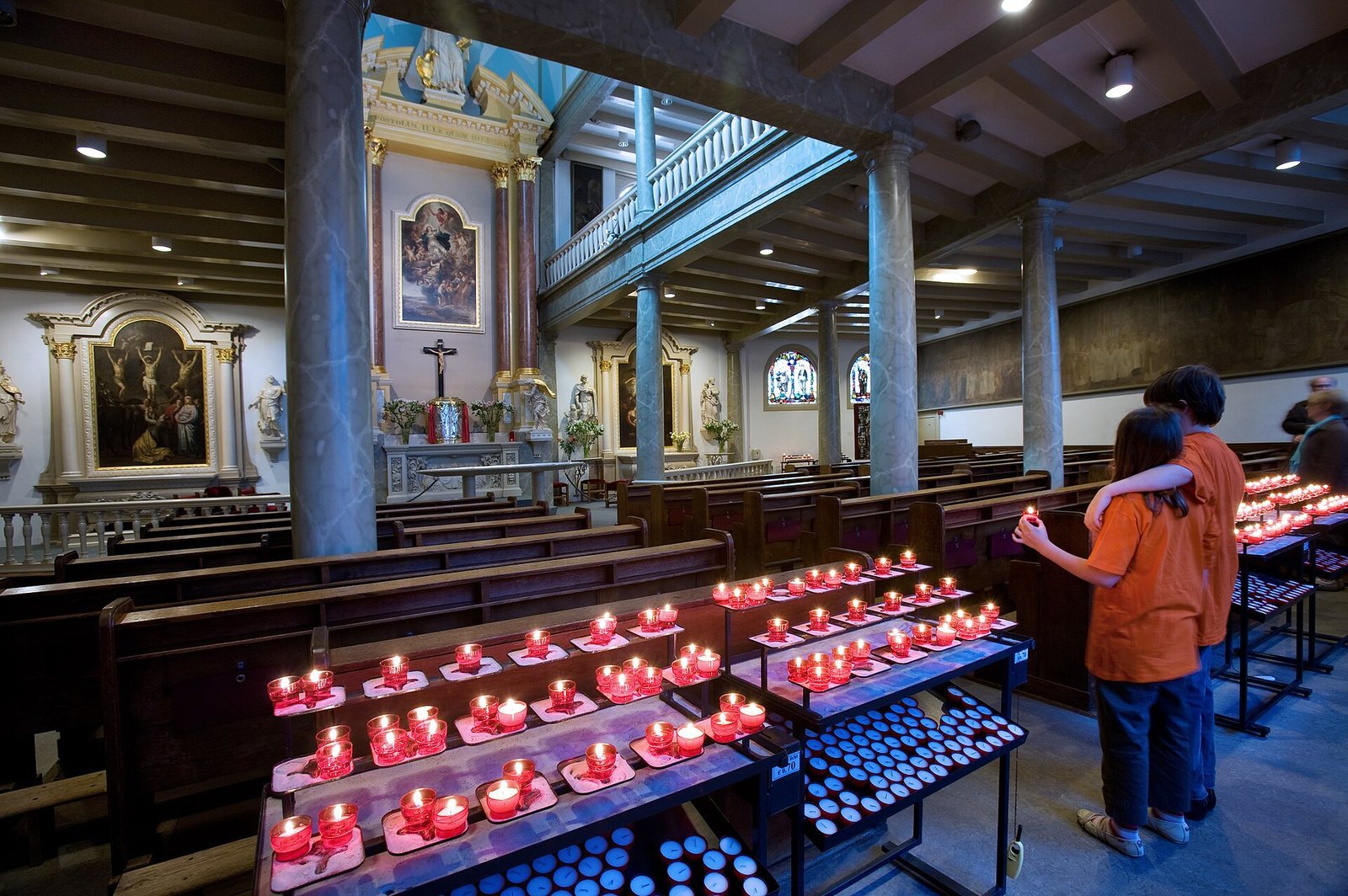
The present facade dates from the 19th century and has leaded, pointed-arch windows in a Gothic style. A porch was added during the facade renewal to improve access. Inside, a gallery has left and right sections supported by six wooden columns.
Altars and sculpture
The high altar has a neoclassical appearance. A painting of the Assumption of Mary hangs above it, with a statue of John the Evangelist higher still. The statue shows John with a book, an eagle, and a chalice containing a serpent. Between the painting and statue is an inscription meaning Behold the apostle, he whom Jesus loved. Selected letters in the inscription represent numbers that encode the year the high altar was built. Paintings above the two side altars are by Claes Corneliszoon Moeyaert. A statue of Saint Nicholas of Myra stands above the arches leading to the side chapel, and other images in the chapel relate to the Miracle of Amsterdam.
Paintings and stained glass
A painting of the Miracle of Amsterdam is associated with the main altar. On the right-hand wall hangs the long painting The Procession by Antoon Derkinderen, depicting the procession held in honor of the Miracle. It was cleaned and restored in 2015, when special lighting was also installed for it. Gisèle d’Ailly van Waterschoot van der Gracht designed and made the chapel’s stained-glass windows in the late 1940s and early 1950s. The window dated 1950 includes a depiction of the artist herself.
Organ
A Cavaillé-Coll organ, a pipe instrument, was transferred to the chapel from Huize St Bernardus when that building was to be demolished for a new residential-care complex.
Cornelia Arens’s grave
Arens’s grave lies at the edge of the Beguinage’s bleaching field, an open area where cloth was spread to dry and whiten in sunlight. Flowers are placed on it each year on 2 May.