Bayraktar Mosque: An Ottoman Memorial Mosque in Nicosia, Cyprus


Site at a Glance
- Rating
- 4.4
- Popularity
- Very Low
- Country
- Cyprus
- Primary era
- Early Modern
- Eras represented
- Early Modern
- Civilizations
- Ottoman
- Site type
- Religious
- Remains
- Mosque
On this page8 sections
History
Bayraktar Mosque is an Islamic Sunni mosque in Nicosia, Cyprus, developed around the tomb of an Ottoman flag-bearer associated with the conquest of the city in 1570. Its exact construction date is unknown. The name bayraktar means flag-bearer, particularly a military standard-bearer in the Ottoman context.
Ottoman foundation and development
The site commemorates a flag-bearer who was killed while planting the first Ottoman flag on the walls of Nicosia at the Constanza Bastion, a fortification in the city walls, on 9 September 1570. The bastion later became known as the Bayraktar Bastion during the Ottoman period. The flag-bearer’s tomb stands beside the mosque, but his identity remains uncertain. He has been identified as Alemdar Kara Mustafa, Alemdar Mehmet Ağa, or, in a local Nicosian tradition, Deli Cafer, known as “Mad Cafer.”
The site began as a grave, which was later developed into a tomb and then accompanied by a small mosque without a minaret. Archaeologist Tuncer Bağışkan interpreted this development as part of efforts to consolidate Islam in Cyprus. A marble inscription dated 1756–1757 states that Hasan Agha, then governor of Cyprus, dedicated the tomb to the soul of his deceased mother. No official record identifies the person who built the tomb.
In 1767, the Italian traveler Giovanni Mariti described a mosque without a minaret beside a tomb. An inscription above the entrance records that Abdullah Pasha added the minaret, minbar, and mihrab in 1820–1821, during the reign of Sultan Mahmud II. The minbar is the pulpit used for the Friday sermon, while the mihrab is the prayer niche indicating the direction of Mecca. The tomb underwent an extensive renovation in 1909, when its stones were replaced.
Relic and twentieth-century conflict
Until 1930, the mosque held a relic alleged to be a hair from the beard of Muhammad. During religious occasions, visitors kissed it three times and placed it against their foreheads. The relic was stolen on 27 November 1930.
The mosque was bombed three times during intercommunal violence in Cyprus. The first attack took place on the night of 24 March 1962 and was initially attributed to EOKA, a Greek Cypriot organization active in the struggle against British rule and in the political conflict surrounding Cyprus. The attack prompted Turkish Cypriot demonstrations across the island and heightened tensions between the two communities.
Turkish Cypriot journalists Ahmet Muzaffer Gürkan and Ayhan Hikmet later wrote in the newspaper Cumhuriyet that the Turkish Resistance Organisation, a Turkish Cypriot paramilitary organization involved in the island’s intercommunal conflict, had carried out the bombing on 23 April 1962. They subsequently met Polycarpos Georgadjis, the Greek Cypriot interior minister, and were assassinated that same day. In 2010, retired Turkish general Sabri Yirmibeşoğlu stated that a mosque in Cyprus had been bombed to inflame intercommunal tensions. Turkish media identified Bayraktar Mosque as the likely target of that statement.
The first bombing created a hole in the minaret. The mosque was repaired and reopened on 25 December 1962. A second bombing, on 26 January 1963, severely damaged the minaret, which was feared to be at risk of collapse. Following Bloody Christmas, the outbreak of intense intercommunal violence in Cyprus in December 1963 and the conflict that followed, a third bombing took place at about 21:00 on 23 January 1964. It completely demolished the minaret, while Ömeriye Mosque was also bombed and seriously damaged.
Restoration
Art-theft specialist Samuel Hardy classified the mosque’s destruction among ethnically motivated incidents of deliberate damage to cultural heritage during the Cyprus conflict. When UNESCO officials visited in February 1975, they found the mosque totally vandalized. The minaret had fallen, the windows were blocked, and the roof was close to collapse. By September 1975 the building had been restored, although reconstruction of the minaret was still underway. In 1985 the minaret remained under construction. The mosque was fully restored in 1990 and reopened for worship in 2003.
Remains
Layout and architectural features
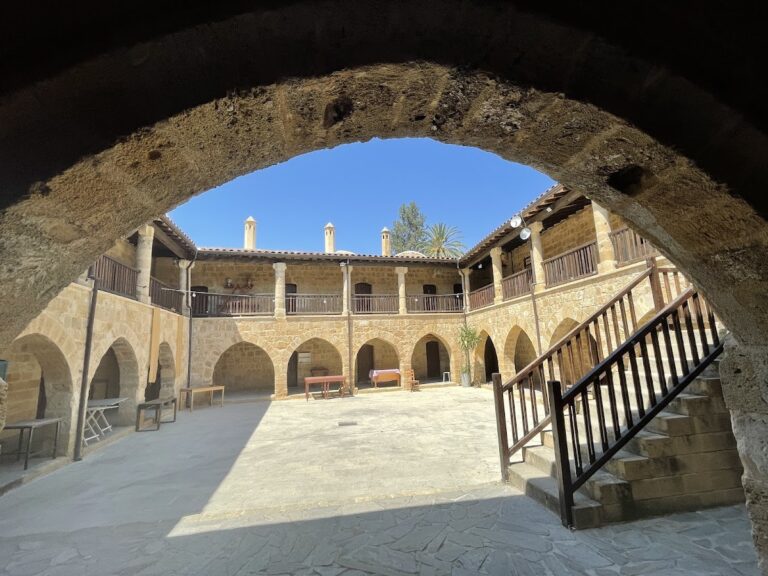
Bayraktar Mosque has a rectangular plan aligned from northwest to southeast. Entry is through a sharp pointed arch, with an inscription above it recording details of a repair. A three-arched narthex, an entrance or vestibule area at the front of a religious building, occupies the front of the mosque.
Tomb
The corner nearest the entrance is separated from the rest of the building to form the tomb of the commemorated flag-bearer. A further wall extends from the tomb toward the opposite side, creating an additional room for visitors to the tomb. The minaret is positioned beside the tomb wall.
Minaret and prayer space
The mosque’s minaret was added in 1820–1821 along with the minbar and mihrab. It was damaged by the bombings of 1962 and 1963, demolished in January 1964, and subsequently rebuilt during the restoration campaigns. The prayer space remains connected architecturally with the tomb and the entrance structures that developed around the original grave.